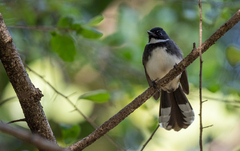
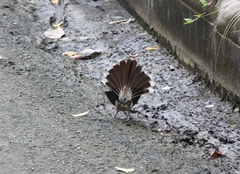
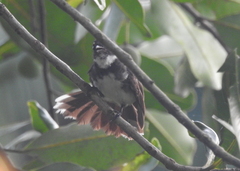
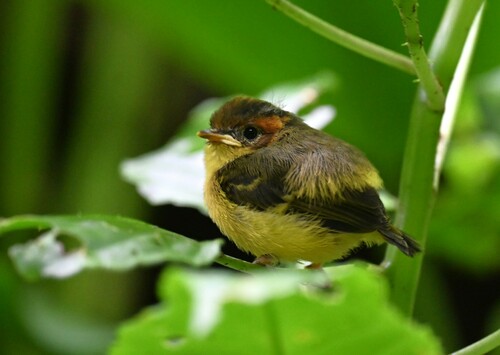
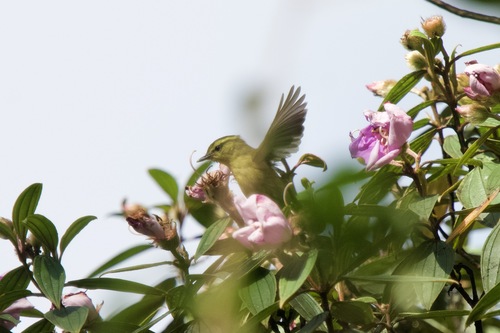
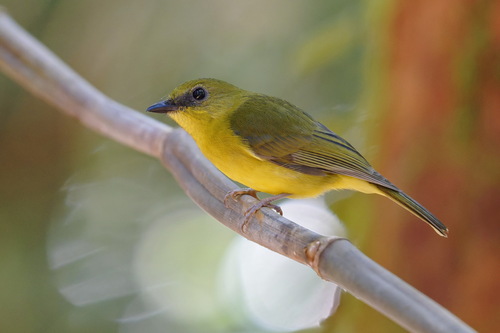
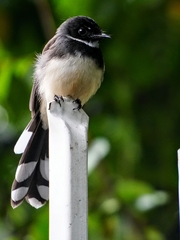
Malaysian Pied-Fantail

Malaysian Pied-Fantail

Rhipidura javanica

Silhouette: Michael Scroggie · PhyloPic

LCLeast ConcernNTVUENCR
Daily sighting probability <5% · Rare
at Kinabalu Park

In 3 days ~10% in a week ~30%

123 Verified sightings at Kinabalu Park From 2019 to 2026
4,786 In all 12 parks
August Best month
🌅 Crepuscular When it's spotted

About the Malaysian Pied-Fantail

The Sunda pied fantail (Rhipidura javanica), also known as the Malaysian pied fantail, is a species of bird in the fantail family. It is locally referred to as murai gila, literally "crazy thrush" in the Malay language. It was previously considered conspecific with the Philippine pied fantail.

It is found in Brunei, Cambodia, Indonesia, Laos, Malaysia, Myanmar, Singapore, Thailand, and Vietnam. It inhabits a wide variety of forest and scrub, including parks, agricultural lands, and other degraded habitat. It resides in lowland areas, sometimes up to 800m in elevation, and is usually found near water.

The Sunda pied fantail eats insects caught on the wing. It often joins mixed feeding flocks with other insectivorous birds, and will sometimes follow large mammals to eat insects stirred up by their movement. It breeds from January to August, varying across its range. It constructs a cup nest from fibers and grasses held together with spiderweb.

It is not known to migrate. The IUCN considers the Sunda pied fantail of Least Concern because of its wide geographic range and large, stable population. Wikipedia →

Sounds

Subsong0:56

Singapore · 2026

© Ding Li Yong · XC1071878 · CC BY-NC-ND 4.0

Song0:09

Singapore · 2025

© Joan Theng · XC1060054 · CC BY-NC-SA 4.0

Alarm call0:22

Indonesia · 2024

© Hamas Fathani · XC954622 · CC BY-SA 4.0

Global Distribution

Parks Where Found

# Park Country Daily sighting probability
1 Tanjung Puting National Park 🇮🇩 Indonesia
~80%
2 Bali Barat National Park 🇮🇩 Indonesia
~60%
3 Danum Valley Conservation Area 🇲🇾 Malaysia
~50%
4 Sepilok 🇲🇾 Malaysia
~40%
5 Kinabatangan Wildlife Sanctuary 🇲🇾 Malaysia
~40%
6 Kaeng Krachan National Park 🇹🇭 Thailand
~20%
7 Way Kambas National Park 🇮🇩 Indonesia
~20%
8 Bako National Park 🇲🇾 Malaysia
~10%
9 Kinabalu Park 🇲🇾 Malaysia
<5%
10 Gunung Leuser National Park 🇮🇩 Indonesia
<5%
11 Khao Yai National Park 🇹🇭 Thailand
<5%
12 Taman Negara National Park 🇲🇾 Malaysia
<5%

Cities Where Found

# City Country Daily sighting probability
1 Bangkok 🇹🇭 Thailand
~80%
2 Phnom Penh 🇰🇭 Cambodia
~70%
3 Jakarta 🇮🇩 Indonesia
~50%
4 Ho Chi Minh City 🇻🇳 Vietnam
~50%
5 Denpasar 🇮🇩 Indonesia
~40%
6 Cần Thơ 🇻🇳 Vietnam
~40%
7 Yogyakarta 🇮🇩 Indonesia
~30%
8 Singapore 🇸🇬 Singapore
~30%
9 Kuching 🇲🇾 Malaysia
~20%
10 Semarang 🇮🇩 Indonesia
~20%

Before you go

What are the chances of seeing a Malaysian Pied-Fantail in Kinabalu Park?

Rare

Under 5% of wildlife watchers report a Malaysian Pied-Fantail sighting in Kinabalu Park on a given day, based on 123 verified sightings from GBIF citizen-science data from 2019 to 2026. It is the 96th most-seen of the 247 birds we can rate there. Over three days the chance rises to about 10%, and over a week to about 30%, if each day is a fresh chance.

When is the best time to see a Malaysian Pied-Fantail in Kinabalu Park?

January, May, August and November

In those months about 10% of wildlife watchers report a Malaysian Pied-Fantail in Kinabalu Park on a given day, against under 5% in February–April, June–July, September–October and December, the lowest months.

What time of day is best to see a Malaysian Pied-Fantail?

Between 2 and 5 am

Across all the parks we cover, that three-hour window holds the most Malaysian Pied-Fantail sightings with a recorded time, and about 6 in 10 of them come between 6 am and 6 pm: it is most active around dawn and dusk.

Where does the Malaysian Pied-Fantail sighting chance come from?

GBIF citizen-science records

It is estimated from how often the Malaysian Pied-Fantail is recorded against all the birds logged in Kinabalu Park (123 verified sightings from 2019 to 2026), calibrated against known sighting rates. Figures are rounded to the nearest 10% because citizen-science data supports honest approximations, not decimals, and months with records from fewer than five people show "—". How it works.

← Back to Kinabalu Park