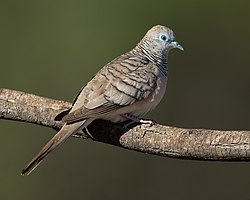
Peaceful Dove

Peaceful Dove

Geopelia placida

Silhouette: Sheatherius · PhyloPic

LCLeast ConcernNTVUENCR
Daily sighting probability <5% · Rare
at Lamington National Park

In 3 days <5% in a week ~10%

24 Verified sightings at Lamington National Park From 2019 to 2026
2,688 In all 10 parks
March Best month
☀️ Diurnal When it's spotted

About the Peaceful Dove

The peaceful dove (Geopelia placida) is a pigeon native to Australia and New Guinea. The peaceful dove is closely related to the zebra dove of south-east Asia and the barred dove of eastern Indonesia. Until recently, the three were classed as a single species, Geopelia striata, known as peaceful dove or zebra dove.

The bird is a relatively small pigeon and varies in length from 19 to 21 centimetres (7.6 to 8.4 inches). The peaceful dove has a pink-grey breast with chequered grey-brown wings. Thin striations of black appear around the neck and nape area and descend down the back. The eye is greyish-white and a blue-grey ring surrounds the eye that tapers off and joins the beak/cere. The juveniles are paler and less striated. They also have a duller eye ring. The nape is similar to that of the bar-shouldered dove in that the nape feathers are striated but differs in that the bar-shouldered dove does not have striated throat feathers like the peaceful dove. Furthermore, the nape feathers are grey-brown in colour compared to the vivid copper colour seen with bar-shouldered doves.

Calls of the peaceful dove are high-pitched "doodle-doo", "co-co-coo" and "croorrr!".... Wikipedia →

Sounds

Song0:24

Australia · 2025

© Peter Boesman · XC1066574 · CC BY-NC-ND 4.0

Call0:30

Australia · 2020

© Toby Esplin · XC580368 · CC BY-NC-ND 4.0

Song0:32

Australia · 2021

© Eddy Smith · XC747824 · CC BY-NC-SA 4.0

Global Distribution

Parks Where Found

# Park Country Daily sighting probability
1 Kakadu National Park 🇦🇺 Australia
~70%
2 Nitmiluk National Park 🇦🇺 Australia
~60%
3 Litchfield National Park 🇦🇺 Australia
~50%
4 Flinders Ranges National Park 🇦🇺 Australia
~30%
5 Hattah-Kulkyne National Park 🇦🇺 Australia
~10%
6 Daintree National Park 🇦🇺 Australia
~10%
7 Blue Mountains National Park 🇦🇺 Australia
<5%
8 Springbrook National Park 🇦🇺 Australia
<5%
9 Noosa National Park 🇦🇺 Australia
<5%
10 Lamington National Park 🇦🇺 Australia
<5%

Cities Where Found

# City Country Daily sighting probability
1 Brisbane 🇦🇺 Australia
~10%

Zoos & Centres Where Found

# Zoo / Centre Country
1 Alice Springs Desert Park 🇦🇺 Australia In captivity
2 Healesville Sanctuary 🇦🇺 Australia In captivity
3 Taronga Zoo 🇦🇺 Australia In captivity
4 Featherdale Sydney Wildlife Park 🇦🇺 Australia In captivity
5 Cairns Aquarium 🇦🇺 Australia In captivity
6 Fauna Reserve 🇦🇺 Australia In captivity
7 Birdworld Kuranda 🇦🇺 Australia In captivity
8 Kuranda Koala Gardens 🇦🇺 Australia In captivity
9 Ranger Red’s Zoo & Conservation Park 🇦🇺 Australia In captivity

Before you go

What are the chances of seeing a Peaceful Dove in Lamington National Park?

Rare

Under 5% of wildlife watchers report a Peaceful Dove sighting in Lamington National Park on a given day, based on 24 verified sightings from GBIF citizen-science data from 2019 to 2026. It is the 134th most-seen of the 171 birds we can rate there. Over three days the chance rises to under 5%, and over a week to about 10%, if each day is a fresh chance.

When is the best time to see a Peaceful Dove in Lamington National Park?

Any time of year

In every month with enough records, under 5% of wildlife watchers report a Peaceful Dove in Lamington National Park on a given day, so our monthly data shows no clear season.

What time of day is best to see a Peaceful Dove?

Between 7 and 10 am

Across all the parks we cover, that three-hour window holds the most Peaceful Dove sightings with a recorded time, and about 9 in 10 of them come between 6 am and 6 pm: it is a daytime animal.

Where does the Peaceful Dove sighting chance come from?

GBIF citizen-science records

It is estimated from how often the Peaceful Dove is recorded against all the birds logged in Lamington National Park (24 verified sightings from 2019 to 2026), calibrated against known sighting rates. Figures are rounded to the nearest 10% because citizen-science data supports honest approximations, not decimals, and months with records from fewer than five people show "—". How it works.

← Back to Lamington National Park