Dark Pewee

Dark Pewee

Contopus lugubris

Silhouette: Andy Wilson · PhyloPic

LCLeast ConcernNTVUENCR
Daily sighting probability ~10% · With luck
at Los Quetzales National Park

In 3 days ~30% in a week ~60%

1,043 Verified sightings at Los Quetzales National Park From 2019 to 2026
3,665 In all 9 parks
July Best month
☀️ Diurnal When it's spotted

About the Dark Pewee

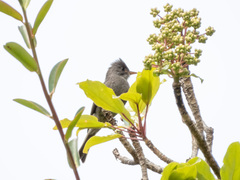
The dark pewee (Contopus lugubris) is a small passerine bird in the tyrant flycatcher family. It is endemic to the Talamancan montane forests of Costa Rica and western Panama. This large, dark pewee is found between 1250 m and 2150 m altitude in wet mountain forests, especially at the edges and in clearings, and in adjacent semi-open areas with tall trees. The nest is a broad, thick-walled saucer of mosses and lichens, lined with plant fibres. It is placed 5–18 m high across a branch. The eggs are undescribed, but the female builds the nest, lays only two eggs and incubates the eggs for 15–16 days before they hatch.

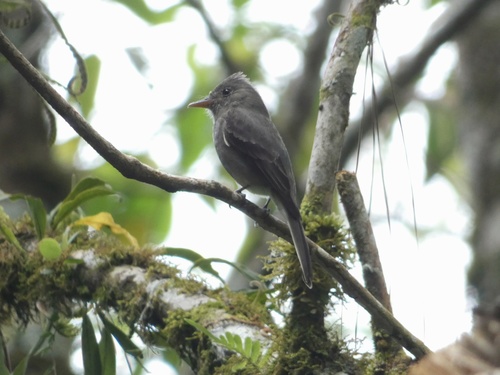
The dark pewee is 26.5 cm long and weighs 23 g. The upperparts are sooty-grey, darkest on the prominently crested crown. The wings and tail are blackish, the wings having grey feather edges and a weak wing bar. The throat is pale grey, with most of the rest of the underparts a paler olive-grey than the back, becoming yellowish on the lower belly. Sexes are similar, but young birds are browner above and have rufous fringes to the wing feathers.

The dark pewee is solitary when not breeding. It perches on a high watchpoint from which it sallies forth to catch flying insects, returning to the same exposed perch. This is a conspicuous species, with an incessant loud whip call, and repetitive fred-reek-fear song. It will defend the nest aggressively against larger species, including the emerald toucanet. Wikipedia →
Sounds

Call0:28

Costa Rica · 2016

© Frank Lambert · XC411372 · CC BY-NC-ND 4.0

Uncertain0:34

Costa Rica · 2022

© Jerome Fischer · XC714774 · CC BY-NC-SA 4.0

Call0:54

Costa Rica · 2011

© Andrew Spencer · XC71547 · CC BY-NC-ND 2.5

Global Distribution

Parks Where Found

# Park Country Daily sighting probability
1 Volcán Barú National Park 🇵🇦 Panama
~30%
2 Los Quetzales National Park 🇨🇷 Costa Rica
~10%
3 La Amistad International Park (Panama) 🇵🇦 Panama
~10%
4 Braulio Carrillo National Park 🇨🇷 Costa Rica
~10%
5 Tapantí-Macizo de la Muerte National Park 🇨🇷 Costa Rica
<5%
6 Chirripó National Park 🇨🇷 Costa Rica
<5%
7 Poás Volcano National Park 🇨🇷 Costa Rica
<5%
8 Irazú Volcano National Park 🇨🇷 Costa Rica
<5%
9 Monteverde Cloud Forest Reserve 🇨🇷 Costa Rica
<5%

Cities Where Found

# City Country Daily sighting probability
1 San José 🇨🇷 Costa Rica
<5%

Before you go

What are the chances of seeing a Dark Pewee in Los Quetzales National Park?

With luck

About 10% of wildlife watchers report a Dark Pewee sighting in Los Quetzales National Park on a given day, based on 1,043 verified sightings from GBIF citizen-science data from 2019 to 2026. It is the 71st most-seen of the 252 birds we can rate there. Over three days the chance rises to about 30%, and over a week to about 60%, if each day is a fresh chance.

When is the best time to see a Dark Pewee in Los Quetzales National Park?

June–July and September

In those months about 20% of wildlife watchers report a Dark Pewee in Los Quetzales National Park on a given day, against about 10% in August and October–May, the lowest months.

What time of day is best to see a Dark Pewee?

Between 8 and 11 am

Across all the parks we cover, that three-hour window holds the most Dark Pewee sightings with a recorded time, and about 9 in 10 of them come between 6 am and 6 pm: it is a daytime animal.

Is Los Quetzales National Park the best place to see a Dark Pewee?

2nd of 9

Of the 9 parks where we can rate Dark Pewee sightings, Los Quetzales National Park ranks 2nd at about 10%. The best odds are in Volcán Barú National Park (Panama, about 30%).

Where does the Dark Pewee sighting chance come from?

GBIF citizen-science records

It is estimated from how often the Dark Pewee is recorded against all the birds logged in Los Quetzales National Park (1,043 verified sightings from 2019 to 2026), calibrated against known sighting rates. Figures are rounded to the nearest 10% because citizen-science data supports honest approximations, not decimals, and months with records from fewer than five people show "—". How it works.

← Back to Los Quetzales National Park