Crowned Hornbill

Crowned Hornbill

Lophoceros alboterminatus

Silhouette: Charles J. Sharp and T. Michael Keesey · PhyloPic

LCLeast ConcernNTVUENCR
Daily sighting probability ~50% · Likely
at Lower Zambezi National Park

In 3 days ~90% in a week >90%

169 Verified sightings at Lower Zambezi National Park From 2019 to 2026
4,130 In all 38 parks
August Best month
☀️ Diurnal When it's spotted

About the Crowned Hornbill

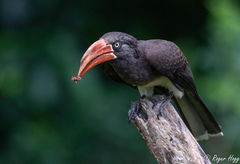
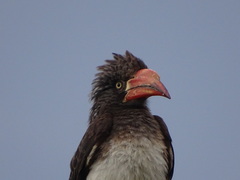
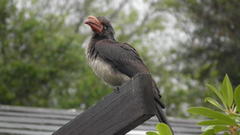
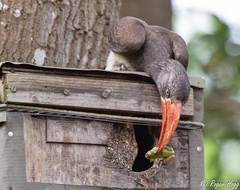
The crowned hornbill (Lophoceros alboterminatus) is an African hornbill. It is a medium-sized bird, 50–54 centimetres (20–21 in) in length, and is characterized by its white belly and black back and wings. The tips of the long tail feathers are white. The eyes are yellow; the beak is red and presents a stocky casque on the upper mandible. In females, the casque is smaller. The crowned hornbill can be distinguished from the similar Bradfield's hornbill by its shorter beak.

The crowned hornbill is a common resident of the coastal and riverine forests of southern (only the eastern coast) to northeastern Africa. It forages mainly in trees, where it feeds on insects (often caught in flight), small rodents, small reptiles, eggs, seeds and fruits. This hornbill species can be seen in flocks, usually in the dry season. Four to five white eggs are incubated for 25 to 30 days; the juveniles remain with both parents for about 8 weeks.

Gordon Lindsay Maclean, Robert's Birds of South Africa, 6th Edition ISBN 0-620-17583-4 Wikipedia →

Sounds

Call1:05

Zambia · 2019

© Peter Boesman · XC508977 · CC BY-NC-ND 4.0

Alarm call0:28

South Africa · 2022

© Lynette Rudman · XC728112 · CC BY-NC-SA 4.0

Song0:49

South Africa · 2019

© Frank Lambert · XC518631 · CC BY-NC-ND 4.0

Global Distribution

Parks Where Found

# Park Country Daily sighting probability
1 Selous Game Reserve 🇹🇿 Tanzania
~60%
2 Mana Pools National Park 🇿🇼 Zimbabwe
~50%
3 Lower Zambezi National Park 🇿🇲 Zambia
~50%
4 Lake Manyara National Park 🇹🇿 Tanzania
~50%
5 Ruaha National Park 🇹🇿 Tanzania
~40%
6 Gorongosa National Park 🇲🇿 Mozambique
~30%
7 Liwonde National Park 🇲🇼 Malawi
~30%
8 iSimangaliso Wetland Park 🇿🇦 South Africa
~30%
9 Kibale National Park 🇺🇬 Uganda
~30%
10 South Luangwa National Park 🇿🇲 Zambia
~30%
11 Meru National Park 🇰🇪 Kenya
~20%
12 uMkhuze Game Reserve 🇿🇦 South Africa
~20%
13 Kafue National Park 🇿🇲 Zambia
~20%
14 Mikumi National Park 🇹🇿 Tanzania
~20%
15 Gonarezhou National Park 🇿🇼 Zimbabwe
~20%
16 Hluhluwe-Imfolozi Park 🇿🇦 South Africa
~10%
17 Akagera National Park 🇷🇼 Rwanda
~10%
18 Bwindi Impenetrable National Park 🇺🇬 Uganda
~10%
19 Virunga National Park 🇨🇩 Democratic Republic of the Congo
~10%
20 Queen Elizabeth National Park 🇺🇬 Uganda
~10%
21 Arusha National Park 🇹🇿 Tanzania
~10%
22 Mkomazi National Park 🇹🇿 Tanzania
~10%
23 Kruger National Park 🇿🇦 South Africa
~10%
24 Lake Mburo National Park 🇺🇬 Uganda
~10%
25 Murchison Falls National Park 🇺🇬 Uganda
~10%
26 Semuliki National Park 🇺🇬 Uganda
~10%
27 Addo Elephant National Park 🇿🇦 South Africa
<5%
28 Hwange National Park 🇿🇼 Zimbabwe
<5%
29 Nyungwe National Park 🇷🇼 Rwanda
<5%
30 Aberdare National Park 🇰🇪 Kenya
<5%
31 Tarangire National Park 🇹🇿 Tanzania
<5%
32 Tsavo East National Park 🇰🇪 Kenya
<5%
33 Tsavo West National Park 🇰🇪 Kenya
<5%
34 Kidepo Valley National Park 🇺🇬 Uganda
<5%
35 Masai Mara National Reserve 🇰🇪 Kenya
<5%
36 Lake Nakuru National Park 🇰🇪 Kenya
<5%
37 Ngorongoro Conservation Area 🇹🇿 Tanzania
<5%
38 Serengeti National Park 🇹🇿 Tanzania
<5%

Cities Where Found

# City Country Daily sighting probability
1 Kampala 🇺🇬 Uganda
~30%
2 Durban 🇿🇦 South Africa
~10%

Zoos & Centres Where Found

# Zoo / Centre Country
1 Pairi Daiza 🇧🇪 Belgium In captivity
2 Parc des oiseaux 🇫🇷 France In captivity
3 Saitama Children's Zoo 🇯🇵 Japan In captivity
4 Ueno Zoo 🇯🇵 Japan In captivity
5 Bird Paradise 🇸🇬 Singapore In captivity
6 Rainforest Wild Asia 🇸🇬 Singapore In captivity
7 Reserva Zoológica Oasys MiniHollywood 🇪🇸 Spain In captivity
8 Inokashira Park Zoo 🇯🇵 Japan In captivity
9 Ōmiya Park Zoo 🇯🇵 Japan In captivity
10 Volière 🇨🇭 Switzerland In captivity

Before you go

What are the chances of seeing a Crowned Hornbill in Lower Zambezi National Park?

Likely

About 50% of wildlife watchers report a Crowned Hornbill sighting in Lower Zambezi National Park on a given day, based on 169 verified sightings from GBIF citizen-science data from 2019 to 2026. It is the 26th most-seen of the 241 birds we can rate there. Over three days the chance rises to about 90%, and over a week to over 90%, if each day is a fresh chance.

When is the best time to see a Crowned Hornbill in Lower Zambezi National Park?

August and November–December

In those months about 60% of wildlife watchers report a Crowned Hornbill in Lower Zambezi National Park on a given day, against about 40% in January and October, the lowest months. February and March have too few records to rate.

What time of day is best to see a Crowned Hornbill?

Between 8 and 11 am

Across all the parks we cover, that three-hour window holds the most Crowned Hornbill sightings with a recorded time, and about 9 in 10 of them come between 6 am and 6 pm: it is a daytime animal.

Is Lower Zambezi National Park the best place to see a Crowned Hornbill?

3rd of 38

Of the 38 parks where we can rate Crowned Hornbill sightings, Lower Zambezi National Park ranks 3rd at about 50%. The best odds are in Selous Game Reserve (Tanzania, about 60%) and Mana Pools National Park (Zimbabwe, about 50%). All parks ranked.

Where does the Crowned Hornbill sighting chance come from?

GBIF citizen-science records

It is estimated from how often the Crowned Hornbill is recorded against all the birds logged in Lower Zambezi National Park (169 verified sightings from 2019 to 2026), calibrated against known sighting rates. Figures are rounded to the nearest 10% because citizen-science data supports honest approximations, not decimals, and months with records from fewer than five people show "—". How it works.

← Back to Lower Zambezi National Park