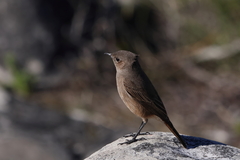
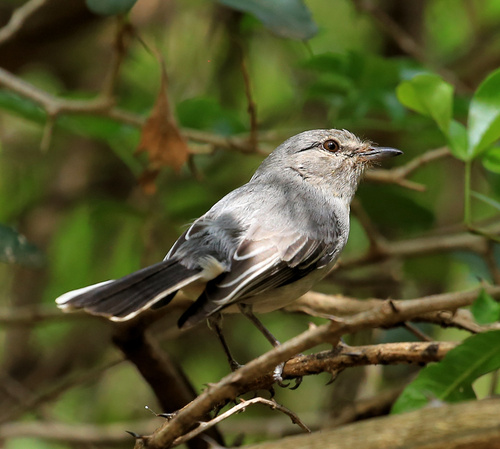
Familiar Chat

Familiar Chat

Oenanthe familiaris

Silhouette: PhyloPic

LCLeast ConcernNTVUENCR
Daily sighting probability <5% · Rare
at Mikumi National Park

In 3 days ~10% in a week ~20%

5 Verified sightings at Mikumi National Park From 2019 to 2026
2,405 In all 24 parks
July Best month
☀️ Diurnal When it's spotted

About the Familiar Chat

The familiar chat (Oenanthe familiaris) is a small passerine bird of the Old World flycatcher family Muscicapidae. It is a common resident breeder in Africa south of the Sahara in rocky and mountainous habitat and around human habitation.

The familiar chat was illustrated and described by the French naturalist François Levaillant in Volume 4 of his Histoire naturelle des oiseaux d'Afrique published in 1805. He named the bird, "Le Traquet Familier" but did not give the species a binomial name. The binomial name Motacilla familiaris was introduced by the English publisher John Wilkes in 1817. The species was subsequently placed in the genus Cercomela introduced by Charles Lucien Bonaparte in 1856. Molecular phylogenetic studies published in 2010 and 2012 found that the genus Cercomela was polyphyletic with five species, including the familiar chat, phylogenetically nested within the genus Oenanthe. As part of a reorganization of the species to create monophyletic genera, the familiar chat was moved to the genus Oenanthe.

There are 7 recognised subspecies: Wikipedia →

Sounds

Call0:27

South Africa · 2023

© Marc Anderson · XC876551 · CC BY-NC-ND 4.0

Song0:56

Zambia · 2020

© Dries Van de Loock · XC660742 · CC BY-NC-SA 4.0

Alarm call0:49

South Africa · 2020

© Tim Cockcroft · XC596255 · CC BY-NC-SA 4.0

Global Distribution

Parks Where Found

# Park Country Daily sighting probability
1 Namib-Naukluft National Park 🇳🇦 Namibia
~60%
2 Waterberg Plateau Park 🇳🇦 Namibia
~50%
3 Golden Gate Highlands National Park 🇿🇦 South Africa
~50%
4 Kgalagadi Transfrontier Park 🇿🇦 South Africa
~30%
5 Kidepo Valley National Park 🇺🇬 Uganda
~20%
6 Pilanesberg National Park 🇿🇦 South Africa
~20%
7 Table Mountain National Park 🇿🇦 South Africa
~10%
8 Hluhluwe-Imfolozi Park 🇿🇦 South Africa
~10%
9 Nyungwe National Park 🇷🇼 Rwanda
~10%
10 Awash National Park 🇪🇹 Ethiopia
~10%
11 Addo Elephant National Park 🇿🇦 South Africa
<5%
12 Liwonde National Park 🇲🇼 Malawi
<5%
13 West Coast National Park 🇿🇦 South Africa
<5%
14 Etosha National Park 🇳🇦 Namibia
<5%
15 De Hoop Nature Reserve 🇿🇦 South Africa
<5%
16 Akagera National Park 🇷🇼 Rwanda
<5%
17 Mikumi National Park 🇹🇿 Tanzania
<5%
18 Virunga National Park 🇨🇩 Democratic Republic of the Congo
<5%
19 uMkhuze Game Reserve 🇿🇦 South Africa
<5%
20 Serengeti National Park 🇹🇿 Tanzania
<5%
21 Volcanoes National Park 🇷🇼 Rwanda
<5%
22 Masai Mara National Reserve 🇰🇪 Kenya
<5%
23 Lake Mburo National Park 🇺🇬 Uganda
<5%
24 Kruger National Park 🇿🇦 South Africa
<5%

Cities Where Found

# City Country Daily sighting probability
1 Durban 🇿🇦 South Africa
~20%
2 Kigali 🇷🇼 Rwanda
<5%
3 Cape Town 🇿🇦 South Africa
<5%
4 Johannesburg 🇿🇦 South Africa
<5%

Before you go

What are the chances of seeing a Familiar Chat in Mikumi National Park?

Rare

Under 5% of wildlife watchers report a Familiar Chat sighting in Mikumi National Park on a given day, based on 5 verified sightings from GBIF citizen-science data from 2019 to 2026. It is the 240th most-seen of the 261 birds we can rate there. Over three days the chance rises to about 10%, and over a week to about 20%, if each day is a fresh chance.

When is the best time to see a Familiar Chat in Mikumi National Park?

July and August

In those months about 10% of wildlife watchers report a Familiar Chat in Mikumi National Park on a given day, against under 5% in September to June, the lowest months. Those are among Mikumi National Park's driest months, with about 20 mm of rain a month against 200 mm in April.

What time of day is best to see a Familiar Chat?

Between 10 am and 1 pm

Across all the parks we cover, that three-hour window holds the most Familiar Chat sightings with a recorded time, and nearly all of them come between 6 am and 6 pm: it is a daytime animal.

Where does the Familiar Chat sighting chance come from?

GBIF citizen-science records

It is estimated from how often the Familiar Chat is recorded against all the birds logged in Mikumi National Park (5 verified sightings from 2019 to 2026), calibrated against known sighting rates. Figures are rounded to the nearest 10% because citizen-science data supports honest approximations, not decimals, and months with records from fewer than five people show "—". How it works.

← Back to Mikumi National Park