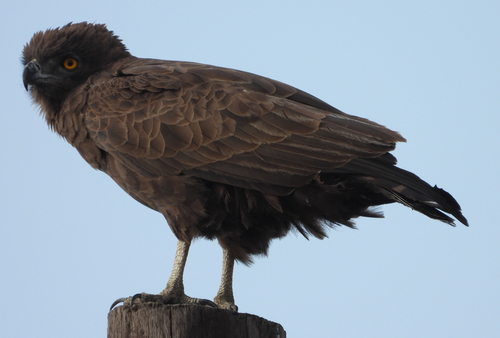
Lizard Buzzard

Lizard Buzzard

Kaupifalco monogrammicus

Silhouette: Sheatherius · PhyloPic

LCLeast ConcernNTVUENCR
Daily sighting probability ~10% · With luck
at Mikumi National Park

In 3 days ~30% in a week ~60%

26 Verified sightings at Mikumi National Park From 2019 to 2026
1,754 In all 29 parks
July Best month
☀️ Diurnal When it's spotted

About the Lizard Buzzard

The lizard buzzard (Kaupifalco monogrammicus), or lizard hawk, is a bird of prey in the family Accipitridae. It is the only species placed in the genus Kaupifalco. It is native to Sub-Saharan Africa. Despite its name, it may be more closely related to the Accipiter hawks than the Buteo buzzards.

Molecular phylogenetic studies have revealed that the lizard buzzard is not closely related to Buteo buzzards but rather to Accipiter hawks. This extends to morphological associations, e.g. the lizard buzzard has pointed and fairly short wings. Despite the lizard buzzard inhabiting Africa, phylogenetic evidence indicates that its closest relatives are the two Microspizias hawks of Central and South America.

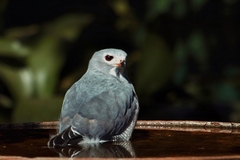
The lizard buzzard is a smallish stocky raptor with a total body length of 35–37 cm and a wingspan of about 79 cm. Males weigh 246 g, females 304 g on average. The upperparts, head and breast are grey. There is a vertical black line on the white throat, which distinguishes this species from all other raptors. The belly is white with fine dark barring. The underwings are white with dark tips. The tail is black with a white tip and a single white band. The eyes... Wikipedia →

Sounds

Duet1:12

Gambia · 2020

© Joost van Bruggen · XC896918 · CC BY-NC-ND 4.0

Call0:34

Zambia · 2023

© Marc Anderson · XC880764 · CC BY-NC-ND 4.0

Song0:04

Kenya · 2019

© isaac kilusu · XC469456 · CC BY-NC-SA 4.0

Global Distribution

Parks Where Found

# Park Country Daily sighting probability
1 Kibale National Park 🇺🇬 Uganda
~30%
2 Niokolo-Koba National Park 🇸🇳 Senegal
~30%
3 Gorongosa National Park 🇲🇿 Mozambique
~20%
4 Kafue National Park 🇿🇲 Zambia
~20%
5 Meru National Park 🇰🇪 Kenya
~10%
6 Semuliki National Park 🇺🇬 Uganda
~10%
7 Mikumi National Park 🇹🇿 Tanzania
~10%
8 Hwange National Park 🇿🇼 Zimbabwe
~10%
9 Mana Pools National Park 🇿🇼 Zimbabwe
~10%
10 South Luangwa National Park 🇿🇲 Zambia
~10%
11 Lower Zambezi National Park 🇿🇲 Zambia
~10%
12 Ruaha National Park 🇹🇿 Tanzania
~10%
13 Queen Elizabeth National Park 🇺🇬 Uganda
~10%
14 Murchison Falls National Park 🇺🇬 Uganda
~10%
15 Akagera National Park 🇷🇼 Rwanda
~10%
16 Gonarezhou National Park 🇿🇼 Zimbabwe
~10%
17 Liwonde National Park 🇲🇼 Malawi
~10%
18 Kidepo Valley National Park 🇺🇬 Uganda
<5%
19 uMkhuze Game Reserve 🇿🇦 South Africa
<5%
20 Arusha National Park 🇹🇿 Tanzania
<5%
21 Kruger National Park 🇿🇦 South Africa
<5%
22 Bwindi Impenetrable National Park 🇺🇬 Uganda
<5%
23 Lake Mburo National Park 🇺🇬 Uganda
<5%
24 Chobe National Park 🇧🇼 Botswana
<5%
25 Tsavo East National Park 🇰🇪 Kenya
<5%
26 Serengeti National Park 🇹🇿 Tanzania
<5%
27 Moremi Game Reserve 🇧🇼 Botswana
<5%
28 Tarangire National Park 🇹🇿 Tanzania
<5%
29 Ngorongoro Conservation Area 🇹🇿 Tanzania
<5%

Cities Where Found

# City Country Daily sighting probability
1 Kampala 🇺🇬 Uganda
~40%
2 Lusaka 🇿🇲 Zambia
~20%
3 Harare 🇿🇼 Zimbabwe
~10%
4 Serrekunda 🇬🇲 Gambia
~10%
5 Freetown 🇸🇱 Sierra Leone
~10%
6 Abuja 🇳🇬 Nigeria
~10%
7 Accra 🇬🇭 Ghana
~10%
8 Dar es-Salaam 🇹🇿 Tanzania
<5%
9 Monrovia 🇱🇷 Liberia
<5%
10 Maputo 🇲🇿 Mozambique
<5%

Zoos & Centres Where Found

# Zoo / Centre Country
1 Pairi Daiza 🇧🇪 Belgium In captivity
2 Dullstroom Bird Of Prey & Rehabilitation Centre 🇿🇦 South Africa In captivity

Before you go

What are the chances of seeing a Lizard Buzzard in Mikumi National Park?

With luck

About 10% of wildlife watchers report a Lizard Buzzard sighting in Mikumi National Park on a given day, based on 26 verified sightings from GBIF citizen-science data from 2019 to 2026. It is the 101st most-seen of the 261 birds we can rate there. Over three days the chance rises to about 30%, and over a week to about 60%, if each day is a fresh chance.

When is the best time to see a Lizard Buzzard in Mikumi National Park?

July

In that month about 30% of wildlife watchers report a Lizard Buzzard in Mikumi National Park on a given day, against about 10% in February–May, August–September and November–December, the lowest months. That is one of Mikumi National Park's driest months, with about 25 mm of rain against 200 mm in April.

What time of day is best to see a Lizard Buzzard?

Between 9 am and noon

Across all the parks we cover, that three-hour window holds the most Lizard Buzzard sightings with a recorded time, and about 9 in 10 of them come between 6 am and 6 pm: it is a daytime animal.

Which relatives of the Lizard Buzzard live in Mikumi National Park?

Same family: Accipitridae

The closest relatives of the Lizard Buzzard that you can see in Mikumi National Park (family Accipitridae, Hawks, Eagles, and Kites) are Bateleur (about 50%), White-backed Vulture (about 40%) and Martial Eagle (about 20%), with each one's daily chance of a sighting.

Where does the Lizard Buzzard sighting chance come from?

GBIF citizen-science records

It is estimated from how often the Lizard Buzzard is recorded against all the birds logged in Mikumi National Park (26 verified sightings from 2019 to 2026), calibrated against known sighting rates. Figures are rounded to the nearest 10% because citizen-science data supports honest approximations, not decimals, and months with records from fewer than five people show "—". How it works.

← Back to Mikumi National Park