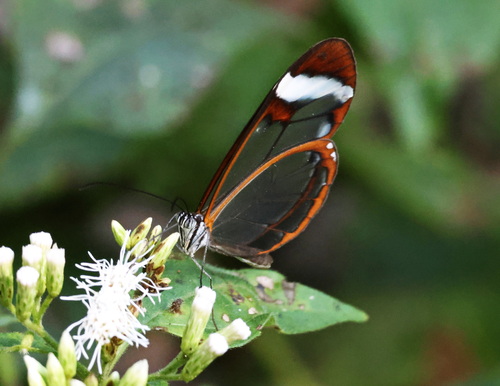
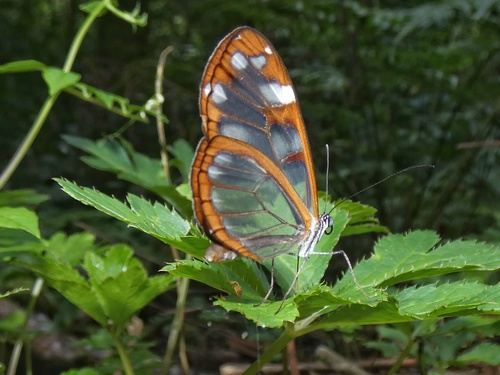
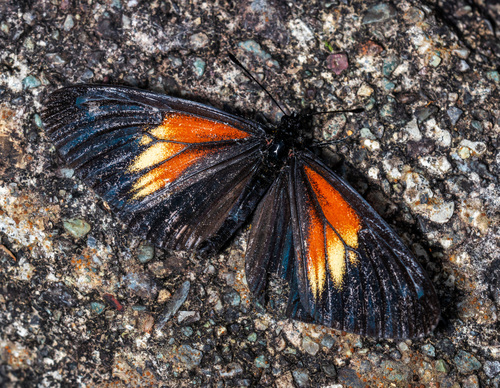
Rusty-Tipped Page

Rusty-Tipped Page

Siproeta epaphus

Daily sighting probability ~20% · Possible
at Monteverde Cloud Forest Reserve

In 3 days ~50% in a week ~80%

86 Verified sightings at Monteverde Cloud Forest Reserve From 2019 to 2026
452 In all 14 parks
July Best month
☀️ Diurnal When it's spotted

About the Rusty-Tipped Page

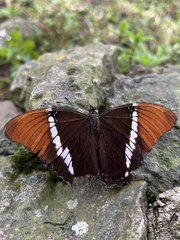
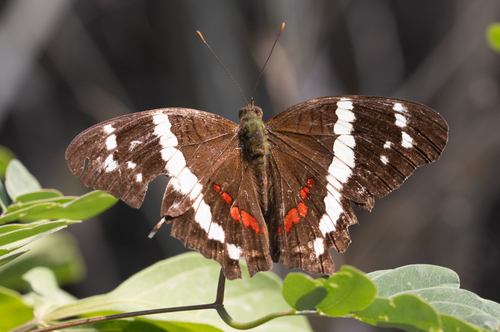
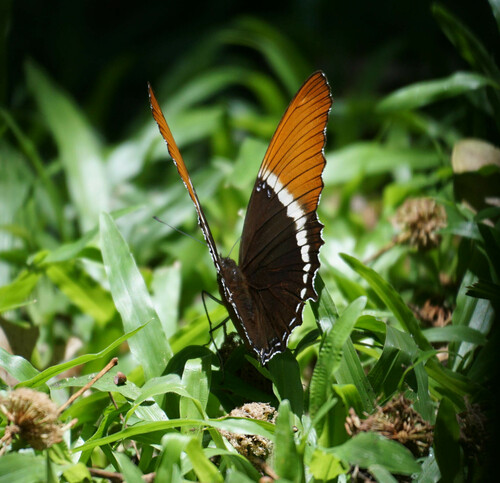
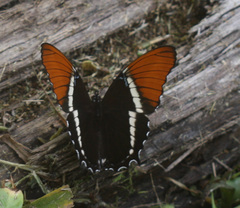
Siproeta epaphus, the rusty-tipped page or brown siproeta, is a New World butterfly that lives all year in tropical habitats. It has large wings, averaging 7.0–7.5 cm (2.8–3.0 in), that are black in the inner portion of the top surface and brown throughout the underside. Both surfaces have a bold white transverse stripe continuing across both wings. The outer portion of the forewings, beyond the white stripe, is rusty orange in the widespread subspecies S. epaphus epaphus; it is mostly or entirely black in the other two subspecies. S. epaphus is found throughout Central America, where it is one of the most common butterflies. Its range extends from southern North America to central South America. The range includes (though may not be limited to) south Texas and rarely southern New Mexico south through both eastern and western Mexico to the Guyanas, Brazil, Bolivia and Peru. Wikipedia →

Global Distribution

Parks Where Found

# Park Country Daily sighting probability
1 Iguazú National Park 🇦🇷 Argentina
~30%
2 Iguaçu National Park 🇧🇷 Brazil
~30%
3 Rincón de la Vieja National Park 🇨🇷 Costa Rica
~30%
4 Chirripó National Park 🇨🇷 Costa Rica
~20%
5 Lago de Yojoa 🇭🇳 Honduras
~20%
6 Monteverde Cloud Forest Reserve 🇨🇷 Costa Rica
~20%
7 Farallones de Cali National Natural Park 🇨🇴 Colombia
~10%
8 Cañón del Sumidero National Park 🇲🇽 Mexico
~10%
9 Tenorio Volcano National Park 🇨🇷 Costa Rica
~10%
10 Cerro Azul Meámbar National Park 🇭🇳 Honduras
~10%
11 Arenal Volcano National Park 🇨🇷 Costa Rica
~10%
12 Tapantí-Macizo de la Muerte National Park 🇨🇷 Costa Rica
~10%
13 Braulio Carrillo National Park 🇨🇷 Costa Rica
~10%
14 La Amistad International Park (Panama) 🇵🇦 Panama
~10%

Cities Where Found

# City Country Daily sighting probability
1 Medellín 🇨🇴 Colombia
~30%
2 San José 🇨🇷 Costa Rica
~30%
3 Curitiba 🇧🇷 Brazil
~20%
4 Cali 🇨🇴 Colombia
~20%
5 Tegucigalpa 🇭🇳 Honduras
~10%
6 Guatemala City 🇬🇹 Guatemala
~10%
7 Porto Alegre 🇧🇷 Brazil
~10%
8 São Paulo 🇧🇷 Brazil
~10%
9 Quito 🇪🇨 Ecuador
~10%
10 Bogota 🇨🇴 Colombia
<5%

Before you go

What are the chances of seeing a Rusty-Tipped Page in Monteverde Cloud Forest Reserve?

Possible

About 20% of wildlife watchers report a Rusty-Tipped Page sighting in Monteverde Cloud Forest Reserve on a given day, based on 86 verified sightings from GBIF citizen-science data from 2019 to 2026. It is the 26th most-seen of the 506 insects we can rate there. Over three days the chance rises to about 50%, and over a week to about 80%, if each day is a fresh chance.

When is the best time to see a Rusty-Tipped Page in Monteverde Cloud Forest Reserve?

July, September and December

In those months about 30% of wildlife watchers report a Rusty-Tipped Page in Monteverde Cloud Forest Reserve on a given day, against about 10% in March–June and October, the lowest months.

What time of day is best to see a Rusty-Tipped Page?

Between 11 am and 2 pm

Across all the parks we cover, that three-hour window holds the most Rusty-Tipped Page sightings with a recorded time, and nearly all of them come between 6 am and 6 pm: it is a daytime animal.

Is Monteverde Cloud Forest Reserve the best place to see a Rusty-Tipped Page?

6th of 14

Of the 14 parks where we can rate Rusty-Tipped Page sightings, Monteverde Cloud Forest Reserve ranks 6th at about 20%. The best odds are in Iguazú National Park (Argentina, about 30%), Iguaçu National Park (Brazil, about 30%) and Rincón de la Vieja National Park (Costa Rica, about 30%).

Where does the Rusty-Tipped Page sighting chance come from?

GBIF citizen-science records

It is estimated from how often the Rusty-Tipped Page is recorded against all the insects logged in Monteverde Cloud Forest Reserve (86 verified sightings from 2019 to 2026), calibrated against known sighting rates. Figures are rounded to the nearest 10% because citizen-science data supports honest approximations, not decimals, and months with records from fewer than five people show "—". How it works.
← Back to Monteverde Cloud Forest Reserve