

Completed


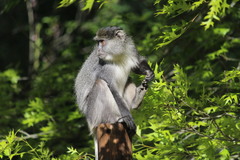
Blue Monkey
Cercopithecus mitis
Silhouette: Kai R. Caspar · PhyloPic
- KingdomAnimalia (Animals)
- PhylumChordata (Chordates)
- ClassMammalia (Mammals)
- OrderPrimates
- FamilyCercopithecidae (Old World Monkeys)
- GenusCercopithecus (Guenons)
- SpeciesCercopithecus mitis (Blue Monkey)
In 3 days ~80% in a week >90%
41 Verified sightings at Nairobi National Park From 2019 to 2026
834 In all 15 parks
August Best month
☀️ Diurnal When it's spotted
About the Blue Monkey
The blue monkey or diademed monkey (Cercopithecus mitis) is a species of Old World monkey native to Central and East Africa, ranging from the upper Congo River basin east to the East African Rift and south to northern Angola and Zambia and populations further south down to South Africa. The taxonomy of this species has been disputed and Sykes' monkey, the silver monkey and the golden monkey are often regarded as subspecies.
Several subspecies are recognised: Cercopithecus mitis boutourlinii – Boutourlini's blue monkey, found in Western Ethiopia. Identified and named by Leopoldo Traversi. Cercopithecus mitis elgonis – Elgon blue monkey Cercopithecus mitis heymansi – Lomami River blue monkey, found in Congo
Cercopithecus mitis kolbi – Kolb's monkey, found in Kenya Cercopithecus mitis labiatus – Samango monkey, found in South Africa, Eswatini and southern Mozambique Cercopithecus mitis mitis – Pluto monkey, found in Angola Cercopithecus mitis moloneyi – Moloney's blue monkey
Cercopithecus mitis opitsthosticus Cercopithecus mitis schoutedeni – Schouteden's blue monkey, found in Congo Cercopithecus mitis stuhlmanni – Stuhlmann's blue monkey At times, some of these have... Wikipedia →
Sounds
Call0:41
Malawi · 2015
© Frank Lambert · XC1031569 · CC BY-NC-ND 4.0
Call0:17
Burundi · 2024
© Bram Piot · XC1024931 · CC BY-NC-SA 4.0
Recording0:11
South Africa · 2021
© dlcastles · iNaturalist · CC BY-NC 4.0
Recent sightings of Blue Monkey in Nairobi National Park
LIVEiNaturalistGlobal Distribution
Parks Where Found
| # | Park | Country | Daily sighting probability |
|---|---|---|---|
| 1 | Arusha National Park | 🇹🇿 Tanzania | |
| 2 | Volcanoes National Park | 🇷🇼 Rwanda | |
| 3 | Aberdare National Park | 🇰🇪 Kenya | |
| 4 | Nyungwe National Park | 🇷🇼 Rwanda | |
| 5 | Bwindi Impenetrable National Park | 🇺🇬 Uganda | |
| 6 | Virunga National Park | 🇨🇩 Democratic Republic of the Congo | |
| 7 | Nairobi National Park | 🇰🇪 Kenya | |
| 8 | Lake Manyara National Park | 🇹🇿 Tanzania | |
| 9 | Tsavo West National Park | 🇰🇪 Kenya | |
| 10 | iSimangaliso Wetland Park | 🇿🇦 South Africa | |
| 11 | Hluhluwe-Imfolozi Park | 🇿🇦 South Africa | |
| 12 | Tsavo East National Park | 🇰🇪 Kenya | |
| 13 | Ngorongoro Conservation Area | 🇹🇿 Tanzania | |
| 14 | Gorongosa National Park | 🇲🇿 Mozambique | |
| 15 | Queen Elizabeth National Park | 🇺🇬 Uganda |
Cities Where Found
| # | City | Country | Daily sighting probability |
|---|---|---|---|
| 1 | Nairobi | 🇰🇪 Kenya |
Zoos & Centres Where Found
| # | Zoo / Centre | Country | |
|---|---|---|---|
| 1 | Beijing Wildlife Park | 🇨🇳 China | |
| 2 | Kansas City Zoo | 🇺🇸 United States | |
| 3 | Beijing Zoo | 🇨🇳 China | |
| 4 | Omaha’s Henry Doorly Zoo and Aquarium | 🇺🇸 United States | |
| 5 | Johannesburg Zoo | 🇿🇦 South Africa | |
| 6 | La Palmyre Zoo | 🇫🇷 France | |
| 7 | Pittsburgh Zoo & Aquarium | 🇺🇸 United States | |
| 8 | Animal Orphanage | 🇰🇪 Kenya | |
| 9 | Bioparc Fuengirola | 🇪🇸 Spain | |
| 10 | Castellar Zoo | 🇪🇸 Spain | |
| 11 | Sobela Ocean Aquarium | 🇺🇸 United States | |
| 12 | Maharani Zoo & Goa | 🇮🇩 Indonesia | |
| 13 | Snakeroom Serpentarium | 🇪🇸 Spain |
Closest Relatives at Nairobi National Park





Before you go
What are the chances of seeing a Blue Monkey in Nairobi National Park?
Likely
About 40% of wildlife watchers report a Blue Monkey sighting in Nairobi National Park on a given day, based on 41 verified sightings from GBIF citizen-science data from 2019 to 2026. It is the 11th most-seen of the 30 mammals we can rate there. Over three days the chance rises to about 80%, and over a week to over 90%, if each day is a fresh chance.
When is the best time to see a Blue Monkey in Nairobi National Park?
August
In that month about 60% of wildlife watchers report a Blue Monkey in Nairobi National Park on a given day, against under 5% in February, the lowest month. That is one of Nairobi National Park's driest months, with about 20 mm of rain against 180 mm in April.
What time of day is best to see a Blue Monkey?
Between 9 am and noon
Across all the parks we cover, that three-hour window holds the most Blue Monkey sightings with a recorded time, and about 9 in 10 of them come between 6 am and 6 pm: it is a daytime animal.
Is Nairobi National Park the best place to see a Blue Monkey?
7th of 15
Of the 15 parks where we can rate Blue Monkey sightings, Nairobi National Park ranks 7th at about 40%. The best odds are in Arusha National Park (Tanzania, about 80%), Volcanoes National Park (Rwanda, about 80%) and Aberdare National Park (Kenya, about 70%). All parks ranked.
Which relatives of the Blue Monkey live in Nairobi National Park?
Same family: Cercopithecidae
The closest relatives of the Blue Monkey that you can see in Nairobi National Park (family Cercopithecidae, Old World Monkeys) are Vervet Monkey (about 70%) and Olive Baboon (about 60%), with each one's daily chance of a sighting.
Where does the Blue Monkey sighting chance come from?
GBIF citizen-science records
It is estimated from how often the Blue Monkey is recorded against all the mammals logged in Nairobi National Park (41 verified sightings from 2019 to 2026), calibrated against known sighting rates. Figures are rounded to the nearest 10% because citizen-science data supports honest approximations, not decimals, and months with records from fewer than five people show "—". How it works.
