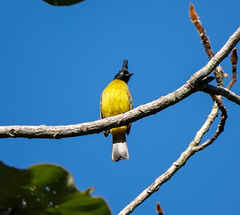
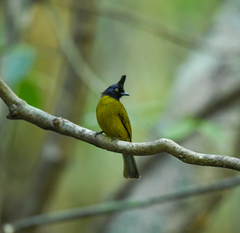
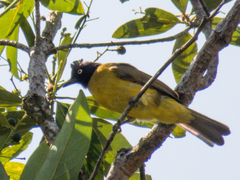
Black-crested Bulbul

Black-crested Bulbul

Pycnonotus flaviventris

LCLeast ConcernNTVUENCR
Daily sighting probability ~10% · With luck
at Namdapha National Park

In 3 days ~40% in a week ~70%

172 Verified sightings at Namdapha National Park From 2019 to 2026
12,834 In all 16 parks
January Best month
☀️ Diurnal When it's spotted

About the Black-crested Bulbul

The black-crested bulbul (Rubigula flaviventris) is a member of the bulbul family of passerine birds. It is found from the Indian subcontinent to southeast Asia. The black-crested bulbul was originally described in the genus Vanga and later moved to the genus Pycnonotus. Pycnonotus was found to be polyphyletic in recent molecular phylogenetic studies and five bulbuls, including the black-crested bulbul, were moved to Rubigula.

Until 2008, the black-crested bulbul was considered as conspecific with the black-capped, ruby-throated, flame-throated and Bornean bulbuls, but these are all now treated as distinct. Wikipedia →

Sounds

Call0:07

Vietnam · 2026

© Tim Dinh / Annambirding · XC1177457 · CC BY-NC-SA 4.0

Song1:09

China · 2026

© Bo Shunqi 薄顺奇 · XC1095764 · CC BY-NC-SA 4.0

Uncertain0:27

Thailand · 2025

© Peter Ericsson · XC973205 · CC BY-NC-SA 4.0

Global Distribution

Parks Where Found

# Park Country Daily sighting probability
1 Khao Yai National Park 🇹🇭 Thailand
~80%
2 Kaeng Krachan National Park 🇹🇭 Thailand
~70%
3 Khao Sok National Park 🇹🇭 Thailand
~50%
4 Doi Inthanon National Park 🇹🇭 Thailand
~50%
5 Cuc Phuong National Park 🇻🇳 Vietnam
~50%
6 Khao Luang National Park 🇹🇭 Thailand
~40%
7 Royal Manas National Park 🇧🇹 Bhutan
~40%
8 Manas National Park 🇮🇳 India
~40%
9 Cat Tien National Park 🇻🇳 Vietnam
~40%
10 Jim Corbett National Park 🇮🇳 India
~20%
11 Namdapha National Park 🇮🇳 India
~10%
12 Royal Bardia National Park 🇳🇵 Nepal
~10%
13 Chitwan National Park 🇳🇵 Nepal
~10%
14 Kaziranga National Park 🇮🇳 India
~10%
15 Satpura National Park 🇮🇳 India
<5%
16 Taman Negara National Park 🇲🇾 Malaysia
<5%

Cities Where Found

# City Country Daily sighting probability
1 Dehradun 🇮🇳 India
<5%
2 Guwahati 🇮🇳 India
<5%
3 Kuala Lumpur 🇲🇾 Malaysia
<5%
4 Bangkok 🇹🇭 Thailand
<5%
5 Singapore 🇸🇬 Singapore
<5%

Zoos & Centres Where Found

# Zoo / Centre Country
1 Kuala Lumpur Bird Park 🇲🇾 Malaysia In captivity
2 Hong Kong Zoological and Botanical Gardens 🇨🇳 China In captivity
3 Penang Bird Park 🇲🇾 Malaysia In captivity
4 Edward Youde Aviary 🇭🇰 Hong Kong SAR China In captivity

Before you go

What are the chances of seeing a Black-crested Bulbul in Namdapha National Park?

With luck

About 10% of wildlife watchers report a Black-crested Bulbul sighting in Namdapha National Park on a given day, based on 172 verified sightings from GBIF citizen-science data from 2019 to 2026. It is the 87th most-seen of the 298 birds we can rate there. Over three days the chance rises to about 40%, and over a week to about 70%, if each day is a fresh chance.

When is the best time to see a Black-crested Bulbul in Namdapha National Park?

January and March

In those months about 20% of wildlife watchers report a Black-crested Bulbul in Namdapha National Park on a given day, against about 10% in February, April–May and October–December, the lowest months. Those are among Namdapha National Park's driest months, with about 85 mm of rain a month against 660 mm in July. June to September have too few records to rate.

What time of day is best to see a Black-crested Bulbul?

Between 7 and 10 am

Across all the parks we cover, that three-hour window holds the most Black-crested Bulbul sightings with a recorded time, and about 9 in 10 of them come between 6 am and 6 pm: it is a daytime animal.

Where does the Black-crested Bulbul sighting chance come from?

GBIF citizen-science records

It is estimated from how often the Black-crested Bulbul is recorded against all the birds logged in Namdapha National Park (172 verified sightings from 2019 to 2026), calibrated against known sighting rates. Figures are rounded to the nearest 10% because citizen-science data supports honest approximations, not decimals, and months with records from fewer than five people show "—". How it works.

← Back to Namdapha National Park