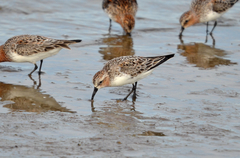
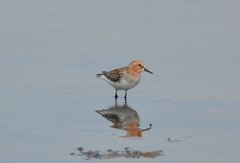
Red-necked Stint

Red-necked Stint

Calidris ruficollis

Silhouette: Edwin Price · PhyloPic

LCNTNear ThreatenedVUENCR
Daily sighting probability ~10% · With luck
at Ningaloo Marine Park

In 3 days ~30% in a week ~50%

32 Verified sightings at Ningaloo Marine Park From 2019 to 2026
700 In all 9 parks
November Best month
☀️ Diurnal When it's spotted

About the Red-necked Stint

The red-necked stint or rufous-necked stint (Calidris ruficollis) is a small migratory wader that breeds in northeast Russia and spends the non-breeding season along the coastlines of Southeast Asia and Australasia. The red-necked stint was formally described in 1776 by the German naturalist Peter Simon Pallas under the binomial name Trynga ruficollis. The specific epithet ruficollis is Modern Latin meaning "red-necked" from Latin rufus meaning "red" or "rufous" and -collis meaning "-necked" or "-throated". The type locality is southern Transbaikal in eastern Siberia. The red-necked stint is now placed with 23 other species in the genus Calidris that was introduced in 1804 by the German naturalist Blasius Merrem. The species is monotypic, with no subspecies recognised. Within the genus Calidris the red-necked stint is most closely related to the spoon-billed sandpiper (Calidris pygmaea).

These birds are among the smallest of waders, very similar to the little stint, Calidris minuta, with which they were once considered conspecific. The red-necked stint's small size, fine dark bill, dark legs and quicker movements distinguish this species from all waders... Wikipedia →

Sounds

Call0:22

Malaysia · 2024

© Lim Ying Hien · XC896223 · CC BY-NC-ND 4.0

Flight call0:18

Mongolia · 2022

© Stanislas Wroza · XC765871 · CC BY-NC-SA 4.0

Song1:21

Russian Federation · 2017

© Jens Kirkeby · XC381052 · CC BY-NC-SA 4.0

Global Distribution

Parks Where Found

# Park Country Daily sighting probability
1 Rottnest Island 🇦🇺 Australia
~60%
2 Bali Barat National Park 🇮🇩 Indonesia
~20%
3 Cape Range 🇦🇺 Australia
~10%
4 Ningaloo Marine Park 🇦🇺 Australia
~10%
5 Wilsons Promontory National Park 🇦🇺 Australia
<5%
6 Noosa National Park 🇦🇺 Australia
<5%
7 Great Otway National Park 🇦🇺 Australia
<5%
8 Daintree National Park 🇦🇺 Australia
<5%
9 Raja Ampat 🇮🇩 Indonesia
<5%

Cities Where Found

# City Country Daily sighting probability
1 Quanzhou 🇨🇳 China
~20%
2 Makassar 🇮🇩 Indonesia
~10%
3 Davao City 🇵🇭 Philippines
~10%
4 Cebu City 🇵🇭 Philippines
~10%
5 Naha 🇯🇵 Japan
~10%
6 Manila 🇵🇭 Philippines
<5%
7 Tokyo 🇯🇵 Japan
<5%
8 Sydney 🇦🇺 Australia
<5%
9 Melbourne 🇦🇺 Australia
<5%
10 Osaka 🇯🇵 Japan
<5%

Before you go

What are the chances of seeing a Red-necked Stint in Ningaloo Marine Park?

With luck

About 10% of wildlife watchers report a Red-necked Stint sighting in Ningaloo Marine Park on a given day, based on 32 verified sightings from GBIF citizen-science data from 2019 to 2026. It is the 54th most-seen of the 102 birds we can rate there. Over three days the chance rises to about 30%, and over a week to about 50%, if each day is a fresh chance.

When is the best time to see a Red-necked Stint in Ningaloo Marine Park?

September to February

In those months about 20% of wildlife watchers report a Red-necked Stint in Ningaloo Marine Park on a given day, against under 5% in March and May–June, the lowest months. Those are among Ningaloo Marine Park's driest months, with about 5 mm of rain a month against 50 mm in June.

What time of day is best to see a Red-necked Stint?

Between 1 and 4 pm

Across all the parks we cover, that three-hour window holds the most Red-necked Stint sightings with a recorded time, and about 9 in 10 of them come between 6 am and 6 pm: it is a daytime animal.

Is Ningaloo Marine Park the best place to see a Red-necked Stint?

4th of 9

Of the 9 parks where we can rate Red-necked Stint sightings, Ningaloo Marine Park ranks 4th at about 10%. The best odds are in Rottnest Island (Australia, about 60%), Bali Barat National Park (Indonesia, about 20%) and Cape Range (Australia, about 10%).

Where does the Red-necked Stint sighting chance come from?

GBIF citizen-science records

It is estimated from how often the Red-necked Stint is recorded against all the birds logged in Ningaloo Marine Park (32 verified sightings from 2019 to 2026), calibrated against known sighting rates. Figures are rounded to the nearest 10% because citizen-science data supports honest approximations, not decimals, and months with records from fewer than five people show "—". How it works.

← Back to Ningaloo Marine Park