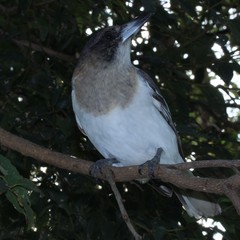
Pied Butcherbird

Pied Butcherbird

Cracticus nigrogularis

Silhouette: Sheatherius · PhyloPic

LCLeast ConcernNTVUENCR Endemic
Daily sighting probability ~30% · Possible
at Noosa National Park

In 3 days ~60% in a week ~90%

186 Verified sightings at Noosa National Park From 2019 to 2026
1,937 In all 12 parks
March Best month
☀️ Diurnal When it's spotted

About the Pied Butcherbird

The pied butcherbird (Cracticus nigrogularis) is a songbird native to Australia. Initially described by John Gould in 1837, it is a black-and-white bird 28 to 32 cm (11 to 12.5 in) long with a long, hooked bill. Its head and throat are black, making a distinctive hood; the mantle and much of the tail and wings are also black. The neck, underparts, and outer wing feathers are white. The juvenile and immature birds are predominantly brown and white. As they mature, black feathers replace their brown feathers. There are two recognised subspecies of pied butcherbird.

Within its range, the pied butcherbird is generally sedentary. Common in woodlands and urban environments, it is carnivorous, eating insects and small vertebrates, including birds. A tame and inquisitive bird, the pied butcherbird has been known to accept food from humans. It nests in trees, constructing a cup-shaped structure out of sticks and laying two to five eggs. The pied butcherbird engages in cooperative breeding, with a mated pair sometimes assisted by several helper birds. The troop is territorial, defending the nesting site from intruders. The International Union for Conservation of Nature (IUCN) has assessed the pied butcherbird as being of least concern on account of its large range and apparently stable population. Wikipedia →

Sounds

Song0:42

Australia · 2021

© Marc Anderson · XC1004414 · CC BY-NC-ND 4.0

Dawn song1:06

Australia · 2022

© Frank van de Loo · XC757808 · CC BY-NC-SA 4.0

Duet1:01

Australia · 2021

© Eddy Smith · XC681467 · CC BY-NC-SA 4.0

Global Distribution

Parks Where Found

# Park Country Daily sighting probability
1 Cape Range 🇦🇺 Australia
~70%
2 Ningaloo Marine Park 🇦🇺 Australia
~60%
3 Nitmiluk National Park 🇦🇺 Australia
~30%
4 Hattah-Kulkyne National Park 🇦🇺 Australia
~30%
5 Noosa National Park 🇦🇺 Australia
~30%
6 Springbrook National Park 🇦🇺 Australia
~20%
7 Uluru-Kata Tjuta National Park 🇦🇺 Australia
~20%
8 Kakadu National Park 🇦🇺 Australia
~10%
9 Litchfield National Park 🇦🇺 Australia
~10%
10 Lamington National Park 🇦🇺 Australia
~10%
11 Flinders Ranges National Park 🇦🇺 Australia
<5%
12 Blue Mountains National Park 🇦🇺 Australia
<5%

Cities Where Found

# City Country Daily sighting probability
1 Brisbane 🇦🇺 Australia
~50%

Zoos & Centres Where Found

# Zoo / Centre Country
1 Alice Springs Desert Park 🇦🇺 Australia In captivity
2 Gorge Wildlife Park 🇦🇺 Australia In captivity

Before you go

What are the chances of seeing a Pied Butcherbird in Noosa National Park?

Possible

About 30% of wildlife watchers report a Pied Butcherbird sighting in Noosa National Park on a given day, based on 186 verified sightings from GBIF citizen-science data from 2019 to 2026. It is the 19th most-seen of the 128 birds we can rate there. Over three days the chance rises to about 60%, and over a week to about 90%, if each day is a fresh chance.

When is the best time to see a Pied Butcherbird in Noosa National Park?

March and June

In those months about 40% of wildlife watchers report a Pied Butcherbird in Noosa National Park on a given day, against about 10% in November, the lowest month.

What time of day is best to see a Pied Butcherbird?

Between 10 am and 1 pm

Across all the parks we cover, that three-hour window holds the most Pied Butcherbird sightings with a recorded time, and nearly all of them come between 6 am and 6 pm: it is a daytime animal.

Is Noosa National Park the best place to see a Pied Butcherbird?

5th of 12

Of the 12 parks where we can rate Pied Butcherbird sightings, Noosa National Park ranks 5th at about 30%. The best odds are in Cape Range (Australia, about 70%), Ningaloo Marine Park (Australia, about 60%) and Nitmiluk National Park (Australia, about 30%). All parks ranked.

Where does the Pied Butcherbird sighting chance come from?

GBIF citizen-science records

It is estimated from how often the Pied Butcherbird is recorded against all the birds logged in Noosa National Park (186 verified sightings from 2019 to 2026), calibrated against known sighting rates. Figures are rounded to the nearest 10% because citizen-science data supports honest approximations, not decimals, and months with records from fewer than five people show "—". How it works.

← Back to Noosa National Park