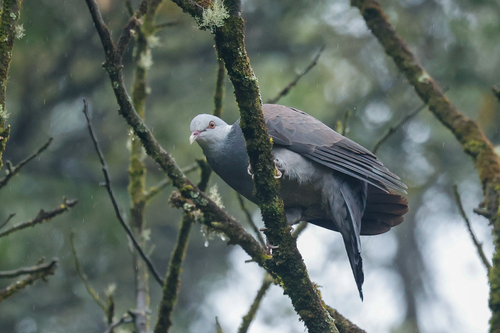
Yellow-footed Green Pigeon

Yellow-footed Green Pigeon

Treron phoenicopterus

Silhouette: Sheatherius · PhyloPic

LCLeast ConcernNTVUENCR
Daily sighting probability <5% · Rare
at Periyar National Park

In 3 days <5% in a week ~10%

12 Verified sightings at Periyar National Park From 2019 to 2026
13,363 In all 17 parks
February Best month
☀️ Diurnal When it's spotted

About the Yellow-footed Green Pigeon

The yellow-footed green pigeon (Treron phoenicopterus), also known as yellow-legged green pigeon, is a common species of green pigeon found in the Indian subcontinent and parts of Southeast Asia. It is the state bird of Maharashtra. Their population is currently increasing.

The yellow-footed green pigeon measures about 33 cm (13 in) long as an adult. Its plumage combines green, yellow, grey, and purple, creating a distinctive appearance. Its most noticeable feature is its bright yellow or yellow-orange legs and feet. Adults have a bluish-grey or greyish crown and nape, a yellowish-green forehead and throat, and a broad yellow or olive-yellow collar around the neck. Their upperparts appear pale greyish-green, while a noticeable mauve or purple patch covers the shoulder. The wings are dark with yellow edges, and the base of the tail has a yellow-green colour. Grey feathers form the end of the tail, while the undertail feathers range from purple to cinnamon-rufous.

The species also shows some geographic variation. Northern birds usually have greyish underparts, while southern birds tend to have more yellow-green underparts. Wikipedia →

Sounds

Song0:24

India · 2022

© Sathyan Meppayur · XC742514 · CC BY-NC-SA 4.0

Call0:24

India · 2019

© Peter Boesman · XC460148 · CC BY-NC-ND 4.0

Global Distribution

Parks Where Found

# Park Country Daily sighting probability
1 Keoladeo National Park 🇮🇳 India
~60%
2 Kaziranga National Park 🇮🇳 India
~60%
3 Kanha National Park 🇮🇳 India
~50%
4 Bandhavgarh National Park 🇮🇳 India
~50%
5 Manas National Park 🇮🇳 India
~50%
6 Gir National Park 🇮🇳 India
~40%
7 Ranthambore National Park 🇮🇳 India
~40%
8 Satpura National Park 🇮🇳 India
~30%
9 Royal Bardia National Park 🇳🇵 Nepal
~20%
10 Mudumalai National Park 🇮🇳 India
~20%
11 Jim Corbett National Park 🇮🇳 India
~20%
12 Nagarhole National Park 🇮🇳 India
~20%
13 Sundarbans National Park 🇮🇳 India
~20%
14 Bandipur National Park 🇮🇳 India
~20%
15 Chitwan National Park 🇳🇵 Nepal
~10%
16 Royal Manas National Park 🇧🇹 Bhutan
<5%
17 Periyar National Park 🇮🇳 India
<5%

Cities Where Found

# City Country Daily sighting probability
1 Asansol 🇮🇳 India
~60%
2 Savar 🇧🇩 Bangladesh
~60%
3 Bareilly 🇮🇳 India
~50%
4 Aligarh 🇮🇳 India
~40%
5 New Delhi 🇮🇳 India
~40%
6 Gwalior 🇮🇳 India
~30%
7 Nagpur 🇮🇳 India
~30%
8 Varanasi 🇮🇳 India
~20%
9 Dhaka 🇧🇩 Bangladesh
~20%
10 Kolkata 🇮🇳 India
~20%

Before you go

What are the chances of seeing a Yellow-footed Green Pigeon in Periyar National Park?

Rare

Under 5% of wildlife watchers report a Yellow-footed Green Pigeon sighting in Periyar National Park on a given day, based on 12 verified sightings from GBIF citizen-science data from 2019 to 2026. It is the 197th most-seen of the 227 birds we can rate there. Over three days the chance rises to under 5%, and over a week to about 10%, if each day is a fresh chance.

When is the best time to see a Yellow-footed Green Pigeon in Periyar National Park?

Any time of year

In every month with enough records, under 5% of wildlife watchers report a Yellow-footed Green Pigeon in Periyar National Park on a given day, so our monthly data shows no clear season.

What time of day is best to see a Yellow-footed Green Pigeon?

Between 6 and 9 am

Across all the parks we cover, that three-hour window holds the most Yellow-footed Green Pigeon sightings with a recorded time, and about 9 in 10 of them come between 6 am and 6 pm: it is a daytime animal.

Where does the Yellow-footed Green Pigeon sighting chance come from?

GBIF citizen-science records

It is estimated from how often the Yellow-footed Green Pigeon is recorded against all the birds logged in Periyar National Park (12 verified sightings from 2019 to 2026), calibrated against known sighting rates. Figures are rounded to the nearest 10% because citizen-science data supports honest approximations, not decimals, and months with records from fewer than five people show "—". How it works.

← Back to Periyar National Park