Fox Moth

Fox Moth

Macrothylacia rubi

Daily sighting probability ~20% · Possible
at Picos de Europa National Park

In 3 days ~50% in a week ~80%

14 Verified sightings at Picos de Europa National Park From 2019 to 2026
780 In all 19 parks
September Best month
☀️ Diurnal When it's spotted

About the Fox Moth

Macrothylacia rubi, the fox moth, is a lepidopteran belonging to the family Lasiocampidae. It was first described by Carl Linnaeus in his 1758 10th edition of Systema Naturae. This species can be found from Western Europe to Central Asia and Siberia. These moths live in open woodlands, moors and prairies.

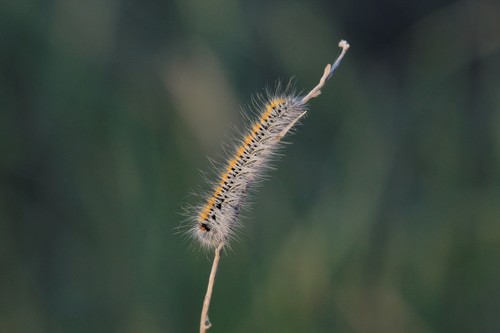
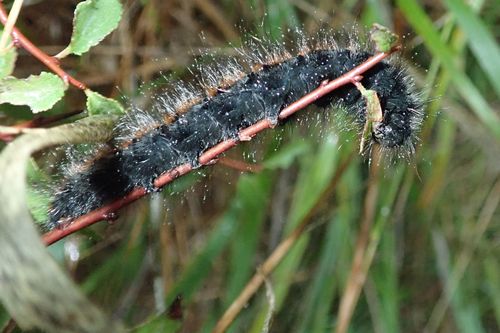
The wingspan of the male is 40–65 mm. The wings are reddish brown in males while females are usually paler, more greyish in colour and slightly larger than males. Both sexes show two narrow, straight, light-yellow, transverse bands, running across the forewings. The abdomen is thick, grey brown and hairy. The caterpillars can reach a length of about 80 millimetres (3.1 in). They are initially black with bright yellow or orange segments, later they become darker, always covered with blackish and tawny-coloured hairs and with light grey hair on the sides.

It is a univoltine species. Between September and March the caterpillars hibernate in leaf litter. These moths take flight from May to July. The males usually fly in the afternoon and night, while the females fly only at night. Caterpillars feed on heather (Calluna) bramble... Wikipedia →
Global Distribution

Parks Where Found

# Park Country Daily sighting probability
1 Hortobágy National Park 🇭🇺 Hungary
~30%
2 Biebrza National Park 🇵🇱 Poland
~30%
3 Snowdonia National Park 🇬🇧 United Kingdom
~30%
4 Mercantour National Park 🇫🇷 France
~30%
5 Aigüestortes National Park 🇪🇸 Spain
~20%
6 Cairngorms National Park 🇬🇧 United Kingdom
~20%
7 Kiskunság National Park 🇭🇺 Hungary
~20%
8 Picos de Europa National Park 🇪🇸 Spain
~20%
9 Cévennes National Park 🇫🇷 France
~20%
10 Pyrénées National Park 🇫🇷 France
~20%
11 Tatra National Park 🇸🇰 Slovakia
~20%
12 Wadden Sea National Park 🇩🇪 Germany
~20%
13 Ecrins National Park 🇫🇷 France
~20%
14 Białowieża National Park 🇵🇱 Poland
~20%
15 Fertő-Hanság National Park 🇭🇺 Hungary
~10%
16 Triglav National Park 🇸🇮 Slovenia
~10%
17 Ordesa y Monte Perdido National Park 🇪🇸 Spain
~10%
18 Bavarian Forest National Park 🇩🇪 Germany
~10%
19 Sierra de Guadarrama National Park 🇪🇸 Spain
~10%

Cities Where Found

# City Country Daily sighting probability
1 Prague 🇨🇿 Czechia
~10%
2 Porto 🇵🇹 Portugal
~10%
3 Stockholm 🇸🇪 Sweden
~10%
4 Helsinki 🇫🇮 Finland
~10%
5 Milan 🇮🇹 Italy
~10%
6 Rome 🇮🇹 Italy
~10%
7 Paris 🇫🇷 France
<5%
8 Novosibirsk 🇷🇺 Russia
<5%
9 Kyiv 🇺🇦 Ukraine
<5%
10 Munich 🇩🇪 Germany
<5%

Before you go

What are the chances of seeing a Fox Moth in Picos de Europa National Park?

Possible

About 20% of wildlife watchers report a Fox Moth sighting in Picos de Europa National Park on a given day, based on 14 verified sightings from GBIF citizen-science data from 2019 to 2026. It is the 40th most-seen of the 118 insects we can rate there. Over three days the chance rises to about 50%, and over a week to about 80%, if each day is a fresh chance.

When is the best time to see a Fox Moth in Picos de Europa National Park?

September and October

In those months about 40% of wildlife watchers report a Fox Moth in Picos de Europa National Park on a given day, against under 5% in February–March, May–June and November, the lowest months.

What time of day is best to see a Fox Moth?

Between noon and 3 pm

Across all the parks we cover, that three-hour window holds the most Fox Moth sightings with a recorded time, and about 8 in 10 of them come between 6 am and 6 pm: it is a daytime animal.

Is Picos de Europa National Park the best place to see a Fox Moth?

8th of 19

Of the 19 parks where we can rate Fox Moth sightings, Picos de Europa National Park ranks 8th at about 20%. The best odds are in Hortobágy National Park (Hungary, about 30%), Biebrza National Park (Poland, about 30%) and Snowdonia National Park (United Kingdom, about 30%).

Where does the Fox Moth sighting chance come from?

GBIF citizen-science records

It is estimated from how often the Fox Moth is recorded against all the insects logged in Picos de Europa National Park (14 verified sightings from 2019 to 2026), calibrated against known sighting rates. Figures are rounded to the nearest 10% because citizen-science data supports honest approximations, not decimals, and months with records from fewer than five people show "—". How it works.

← Back to Picos de Europa National Park