


Completed

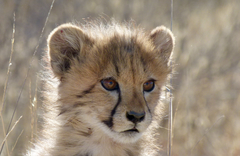


Cheetah
Acinonyx jubatus
Silhouette: nicubunu · PhyloPic
- KingdomAnimalia (Animals)
- PhylumChordata (Chordates)
- ClassMammalia (Mammals)
- OrderCarnivora (Carnivorans)
- FamilyFelidae (Felids)
- GenusAcinonyx (Cheetahs)
- SpeciesAcinonyx jubatus (Cheetah)
In 3 days ~60% in a week ~90%
42 Verified sightings at Pilanesberg National Park From 2019 to 2026
2,191 In all 21 parks
October Best month
☀️ Diurnal When it's spotted


Completed

Completed
About the Cheetah
The cheetah (Acinonyx jubatus) is a species of large feline and the only living member of the genus Acinonyx. The cheetah is a pursuit predator and the fastest land animal, capable of running at 93–104 km/h (58–65 mph); it has evolved for speed, having powerful hindlimb muscles, long limbs and a flexible spine. The cheetah has a tawny to creamy white or pale buff fur that is marked with evenly spaced, solid black spots. The head is small and rounded, with a short snout and black tear-like facial streaks. It has a height of 67–94 cm (2.20–3.08 ft) at the shoulder, and the head-and-body length is between 1.1 and 1.5 m (3 ft 7 in and 4 ft 11 in). Adults weigh between 21 and 65 kg (46 and 143 lb).
The cheetah was first scientifically described in the late 18th century. Four subspecies are recognised today that are native to Africa and central Iran. An African subspecies was introduced to India in 2022. It is now distributed mainly in small, fragmented populations in northwestern, eastern and southern Africa and central Iran. It lives in a variety of habitats such as savannahs in the Serengeti, arid mountain ranges in the Sahara, and hilly desert terrain.
The cheetah lives in three main social groups: females and their cubs, male "coalitions", and solitary males. While females lead a nomadic life searching for prey in large home ranges, males are more sedentary and instead establish much smaller territories in areas with plentiful prey and access to females. The cheetah is active during the day, with peaks during dawn and dusk. It feeds on small- to medium-sized prey, mostly weighing under 40 kg (88 lb), and prefers medium-sized ungulates such as impala, springbok and Thomson's gazelles. The cheetah typically stalks and approaches its prey within 30–200 m (98–656 ft) before charging at high speed, striking down the prey with its dewclaw in full pursuit and killing it with a throat bite. It breeds throughout the year. After a gestation of nearly three months, females give birth to a litter of three or four cubs, who are weaned at around four months and are independent by around 20 months of age. Cheetah cubs are highly vulnerable to predation by other large carnivores such as lions and hyenas, who also routinely steal kills from adult cheetahs.
The cheetah is threatened by habitat loss, conflict with humans, poaching and high susceptibility to diseases. The global cheetah population was estimated at 6,517 mature individuals in 2021; it is listed as Vulnerable on the IUCN Red List. It has been widely depicted in art, literature, advertising, and animation. Wikipedia →
Recent sightings of Cheetah in Pilanesberg National Park
LIVEiNaturalistGlobal Distribution
Parks Where Found
| # | Park | Country | Daily sighting probability |
|---|---|---|---|
| 1 | Serengeti National Park | 🇹🇿 Tanzania | |
| 2 | Masai Mara National Reserve | 🇰🇪 Kenya | |
| 3 | Samburu National Reserve | 🇰🇪 Kenya | |
| 4 | Liwonde National Park | 🇲🇼 Malawi | |
| 5 | Tsavo East National Park | 🇰🇪 Kenya | |
| 6 | Amboseli National Park | 🇰🇪 Kenya | |
| 7 | Etosha National Park | 🇳🇦 Namibia | |
| 8 | Kgalagadi Transfrontier Park | 🇿🇦 South Africa | |
| 9 | Ngorongoro Conservation Area | 🇹🇿 Tanzania | |
| 10 | Moremi Game Reserve | 🇧🇼 Botswana | |
| 11 | Tarangire National Park | 🇹🇿 Tanzania | |
| 12 | Hluhluwe-Imfolozi Park | 🇿🇦 South Africa | |
| 13 | Kruger National Park | 🇿🇦 South Africa | |
| 14 | Hwange National Park | 🇿🇼 Zimbabwe | |
| 15 | uMkhuze Game Reserve | 🇿🇦 South Africa | |
| 16 | Pilanesberg National Park | 🇿🇦 South Africa | |
| 17 | Kafue National Park | 🇿🇲 Zambia | |
| 18 | Waterberg Plateau Park | 🇳🇦 Namibia | |
| 19 | Chobe National Park | 🇧🇼 Botswana | |
| 20 | Tsavo West National Park | 🇰🇪 Kenya | |
| 21 | iSimangaliso Wetland Park | 🇿🇦 South Africa |
Zoos & Centres Where Found
Closest Relatives at Pilanesberg National Park





Before you go
What are the chances of seeing a Cheetah in Pilanesberg National Park?
Possible
About 30% of wildlife watchers report a Cheetah sighting in Pilanesberg National Park on a given day, based on 42 verified sightings from GBIF citizen-science data from 2019 to 2026. It is the 22nd most-seen of the 31 mammals we can rate there. Over three days the chance rises to about 60%, and over a week to about 90%, if each day is a fresh chance.
When is the best time to see a Cheetah in Pilanesberg National Park?
October and December
In those months about 40% of wildlife watchers report a Cheetah in Pilanesberg National Park on a given day, against under 5% in May, the lowest month. Those are among Pilanesberg National Park's wettest months, with about 85 mm of rain a month against almost none in August.
What time of day is best to see a Cheetah?
Between 2 and 5 pm
Across all the parks we cover, that three-hour window holds the most Cheetah sightings with a recorded time, and about 9 in 10 of them come between 6 am and 6 pm: it is a daytime animal.
Is Pilanesberg National Park the best place to see a Cheetah?
16th of 21
Of the 21 parks where we can rate Cheetah sightings, Pilanesberg National Park ranks 16th at about 30%. The best odds are in Serengeti National Park (Tanzania, about 70%), Masai Mara National Reserve (Kenya, about 60%) and Samburu National Reserve (Kenya, about 50%). All parks ranked.
Which relatives of the Cheetah live in Pilanesberg National Park?
Same family: Felidae
The closest relatives of the Cheetah that you can see in Pilanesberg National Park (family Felidae, Felids) are Lion (about 40%), Leopard (about 30%) and Serval (about 10%), with each one's daily chance of a sighting.
Where does the Cheetah sighting chance come from?
GBIF citizen-science records
It is estimated from how often the Cheetah is recorded against all the mammals logged in Pilanesberg National Park (42 verified sightings from 2019 to 2026), calibrated against known sighting rates. Figures are rounded to the nearest 10% because citizen-science data supports honest approximations, not decimals, and months with records from fewer than five people show "—". How it works.
