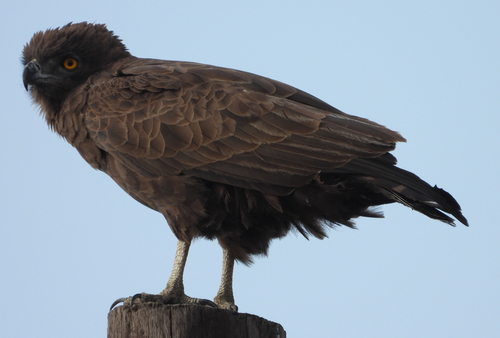
Secretary Bird

Secretary Bird

Sagittarius serpentarius

Silhouette: Danielle Alba · PhyloPic

LCNTVUENEndangeredCR
Daily sighting probability ~10% · With luck
at Pilanesberg National Park

In 3 days ~30% in a week ~60%

65 Verified sightings at Pilanesberg National Park From 2019 to 2026
7,550 In all 29 parks
December Best month
☀️ Diurnal When it's spotted

About the Secretary Bird

The secretarybird or secretary bird (Sagittarius serpentarius) is a large bird of prey that is endemic to Africa. It is mostly terrestrial, spending most of its time on the ground, and is usually found in the open grasslands and savanna of the sub-Saharan region. John Frederick Miller described the species in 1779. A member of the order Accipitriformes, which also includes many other diurnal birds of prey such as eagles, hawks, kites, vultures, and harriers, it is placed in its own family, the Sagittariidae.

The secretarybird is instantly recognizable as a very large bird with an eagle-like body on crane-like legs that give the bird a height of as much as 1.3 m (4 ft 3 in). The sexes are similar in appearance. Adults have a featherless, red-orange face and predominantly grey plumage, with a flattened dark crest and black flight feathers and thighs.

Breeding can take place at any time of year, but tends to be late in the dry season. The nest is built at the top of a thorny tree, and a clutch of one to three eggs is laid. In years with plentiful food, all three young can survive to fledging. The secretarybird hunts and catches prey on the ground, often stomping on victims to kill them. Insects and small vertebrates make up its diet.

Although the secretarybird resides over a large range, the results of localized surveys suggest that the total population is experiencing a rapid decline, probably as a result of habitat destruction. The species is therefore classed as endangered by the International Union for Conservation of Nature. The secretarybird appears on the coats of arms of South Africa and Sudan. Wikipedia →

Sounds

Courtship at nest site0:34

South Africa · 2017

© Niall Perrins · XC391856 · CC BY-NC-SA 4.0

Global Distribution

Parks Where Found

# Park Country Daily sighting probability
1 Serengeti National Park 🇹🇿 Tanzania
~50%
2 Masai Mara National Reserve 🇰🇪 Kenya
~40%
3 Samburu National Reserve 🇰🇪 Kenya
~30%
4 Ngorongoro Conservation Area 🇹🇿 Tanzania
~30%
5 Kgalagadi Transfrontier Park 🇿🇦 South Africa
~30%
6 Hwange National Park 🇿🇼 Zimbabwe
~30%
7 Tarangire National Park 🇹🇿 Tanzania
~20%
8 Amboseli National Park 🇰🇪 Kenya
~20%
9 Mkomazi National Park 🇹🇿 Tanzania
~20%
10 Lake Nakuru National Park 🇰🇪 Kenya
~20%
11 Golden Gate Highlands National Park 🇿🇦 South Africa
~20%
12 Kidepo Valley National Park 🇺🇬 Uganda
~20%
13 Nairobi National Park 🇰🇪 Kenya
~20%
14 Tsavo East National Park 🇰🇪 Kenya
~20%
15 Etosha National Park 🇳🇦 Namibia
~20%
16 Pilanesberg National Park 🇿🇦 South Africa
~10%
17 Meru National Park 🇰🇪 Kenya
~10%
18 Addo Elephant National Park 🇿🇦 South Africa
~10%
19 Tsavo West National Park 🇰🇪 Kenya
~10%
20 Gonarezhou National Park 🇿🇼 Zimbabwe
~10%
21 Moremi Game Reserve 🇧🇼 Botswana
~10%
22 Kruger National Park 🇿🇦 South Africa
<5%
23 De Hoop Nature Reserve 🇿🇦 South Africa
<5%
24 Chobe National Park 🇧🇼 Botswana
<5%
25 iSimangaliso Wetland Park 🇿🇦 South Africa
<5%
26 Hluhluwe-Imfolozi Park 🇿🇦 South Africa
<5%
27 West Coast National Park 🇿🇦 South Africa
<5%
28 Lake Manyara National Park 🇹🇿 Tanzania
<5%
29 Murchison Falls National Park 🇺🇬 Uganda
<5%

Zoos & Centres Where Found

# Zoo / Centre Country
1 San Diego Zoo 🇺🇸 United States In captivity
2 Pairi Daiza 🇧🇪 Belgium In captivity
3 Denver Zoo 🇺🇸 United States In captivity
4 Tierpark Berlin 🇩🇪 Germany In captivity
5 Zlín-Lešná Zoo 🇨🇿 Czechia In captivity
6 Dvůr Králové Zoo 🇨🇿 Czechia In captivity
7 Parc des oiseaux 🇫🇷 France In captivity
8 San Diego Zoo Safari Park 🇺🇸 United States In captivity
9 Espace Rambouillet 🇫🇷 France In captivity
10 Al Ain Zoo 🇦🇪 United Arab Emirates In captivity
11 Safaripark Beekse Bergen 🇳🇱 Netherlands In captivity
12 Longleat Safari and Adventure Park 🇬🇧 United Kingdom In captivity
13 Phoenix Zoo 🇺🇸 United States In captivity
14 Birmingham Zoo 🇺🇸 United States In captivity
15 Temaikén 🇦🇷 Argentina In captivity
16 Diergaarde Blijdorp 🇳🇱 Netherlands In captivity
17 Chiba Zoological Park 🇯🇵 Japan In captivity
18 Fort Worth Zoo 🇺🇸 United States In captivity
19 Zoo de la Bourbansais 🇫🇷 France In captivity
20 Little Rock Zoo 🇺🇸 United States In captivity
21 Reserva Zoológica Oasys MiniHollywood 🇪🇸 Spain In captivity
22 The Abilene Zoo 🇺🇸 United States In captivity
23 Dullstroom Bird Of Prey & Rehabilitation Centre 🇿🇦 South Africa In captivity
24 Kakegawa Kachoen 🇯🇵 Japan In captivity
25 Les Aigles du Léman 🇫🇷 France In captivity
26 World of Birds Wildlife Sanctuary and Monkey Park 🇿🇦 South Africa In captivity
27 Cim d'Àligues 🇪🇸 Spain In captivity
28 Orange County Zoo 🇺🇸 United States In captivity
29 Aqua Park Shinagawa 🇯🇵 Japan In captivity
30 Gauntlet Birds of Prey 🇬🇧 United Kingdom In captivity
31 Kinderbauernhof auf dem Görlitzer 🇩🇪 Germany In captivity
32 Zoo de Lourosa 🇵🇹 Portugal In captivity
33 OdySea Aquarium 🇺🇸 United States In captivity
34 Paupau Aqua Garden 🇯🇵 Japan In captivity
35 Volerie des aigles 🇫🇷 France In captivity
36 Dar es Salaam Zoo 🇹🇿 Tanzania In captivity
37 Donjon des aigles 🇫🇷 France In captivity
38 Fauconnerie du Puy du Fou 🇫🇷 France In captivity
39 Kung Fu Corals 🇺🇸 United States In captivity
40 Mořský svět 🇨🇿 Czechia In captivity
41 Moscow Oceanarium 🇷🇺 Russia In captivity
42 Schildpaddencentrum 🇳🇱 Netherlands In captivity
43 Sea Life Aquarium Kansas City 🇺🇸 United States In captivity
44 Sunshine Aquarium 🇯🇵 Japan In captivity
45 The Lost Chambers aquarium 🇦🇪 United Arab Emirates In captivity

Before you go

What are the chances of seeing a Secretary Bird in Pilanesberg National Park?

With luck

About 10% of wildlife watchers report a Secretary Bird sighting in Pilanesberg National Park on a given day, based on 65 verified sightings from GBIF citizen-science data from 2019 to 2026. It is the 106th most-seen of the 233 birds we can rate there. Over three days the chance rises to about 30%, and over a week to about 60%, if each day is a fresh chance.

When is the best time to see a Secretary Bird in Pilanesberg National Park?

February–March, May, July and December

In those months about 20% of wildlife watchers report a Secretary Bird in Pilanesberg National Park on a given day, against under 5% in September, the lowest month.

What time of day is best to see a Secretary Bird?

Between 9 am and noon

Across all the parks we cover, that three-hour window holds the most Secretary Bird sightings with a recorded time, and about 9 in 10 of them come between 6 am and 6 pm: it is a daytime animal.

Which relatives of the Secretary Bird live in Pilanesberg National Park?

Same order: Accipitriformes

The closest relatives of the Secretary Bird that you can see in Pilanesberg National Park (order Accipitriformes, Hawks, Eagles, Kites, and Allies) are Black-winged Kite (about 40%), African Fish-Eagle (about 30%) and Gabar Goshawk (about 10%), with each one's daily chance of a sighting.

Where does the Secretary Bird sighting chance come from?

GBIF citizen-science records

It is estimated from how often the Secretary Bird is recorded against all the birds logged in Pilanesberg National Park (65 verified sightings from 2019 to 2026), calibrated against known sighting rates. Figures are rounded to the nearest 10% because citizen-science data supports honest approximations, not decimals, and months with records from fewer than five people show "—". How it works.

← Back to Pilanesberg National Park