
Northern Fiscal

Northern Fiscal

Lanius humeralis

Silhouette: Andy Wilson · PhyloPic

Daily sighting probability ~20% · Possible
at Queen Elizabeth National Park

In 3 days ~50% in a week ~80%

297 Verified sightings at Queen Elizabeth National Park From 2019 to 2026
5,002 In all 25 parks
December Best month
☀️ Diurnal When it's spotted

About the Northern Fiscal

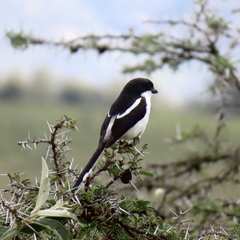
The northern fiscal (Lanius humeralis) is a member of the shrike family found through most of Sub-Saharan Africa. It used to be grouped with the southern fiscal (Lanius collaris). Together they were called the common fiscal. The fiscal gets its English and Afrikaans common names from its black and white 'suit-and-tie' appearance reminiscent of the taxman (‘fiscal’).

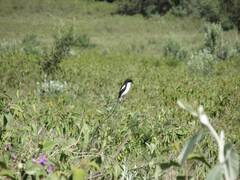
This is a fairly distinctive 21–23 cm long passerine with white underparts and black upperparts extending from the top of the head down to the tail. The bird has a characteristic white 'V' on the back and a relatively long black tail with white outer feathers and white tips on the other feathers. The bill, eyes and legs are black. Adult male and female northern fiscals are quite similar except for the rufous lower flank of the female. Wikipedia →

Sounds

Call0:54

Kenya · 2026

© Ding Li Yong · XC1176972 · CC BY-NC-ND 4.0

Song0:24

Kenya · 2020

© isaac kilusu · XC606231 · CC BY-NC-SA 4.0

Song0:39

Ethiopia · 2019

© Oscar Campbell · XC474302 · CC BY-NC-SA 4.0

Global Distribution

Parks Where Found

# Park Country Daily sighting probability
1 Arusha National Park 🇹🇿 Tanzania
~60%
2 Nairobi National Park 🇰🇪 Kenya
~40%
3 Ngorongoro Conservation Area 🇹🇿 Tanzania
~40%
4 Lake Manyara National Park 🇹🇿 Tanzania
~30%
5 Aberdare National Park 🇰🇪 Kenya
~30%
6 Masai Mara National Reserve 🇰🇪 Kenya
~30%
7 Lake Nakuru National Park 🇰🇪 Kenya
~30%
8 Volcanoes National Park 🇷🇼 Rwanda
~20%
9 Queen Elizabeth National Park 🇺🇬 Uganda
~20%
10 Kibale National Park 🇺🇬 Uganda
~10%
11 Tarangire National Park 🇹🇿 Tanzania
~10%
12 Virunga National Park 🇨🇩 Democratic Republic of the Congo
~10%
13 Akagera National Park 🇷🇼 Rwanda
~10%
14 Bale Mountains National Park 🇪🇹 Ethiopia
~10%
15 Mkomazi National Park 🇹🇿 Tanzania
~10%
16 Nyungwe National Park 🇷🇼 Rwanda
~10%
17 Serengeti National Park 🇹🇿 Tanzania
~10%
18 Amboseli National Park 🇰🇪 Kenya
~10%
19 Meru National Park 🇰🇪 Kenya
~10%
20 Bwindi Impenetrable National Park 🇺🇬 Uganda
<5%
21 Samburu National Reserve 🇰🇪 Kenya
<5%
22 Kafue National Park 🇿🇲 Zambia
<5%
23 Kidepo Valley National Park 🇺🇬 Uganda
<5%
24 Murchison Falls National Park 🇺🇬 Uganda
<5%
25 Lake Mburo National Park 🇺🇬 Uganda
<5%

Cities Where Found

# City Country Daily sighting probability
1 Bujumbura 🇧🇮 Burundi
~30%
2 Addis Ababa 🇪🇹 Ethiopia
~30%
3 Nairobi 🇰🇪 Kenya
~20%
4 Kigali 🇷🇼 Rwanda
~10%
5 Monrovia 🇱🇷 Liberia
~10%
6 Lubango 🇦🇴 Angola
~10%
7 Accra 🇬🇭 Ghana
<5%
8 Kampala 🇺🇬 Uganda
<5%

Before you go

What are the chances of seeing a Northern Fiscal in Queen Elizabeth National Park?

Possible

About 20% of wildlife watchers report a Northern Fiscal sighting in Queen Elizabeth National Park on a given day, based on 297 verified sightings from GBIF citizen-science data from 2019 to 2026. It is the 97th most-seen of the 434 birds we can rate there. Over three days the chance rises to about 50%, and over a week to about 80%, if each day is a fresh chance.

When is the best time to see a Northern Fiscal in Queen Elizabeth National Park?

December

In that month about 30% of wildlife watchers report a Northern Fiscal in Queen Elizabeth National Park on a given day, against about 10% in April and October, the lowest months.

What time of day is best to see a Northern Fiscal?

Between 8 and 11 am

Across all the parks we cover, that three-hour window holds the most Northern Fiscal sightings with a recorded time, and about 8 in 10 of them come between 6 am and 6 pm: it is a daytime animal.

Where does the Northern Fiscal sighting chance come from?

GBIF citizen-science records

It is estimated from how often the Northern Fiscal is recorded against all the birds logged in Queen Elizabeth National Park (297 verified sightings from 2019 to 2026), calibrated against known sighting rates. Figures are rounded to the nearest 10% because citizen-science data supports honest approximations, not decimals, and months with records from fewer than five people show "—". How it works.

← Back to Queen Elizabeth National Park