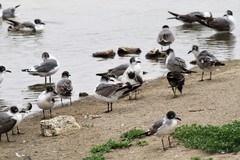
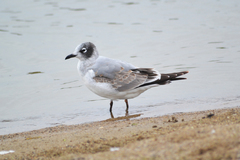
Franklin's Gull

Franklin's Gull

Leucophaeus pipixcan

Silhouette: Kai Caspar · PhyloPic

Daily sighting probability <5% · Rare
at Ría Lagartos Biosphere Reserve

In 3 days <5% in a week ~10%

16 Verified sightings at Ría Lagartos Biosphere Reserve From 2019 to 2026
2,587 In all 24 parks
October Best month
☀️ Diurnal When it's spotted

About the Franklin's Gull

Franklin's gull (Leucophaeus pipixcan) is a small (length 12.6–14.2 in, 32–36 cm) gull. The genus name Leucophaeus is from Ancient Greek leukos, "white", and phaios, "dusky". The specific pipixcan is a Nahuatl name for a type of gull. The English common name was given to commemorate the arctic explorer Sir John Franklin, who led an expedition in 1825 on which the type was collected.

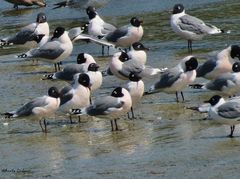
It breeds in central provinces of Canada and adjacent states of the northern United States. It is a migratory bird, wintering in Argentina, the Caribbean, Chile, and Peru. The summer adult's body is white and its back and wings are much darker grey than all other gulls of similar size except the larger laughing gull. The wings have black tips with an adjacent white band. The bill and legs are red. The black hood of the breeding adult is mostly lost in winter.

Young birds are similar to the adult but have less developed hoods and lack the white wing band. They take three years to reach maturity. Measurements: Length: 12.6–14.2 in (32–36 cm) Weight: 8.1–10.6 oz (230–300 g) Wingspan: 33.5–37.4 in (85–95 cm) Although the bird is uncommon on the coasts of North America,... Wikipedia →

Sounds

Call0:05

Chile · 2020

© Dante Buzzetti · XC534303 · CC BY-NC-SA 4.0

Flight call0:13

United States · 2015

© Paul Marvin · XC282852 · CC BY-NC-SA 4.0

Call0:10

Ecuador · 2003

© John V. Moore · XC257579 · CC BY-NC-SA 4.0

Global Distribution

Parks Where Found

# Park Country Daily sighting probability
1 Elk Island National Park 🇨🇦 Canada
~50%
2 Riding Mountain National Park 🇨🇦 Canada
~30%
3 Isla del Coco National Park 🇨🇷 Costa Rica
~20%
4 Utría National Natural Park 🇨🇴 Colombia
~10%
5 Galápagos Islands 🇪🇨 Ecuador
~10%
6 Celestún Biosphere Reserve 🇲🇽 Mexico
~10%
7 Padre Island National Seashore 🇺🇸 United States
~10%
8 Cabo Blanco Absolute Nature Reserve 🇨🇷 Costa Rica
<5%
9 Machalilla National Park 🇪🇨 Ecuador
<5%
10 Carara National Park 🇨🇷 Costa Rica
<5%
11 Palo Verde National Park 🇨🇷 Costa Rica
<5%
12 Bastimentos Island National Marine Park 🇵🇦 Panama
<5%
13 Ría Lagartos Biosphere Reserve 🇲🇽 Mexico
<5%
14 Marino Ballena National Park 🇨🇷 Costa Rica
<5%
15 Yellowstone National Park 🇺🇸 United States
<5%
16 Tierra del Fuego National Park 🇦🇷 Argentina
<5%
17 Grand Teton National Park 🇺🇸 United States
<5%
18 La Amistad International Park (Panama) 🇵🇦 Panama
<5%
19 Rocky Mountain National Park 🇺🇸 United States
<5%
20 Channel Islands National Park 🇺🇸 United States
<5%
21 Soberanía National Park 🇵🇦 Panama
<5%
22 Great Bear Rainforest 🇨🇦 Canada
<5%
23 Acadia National Park 🇺🇸 United States
<5%
24 Point Pelee National Park 🇨🇦 Canada
<5%

Cities Where Found

# City Country Daily sighting probability
1 Calgary 🇨🇦 Canada
~30%
2 Lima 🇵🇪 Peru
~30%
3 Edmonton 🇨🇦 Canada
~20%
4 Panama City 🇵🇦 Panama
~10%
5 Dallas 🇺🇸 United States
~10%
6 León 🇲🇽 México
~10%
7 Salt Lake City 🇺🇸 United States
<5%
8 Austin 🇺🇸 United States
<5%
9 Denver 🇺🇸 United States
<5%
10 Havana 🇨🇺 Cuba
<5%

Zoos & Centres Where Found

# Zoo / Centre Country
1 Abilene Zoological Gardens 🇺🇸 United States In captivity
2 Cameron Park Zoo 🇺🇸 United States In captivity
3 The Abilene Zoo 🇺🇸 United States In captivity
4 Albuquerque Aquarium 🇺🇸 United States In captivity
5 Rio Grande Botanic Garden 🇺🇸 United States In captivity

Before you go

What are the chances of seeing a Franklin's Gull in Ría Lagartos Biosphere Reserve?

Rare

Under 5% of wildlife watchers report a Franklin's Gull sighting in Ría Lagartos Biosphere Reserve on a given day, based on 16 verified sightings from GBIF citizen-science data from 2019 to 2026. It is the 164th most-seen of the 216 birds we can rate there. Over three days the chance rises to under 5%, and over a week to about 10%, if each day is a fresh chance.

When is the best time to see a Franklin's Gull in Ría Lagartos Biosphere Reserve?

Any time of year

In every month with enough records, under 5% of wildlife watchers report a Franklin's Gull in Ría Lagartos Biosphere Reserve on a given day, so our monthly data shows no clear season.

What time of day is best to see a Franklin's Gull?

Between 10 am and 1 pm

Across all the parks we cover, that three-hour window holds the most Franklin's Gull sightings with a recorded time, and about 9 in 10 of them come between 6 am and 6 pm: it is a daytime animal.

Where does the Franklin's Gull sighting chance come from?

GBIF citizen-science records

It is estimated from how often the Franklin's Gull is recorded against all the birds logged in Ría Lagartos Biosphere Reserve (16 verified sightings from 2019 to 2026), calibrated against known sighting rates. Figures are rounded to the nearest 10% because citizen-science data supports honest approximations, not decimals, and months with records from fewer than five people show "—". How it works.

← Back to Ría Lagartos Biosphere Reserve