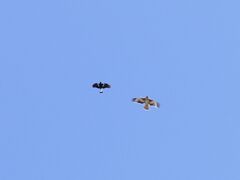
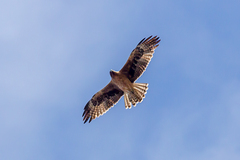
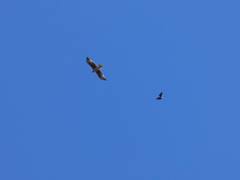
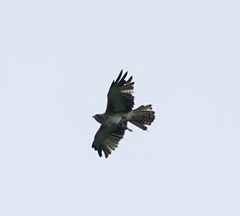
About the Little Eagle
The little eagle (Hieraaetus morphnoides) is a very small eagle endemic to Australia. John Gould described the little eagle in 1841. The distinctive pygmy eagle has long been considered a subspecies, but a 2009 genetic study shows it to be distinctive genetically and warrants species status. It is a near relative of both the Palearctic booted eagle and the massive but now extinct Haast's eagle of New Zealand.
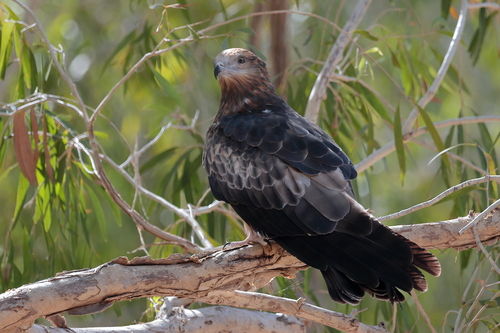
The little eagle is a medium-sized bird of prey, measuring 45–55 cm (17–21.5 inches) in length and weighing 815 g (1.8 lb), roughly the size of a peregrine falcon. It has fully feathered legs and a square-cut, barred tail. Wingspan is about 120 cm with males having longer wings in proportion to their bodies, but being nearly half the weight of females. It is a powerful bird and during flight has strong wing beats, glides on flat wings and soars on slightly raised or flat wings.
The little eagle occurs in light and dark colour forms and generally these colours change with age. The most common is the light form which is dark brown occurring on the back and wings with black streaks on the head and neck, and a sandy to pale under body. The dark form... Wikipedia →