Red Bishop

Red Bishop

Euplectes orix

Silhouette: Sheatherius · PhyloPic

LCLeast ConcernNTVUENCR
Daily sighting probability ~10% · With luck
at Serengeti National Park

In 3 days ~20% in a week ~40%

250 Verified sightings at Serengeti National Park From 2019 to 2026
3,407 In all 32 parks
March Best month
☀️ Diurnal When it's spotted

About the Red Bishop

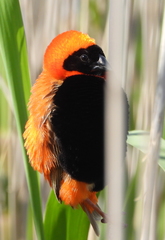
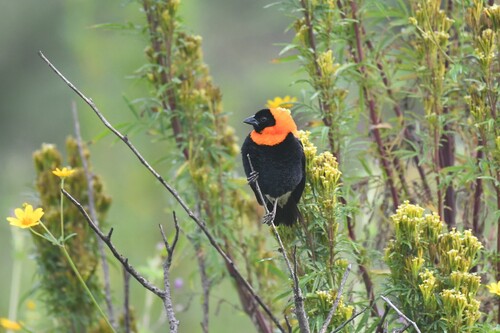
The southern red bishop or red bishop (Euplectes orix) is a small passerine bird belonging to the bishop and widowbird genus Euplectes in the weaver family, the Ploceidae. It is common in wetlands and grassland in Africa south of the Equator. North of the Equator, it is replaced by the northern red bishop or orange bishop (E. franciscanus) which was formerly regarded as a subspecies of this species.

In 1751 the English naturalist George Edwards included an illustration and a description of the southern red bishop in the fourth volume of his A Natural History of Uncommon Birds. He used the English name "The Grenadier". Edwards based his hand-coloured etching on a live bird kept at the home of George Shelvocke in Greenwich. Edwards was told that the bird had come from Angola. When in 1758 the Swedish naturalist Carl Linnaeus updated his Systema Naturae for the tenth edition, he placed the southern red bishop with the buntings in the genus Emberiza. Linnaeus included a brief description, coined the binomial name Emberiza orix and cited Edwards' work. The southern red bishop is now one of 17 species placed in the genus Euplectes that was introduced in 1829 by the English... Wikipedia →

Sounds

Song0:30

South Africa · 2022

© Lynette Rudman · XC758154 · CC BY-NC-SA 4.0

Call0:17

South Africa · 2021

© Tony Archer · XC694845 · CC BY-NC-SA 4.0

Song0:31

Burundi · 2020

© Bram Piot · XC524477 · CC BY-NC-SA 4.0

Global Distribution

Parks Where Found

# Park Country Daily sighting probability
1 Golden Gate Highlands National Park 🇿🇦 South Africa
~50%
2 Queen Elizabeth National Park 🇺🇬 Uganda
~30%
3 De Hoop Nature Reserve 🇿🇦 South Africa
~20%
4 Addo Elephant National Park 🇿🇦 South Africa
~20%
5 Ngorongoro Conservation Area 🇹🇿 Tanzania
~10%
6 Lake Manyara National Park 🇹🇿 Tanzania
~10%
7 Ruaha National Park 🇹🇿 Tanzania
~10%
8 West Coast National Park 🇿🇦 South Africa
~10%
9 South Luangwa National Park 🇿🇲 Zambia
~10%
10 Tarangire National Park 🇹🇿 Tanzania
~10%
11 Kruger National Park 🇿🇦 South Africa
~10%
12 Pilanesberg National Park 🇿🇦 South Africa
~10%
13 Kibale National Park 🇺🇬 Uganda
~10%
14 Lake Mburo National Park 🇺🇬 Uganda
~10%
15 Serengeti National Park 🇹🇿 Tanzania
~10%
16 Liwonde National Park 🇲🇼 Malawi
~10%
17 Amboseli National Park 🇰🇪 Kenya
~10%
18 iSimangaliso Wetland Park 🇿🇦 South Africa
~10%
19 uMkhuze Game Reserve 🇿🇦 South Africa
~10%
20 Hluhluwe-Imfolozi Park 🇿🇦 South Africa
~10%
21 Akagera National Park 🇷🇼 Rwanda
<5%
22 Hwange National Park 🇿🇼 Zimbabwe
<5%
23 Chobe National Park 🇧🇼 Botswana
<5%
24 Gorongosa National Park 🇲🇿 Mozambique
<5%
25 Mkomazi National Park 🇹🇿 Tanzania
<5%
26 Garden Route National Park 🇿🇦 South Africa
<5%
27 Mikumi National Park 🇹🇿 Tanzania
<5%
28 Virunga National Park 🇨🇩 Democratic Republic of the Congo
<5%
29 Mana Pools National Park 🇿🇼 Zimbabwe
<5%
30 Etosha National Park 🇳🇦 Namibia
<5%
31 Tsavo West National Park 🇰🇪 Kenya
<5%
32 Table Mountain National Park 🇿🇦 South Africa
<5%

Cities Where Found

# City Country Daily sighting probability
1 Johannesburg 🇿🇦 South Africa
~30%
2 Pretoria 🇿🇦 South Africa
~30%
3 Harare 🇿🇼 Zimbabwe
~20%
4 Maputo 🇲🇿 Mozambique
~20%
5 Durban 🇿🇦 South Africa
~20%
6 Kigali 🇷🇼 Rwanda
~10%
7 Abu Dhabi 🇦🇪 United Arab Emirates
~10%
8 Cape Town 🇿🇦 South Africa
~10%
9 Lubango 🇦🇴 Angola
~10%
10 Lusaka 🇿🇲 Zambia
<5%

Zoos & Centres Where Found

# Zoo / Centre Country
1 Cheyenne Mountain Zoo 🇺🇸 United States In captivity
2 Warsaw Zoo 🇵🇱 Poland In captivity
3 Temaikén 🇦🇷 Argentina In captivity
4 Halls Gap Zoo 🇦🇺 Australia In captivity
5 Bloedel Conservatory 🇨🇦 Canada In captivity
6 herpetarium warszawskiego ZOO 🇵🇱 Poland In captivity
7 akwarium warszawskiego ZOO 🇵🇱 Poland In captivity
8 Limburg Zoo 🇧🇪 Belgium In captivity

Before you go

What are the chances of seeing a Red Bishop in Serengeti National Park?

With luck

About 10% of wildlife watchers report a Red Bishop sighting in Serengeti National Park on a given day, based on 250 verified sightings from GBIF citizen-science data from 2019 to 2026. It is the 186th most-seen of the 469 birds we can rate there. Over three days the chance rises to about 20%, and over a week to about 40%, if each day is a fresh chance.

When is the best time to see a Red Bishop in Serengeti National Park?

February to April

In those months about 20% of wildlife watchers report a Red Bishop in Serengeti National Park on a given day, against under 5% in May to December, the lowest months. Those are among Serengeti National Park's wettest months, with about 95 mm of rain a month against 5 mm in July.

What time of day is best to see a Red Bishop?

Between 9 am and noon

Across all the parks we cover, that three-hour window holds the most Red Bishop sightings with a recorded time, and about 9 in 10 of them come between 6 am and 6 pm: it is a daytime animal.

Which relatives of the Red Bishop live in Serengeti National Park?

Same genus: Euplectes

The closest relatives of the Red Bishop that you can see in Serengeti National Park (genus Euplectes, Bishops and Widowbirds) are White-winged Widowbird (about 10%) and Fan-tailed Widowbird (about 10%), with each one's daily chance of a sighting.

Where does the Red Bishop sighting chance come from?

GBIF citizen-science records

It is estimated from how often the Red Bishop is recorded against all the birds logged in Serengeti National Park (250 verified sightings from 2019 to 2026), calibrated against known sighting rates. Figures are rounded to the nearest 10% because citizen-science data supports honest approximations, not decimals, and months with records from fewer than five people show "—". How it works.

← Back to Serengeti National Park