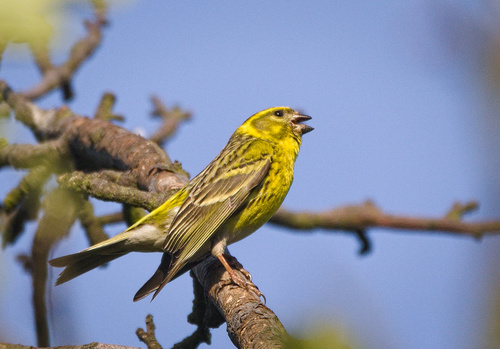
Great Reed-Warbler

Great Reed-Warbler

Acrocephalus arundinaceus

Silhouette: Yves Hoebeke · PhyloPic

LCLeast ConcernNTVUENCR
Daily sighting probability <5% · Rare
at Sierra Nevada National Park

In 3 days ~10% in a week ~20%

24 Verified sightings at Sierra Nevada National Park From 2019 to 2026
2,564 In all 14 parks
May Best month
☀️ Diurnal When it's spotted

About the Great Reed-Warbler

The great reed warbler (Acrocephalus arundinaceus) is an insectivorous bird in the family Acrocephalidae. It is a medium-sized passerine bird and the largest of the warblers. It breeds throughout mainland Europe and the Western Palearctic and migrates to sub-Saharan Africa in the winter. It favours reed beds during the breeding season, while living in reed beds, bush thickets, rice fields, and forest clearings during the winter. It exhibits relatively low sexual dimorphism, and the sexes are similar in appearance. This species mates both polygynously and monogamously.

The great reed warbler was formally described in 1758 by the Swedish naturalist Carl Linnaeus in the tenth edition of his Systema Naturae. He placed it with the thrushes in the genus Turdus and coined the binomial name Turdus arundinaceus. He specified the type locality as Northern Europe. Linnaeus based his entry on the Turdus musicus palustris or Bruch Beiden Rohr Drossel that had been described in 1750 by the German naturalist Jacob Theodor Klein in his book Historiae avium prodromus. The specific epithet arundinaceus is Latin meaning "like a reed" (hence "of the reeds"), from arundo, arundinis meaning... Wikipedia →

Sounds

Song1:05

Sweden · 2026

© Dag Österlund · XC1138129 · CC BY-NC-SA 4.0

Alarm call0:31

Ukraine · 2024

© Мітла Андрій Володимирович · XC914697 · CC BY-NC-SA 4.0

Call0:50

Kazakhstan · 2023

© Peter Boesman · XC813202 · CC BY-NC-ND 4.0

Global Distribution

Parks Where Found

# Park Country Daily sighting probability
1 Fertő-Hanság National Park 🇭🇺 Hungary
~40%
2 Białowieża National Park 🇵🇱 Poland
~30%
3 Kiskunság National Park 🇭🇺 Hungary
~30%
4 Hortobágy National Park 🇭🇺 Hungary
~20%
5 Biebrza National Park 🇵🇱 Poland
~20%
6 Camargue 🇫🇷 France
~10%
7 Monfragüe National Park 🇪🇸 Spain
~10%
8 Bavarian Forest National Park 🇩🇪 Germany
~10%
9 Doñana National Park 🇪🇸 Spain
~10%
10 Sierra Nevada National Park 🇪🇸 Spain
<5%
11 Tsavo West National Park 🇰🇪 Kenya
<5%
12 Nairobi National Park 🇰🇪 Kenya
<5%
13 Wadden Sea National Park 🇩🇪 Germany
<5%
14 Kruger National Park 🇿🇦 South Africa
<5%

Cities Where Found

# City Country Daily sighting probability
1 Yerevan 🇦🇲 Armenia
~10%
2 Kuwait City 🇰🇼 Kuwait
~10%
3 Kyiv 🇺🇦 Ukraine
~10%
4 Budapest 🇭🇺 Hungary
~10%
5 Abu Dhabi 🇦🇪 United Arab Emirates
~10%
6 Bucharest 🇷🇴 Romania
~10%
7 Antalya 🇹🇷 Turkey
~10%
8 Jerusalem 🇮🇱 Israel
<5%
9 Turin 🇮🇹 Italy
<5%
10 Doha 🇶🇦 Qatar
<5%

Before you go

What are the chances of seeing a Great Reed-Warbler in Sierra Nevada National Park?

Rare

Under 5% of wildlife watchers report a Great Reed-Warbler sighting in Sierra Nevada National Park on a given day, based on 24 verified sightings from GBIF citizen-science data from 2019 to 2026. It is the 119th most-seen of the 153 birds we can rate there. Over three days the chance rises to about 10%, and over a week to about 20%, if each day is a fresh chance.

When is the best time to see a Great Reed-Warbler in Sierra Nevada National Park?

May

In that month about 10% of wildlife watchers report a Great Reed-Warbler in Sierra Nevada National Park on a given day, against under 5% in June to April, the lowest months.

What time of day is best to see a Great Reed-Warbler?

Between 7 and 10 am

Across all the parks we cover, that three-hour window holds the most Great Reed-Warbler sightings with a recorded time, and about 9 in 10 of them come between 6 am and 6 pm: it is a daytime animal.

Where does the Great Reed-Warbler sighting chance come from?

GBIF citizen-science records

It is estimated from how often the Great Reed-Warbler is recorded against all the birds logged in Sierra Nevada National Park (24 verified sightings from 2019 to 2026), calibrated against known sighting rates. Figures are rounded to the nearest 10% because citizen-science data supports honest approximations, not decimals, and months with records from fewer than five people show "—". How it works.

← Back to Sierra Nevada National Park