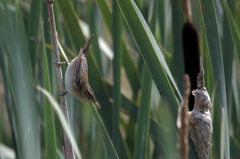
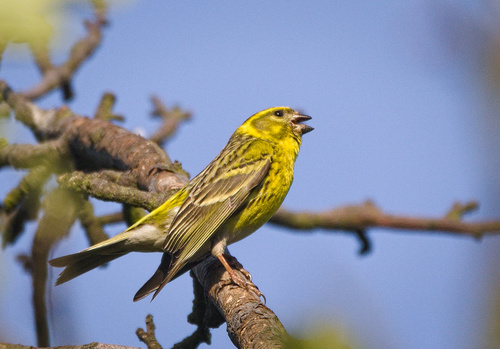
Sedge Warbler

Sedge Warbler

Acrocephalus schoenobaenus

Silhouette: Yves Hoebeke · PhyloPic

LCLeast ConcernNTVUENCR
Daily sighting probability <5% · Rare
at Sierra Nevada National Park

In 3 days ~10%

21 Verified sightings at Sierra Nevada National Park From 2019 to 2026
4,103 In all 20 parks
March Best month
☀️ Diurnal When it's spotted

About the Sedge Warbler

The sedge warbler (Acrocephalus schoenobaenus) is an Old World warbler in the genus Acrocephalus. It is a medium-sized warbler with a brown, streaked back and wings and a distinct pale supercilium. Sedge warblers are migratory, crossing the Sahara to get from their European and Asian breeding grounds to spend winter in Africa. The male's song is composed of random chattering phrases and can include mimicry of other species. The sedge warbler is mostly insectivorous.

The sedge warbler was formally described by the Swedish naturalist Carl Linnaeus in 1758 in the tenth edition of his Systema Naturae under the binomial name Motacilla schoenobaenus. The species is now placed in the genus Acrocephalus that was introduced in 1811 by Johann Andreas Naumann and his son Johann Friedrich Naumann. British ornithologists did not distinguish the species from the common reed warbler until the 18th century. The genus name Acrocephalus is from Ancient Greek akros, "highest", and kephale, "head". It is possible that the Naumanns thought akros meant "sharp-pointed". The specific schoenobaenus is from Ancient Greek skhoinos, "reed", and baino, "to tread". It is a translation of the old Swedish... Wikipedia →

Sounds

Song0:35

France · 2026

© SWIFT Olivier · XC1156376 · CC BY-NC 4.0

Call-song0:21

Russian Federation · 2017

© Albert Lastukhin · XC1007235 · CC BY-NC-ND 4.0

Call0:59

Sweden · 2023

© Thomas Bergman · XC819502 · CC BY-NC-SA 4.0

Global Distribution

Parks Where Found

# Park Country Daily sighting probability
1 Biebrza National Park 🇵🇱 Poland
~50%
2 Fertő-Hanság National Park 🇭🇺 Hungary
~40%
3 Białowieża National Park 🇵🇱 Poland
~40%
4 Hortobágy National Park 🇭🇺 Hungary
~40%
5 Kiskunság National Park 🇭🇺 Hungary
~30%
6 Snowdonia National Park 🇬🇧 United Kingdom
~10%
7 Wadden Sea National Park 🇩🇪 Germany
~10%
8 Bavarian Forest National Park 🇩🇪 Germany
~10%
9 Doñana National Park 🇪🇸 Spain
<5%
10 Cairngorms National Park 🇬🇧 United Kingdom
<5%
11 Sierra Nevada National Park 🇪🇸 Spain
<5%
12 Monfragüe National Park 🇪🇸 Spain
<5%
13 Amboseli National Park 🇰🇪 Kenya
<5%
14 Gauja National Park 🇱🇻 Latvia
<5%
15 Tsavo West National Park 🇰🇪 Kenya
<5%
16 Nairobi National Park 🇰🇪 Kenya
<5%
17 Serengeti National Park 🇹🇿 Tanzania
<5%
18 Chobe National Park 🇧🇼 Botswana
<5%
19 Lake Nakuru National Park 🇰🇪 Kenya
<5%
20 Camargue 🇫🇷 France
<5%

Cities Where Found

# City Country Daily sighting probability
1 Brazzaville 🇨🇬 Republic of the Congo
~30%
2 Helsinki 🇫🇮 Finland
~20%
3 Jerusalem 🇮🇱 Israel
~20%
4 Dakar 🇸🇳 Senegal
~10%
5 Minsk 🇧🇾 Belarus
~10%
6 Saint Petersburg 🇷🇺 Russia
~10%
7 Rotterdam [The Hague] 🇳🇱 Netherlands
~10%
8 Beirut 🇱🇧 Lebanon
~10%
9 Nizhny Novgorod 🇷🇺 Russia
~10%
10 Antalya 🇹🇷 Turkey
~10%

Before you go

What are the chances of seeing a Sedge Warbler in Sierra Nevada National Park?

Rare

Under 5% of wildlife watchers report a Sedge Warbler sighting in Sierra Nevada National Park on a given day, based on 21 verified sightings from GBIF citizen-science data from 2019 to 2026. It is the 121st most-seen of the 153 birds we can rate there. Over three days the chance rises to about 10%, if each day is a fresh chance.

When is the best time to see a Sedge Warbler in Sierra Nevada National Park?

March and April

In those months about 10% of wildlife watchers report a Sedge Warbler in Sierra Nevada National Park on a given day, against under 5% in May to February, the lowest months. Those are among Sierra Nevada National Park's wettest months, with about 100 mm of rain a month against 30 mm in July.

What time of day is best to see a Sedge Warbler?

Between 7 and 10 am

Across all the parks we cover, that three-hour window holds the most Sedge Warbler sightings with a recorded time, and about 9 in 10 of them come between 6 am and 6 pm: it is a daytime animal.

Where does the Sedge Warbler sighting chance come from?

GBIF citizen-science records

It is estimated from how often the Sedge Warbler is recorded against all the birds logged in Sierra Nevada National Park (21 verified sightings from 2019 to 2026), calibrated against known sighting rates. Figures are rounded to the nearest 10% because citizen-science data supports honest approximations, not decimals, and months with records from fewer than five people show "—". How it works.

← Back to Sierra Nevada National Park