
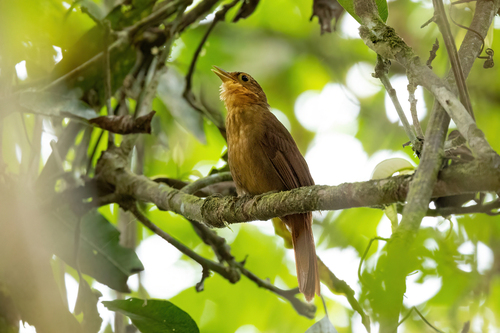
Scaly-throated Leaftosser

Scaly-throated Leaftosser

Sclerurus guatemalensis

Silhouette: Sheatherius · PhyloPic

LCLeast ConcernNTVUENCR
Daily sighting probability <5% · Rare
at Soberanía National Park

In 3 days ~10% in a week ~30%

470 Verified sightings at Soberanía National Park From 2019 to 2026
1,099 In all 13 parks
October Best month
☀️ Diurnal When it's spotted

About the Scaly-throated Leaftosser

The scaly-throated leaftosser (Sclerurus guatemalensis) is a species of bird in subfamily Sclerurinae, the leaftossers and miners, of the ovenbird family Furnariidae. It is found in Mexico, every Central American country except El Salvador, and in Colombia and Ecuador.

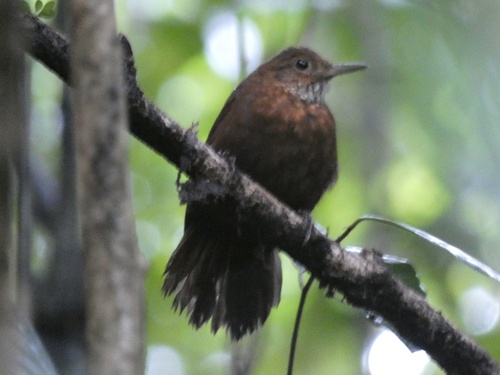
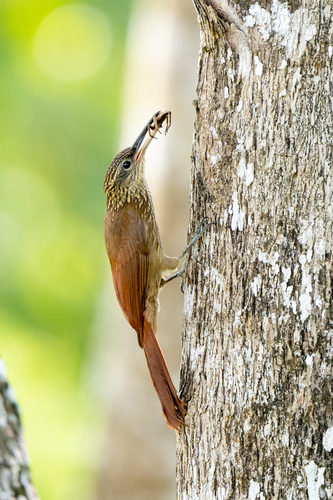
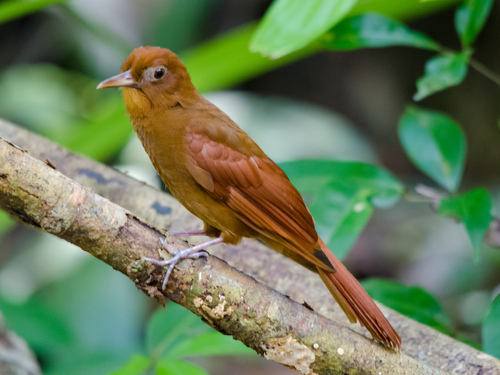
The scaly throated and black-tailed leaftossers (S. caudacutus) are sister species. The scaly-throated leaftosser is 16.5 to 18 cm (6.5 to 7.1 in) long and weighs about 35 g (1.2 oz). The sexes are alike. Adults of the nominate subspecies have a dark brown crown and nape with a scalloped appearance. Their back is dark brown, their rump and uppertail coverts reddish brown, and their tail is a darker brown than their back. Their flight feathers are dusky. Their face is shades of brown. Their chin and throat feathers are whitish with darker margins that give a scaly appearance. The sides of their neck and their upper breast are tawny brown and the rest of their breast is dull reddish brown with... Wikipedia →

Sounds

Call1:00

Ecuador · 2025

© Charlie Vogt · XC1054109 · CC BY-NC-SA 4.0

Song0:04

Panama · 2020

© Kent Livezey · XC610430 · CC BY-NC-ND 4.0

Alarm call0:57

Ecuador · 2014

© Jerome Fischer · XC205279 · CC BY-NC-SA 4.0

Global Distribution

Parks Where Found

# Park Country Daily sighting probability
1 Tikal National Park 🇬🇹 Guatemala
<5%
2 Darién National Park 🇵🇦 Panama
<5%
3 Soberanía National Park 🇵🇦 Panama
<5%
4 Carara National Park 🇨🇷 Costa Rica
<5%
5 Corcovado National Park 🇨🇷 Costa Rica
<5%
6 Chagres National Park 🇵🇦 Panama
<5%
7 Piedras Blancas National Park 🇨🇷 Costa Rica
<5%
8 Cockscomb Basin Wildlife Sanctuary 🇧🇿 Belize
<5%
9 Bastimentos Island National Marine Park 🇵🇦 Panama
<5%
10 La Amistad International Park (Panama) 🇵🇦 Panama
<5%
11 Arenal Volcano National Park 🇨🇷 Costa Rica
<5%
12 Braulio Carrillo National Park 🇨🇷 Costa Rica
<5%
13 Tapantí-Macizo de la Muerte National Park 🇨🇷 Costa Rica
<5%

Before you go

What are the chances of seeing a Scaly-throated Leaftosser in Soberanía National Park?

Rare

Under 5% of wildlife watchers report a Scaly-throated Leaftosser sighting in Soberanía National Park on a given day, based on 470 verified sightings from GBIF citizen-science data from 2019 to 2026. It is the 229th most-seen of the 449 birds we can rate there. Over three days the chance rises to about 10%, and over a week to about 30%, if each day is a fresh chance.

When is the best time to see a Scaly-throated Leaftosser in Soberanía National Park?

September to November

In those months about 10% of wildlife watchers report a Scaly-throated Leaftosser in Soberanía National Park on a given day, against under 5% in December to August, the lowest months. Those are among Soberanía National Park's wettest months, with about 330 mm of rain a month against 25 mm in February.

What time of day is best to see a Scaly-throated Leaftosser?

Between 7 and 10 am

Across all the parks we cover, that three-hour window holds the most Scaly-throated Leaftosser sightings with a recorded time, and about 8 in 10 of them come between 6 am and 6 pm: it is a daytime animal.

Is Soberanía National Park the best place to see a Scaly-throated Leaftosser?

Among the best

Of the 13 parks where we can rate Scaly-throated Leaftosser sightings, Soberanía National Park ranks 3rd at under 5%, level with the leaders once rounded. The best odds are in Tikal National Park (Guatemala, under 5%) and Darién National Park (Panama, under 5%).

Where does the Scaly-throated Leaftosser sighting chance come from?

GBIF citizen-science records

It is estimated from how often the Scaly-throated Leaftosser is recorded against all the birds logged in Soberanía National Park (470 verified sightings from 2019 to 2026), calibrated against known sighting rates. Figures are rounded to the nearest 10% because citizen-science data supports honest approximations, not decimals, and months with records from fewer than five people show "—". How it works.

← Back to Soberanía National Park