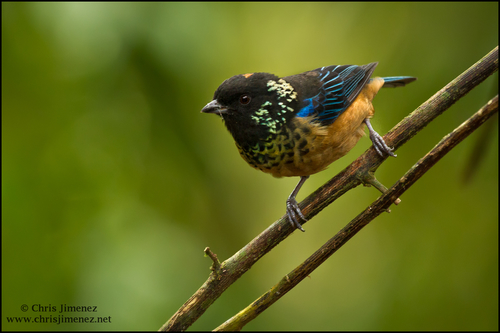
Silver-throated Tanager

Silver-throated Tanager

Tangara icterocephala

Silhouette: Sheatherius · PhyloPic

LCLeast ConcernNTVUENCR
Daily sighting probability ~20% · Possible
at Tapantí-Macizo de la Muerte National Park

In 3 days ~60% in a week ~80%

2,527 Verified sightings at Tapantí-Macizo de la Muerte National Park From 2019 to 2026
27,277 In all 15 parks
October Best month
☀️ Diurnal When it's spotted

About the Silver-throated Tanager

The silver-throated tanager (Tangara icterocephala) is a species of passerine bird in the tanager family Thraupidae. It is found in Costa Rica, Panama, Colombia, Ecuador, and northeastern Peru. It inhabits mossy forests, montane forests, tropical lowland evergreen forests and forest edges, along with tall secondary forests and disturbed habitat with remnant trees and forest. It is 13 centimetres (5.1 in) long and weighs 22 grams (0.78 oz) on average, and shows slight sexual dimorphism, with duller female plumage. Adult males are mainly bright yellow, with a silvery-white throat bordered above with a black stripe on the cheeks, black streaking on the back, and green edges to the wings and tail. Juveniles are duller and greener.

The silver-throated tanager is omnivorous, and mainly feeds on fruits, especially melastomes, supplemented with arthropods. Breeding occurs from April–September, and two broods are raised in a single breeding season. Cup nests are built by females out of moss, leaves, and spider webs in forests or isolated trees. Eggs are laid in clutches of two and incubated by females. Nestlings leave the nest at around 15 days old. The silver-throated tanager is listed as being of least concern by the International Union for Conservation of Nature (IUCN) on the IUCN Red List, but is threatened by habitat destruction. Wikipedia →

Sounds

Call0:41

Ecuador · 2024

© Manuel Sánchez-Nivicela · XC1161652 · CC BY-NC-ND 4.0

Call0:42

Costa Rica · 2024

© Scott Olmstead · XC956767 · CC BY-NC-SA 4.0

Call0:06

Panama · 2021

© Daniel Errichetti · XC660845 · CC BY-NC-SA 4.0

Global Distribution

Parks Where Found

# Park Country Daily sighting probability
1 Poás Volcano National Park 🇨🇷 Costa Rica
~80%
2 Chirripó National Park 🇨🇷 Costa Rica
~60%
3 Farallones de Cali National Natural Park 🇨🇴 Colombia
~60%
4 Volcán Barú National Park 🇵🇦 Panama
~50%
5 Los Quetzales National Park 🇨🇷 Costa Rica
~40%
6 La Amistad International Park (Panama) 🇵🇦 Panama
~30%
7 Monteverde Cloud Forest Reserve 🇨🇷 Costa Rica
~30%
8 Braulio Carrillo National Park 🇨🇷 Costa Rica
~30%
9 Arenal Volcano National Park 🇨🇷 Costa Rica
~30%
10 Tapantí-Macizo de la Muerte National Park 🇨🇷 Costa Rica
~20%
11 Darién National Park 🇵🇦 Panama
~10%
12 Tenorio Volcano National Park 🇨🇷 Costa Rica
<5%
13 Piedras Blancas National Park 🇨🇷 Costa Rica
<5%
14 Chagres National Park 🇵🇦 Panama
<5%
15 Rincón de la Vieja National Park 🇨🇷 Costa Rica
<5%

Cities Where Found

# City Country Daily sighting probability
1 San José 🇨🇷 Costa Rica
<5%

Zoos & Centres Where Found

# Zoo / Centre Country
1 La Paz Waterfall Gardens 🇨🇷 Costa Rica In captivity

Before you go

What are the chances of seeing a Silver-throated Tanager in Tapantí-Macizo de la Muerte National Park?

Possible

About 20% of wildlife watchers report a Silver-throated Tanager sighting in Tapantí-Macizo de la Muerte National Park on a given day, based on 2,527 verified sightings from GBIF citizen-science data from 2019 to 2026. It is the 34th most-seen of the 467 birds we can rate there. Over three days the chance rises to about 60%, and over a week to about 80%, if each day is a fresh chance.

When is the best time to see a Silver-throated Tanager in Tapantí-Macizo de la Muerte National Park?

October

In that month about 40% of wildlife watchers report a Silver-throated Tanager in Tapantí-Macizo de la Muerte National Park on a given day, against about 20% in January to April, the lowest months. That is one of Tapantí-Macizo de la Muerte National Park's wettest months, with about 570 mm of rain against 160 mm in February.

What time of day is best to see a Silver-throated Tanager?

Between 8 and 11 am

Across all the parks we cover, that three-hour window holds the most Silver-throated Tanager sightings with a recorded time, and about 9 in 10 of them come between 6 am and 6 pm: it is a daytime animal.

Which relatives of the Silver-throated Tanager live in Tapantí-Macizo de la Muerte National Park?

Same genus: Tangara

The closest relatives of the Silver-throated Tanager that you can see in Tapantí-Macizo de la Muerte National Park (genus Tangara, Tangara Tanagers) are Bay-headed Tanager (about 20%), Emerald Tanager (about 10%) and Spangle-cheeked Tanager (about 10%), with each one's daily chance of a sighting.

Where does the Silver-throated Tanager sighting chance come from?

GBIF citizen-science records

It is estimated from how often the Silver-throated Tanager is recorded against all the birds logged in Tapantí-Macizo de la Muerte National Park (2,527 verified sightings from 2019 to 2026), calibrated against known sighting rates. Figures are rounded to the nearest 10% because citizen-science data supports honest approximations, not decimals, and months with records from fewer than five people show "—". How it works.

← Back to Tapantí-Macizo de la Muerte National Park