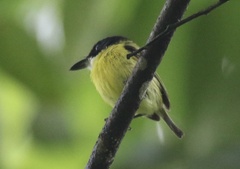

Black-headed Tody-Flycatcher

Black-headed Tody-Flycatcher

Todirostrum nigriceps

Silhouette: Emily Willoughby · PhyloPic

LCLeast ConcernNTVUENCR
Daily sighting probability <5% · Rare
at Tayrona National Natural Park

In 3 days <5% in a week ~10%

19 Verified sightings at Tayrona National Natural Park From 2019 to 2026
3,079 In all 17 parks
July Best month
☀️ Diurnal When it's spotted

About the Black-headed Tody-Flycatcher

The black-headed tody-flycatcher (Todirostrum nigriceps) is a species of bird in the family Tyrannidae. It is found in Colombia, Costa Rica, Ecuador, Panama, and Venezuela. Its natural habitat is subtropical or tropical moist lowland forests. It is a small, black and yellow, insectivorous bird.

Its call and song are composed of high pitched one-note chirps. Each vocalization is often confounded for the other. Its reproductive traits are not well documented but both parents contribute to building the nest and clutches only have one egg at a time. In 2021, the IUCN assessed its conservation status and deemed it of least concern.

The black-headed tody flycatcher is a small bird with a glossy black head and a white throat. The black coloring continues down the sides of the neck. It has bright yellow underparts and olive-yellow upperparts. The wings are black with two yellow wingbars and yellow streaking and the tail is short and black. Its head is relatively large, as is its straight black bill. It has dark irises and no eye-rings. Its legs are blueish-gray.

The females and males have the same coloring. Adults are between 8–10.2 cm long and weigh 6–6.5 g. Juveniles... Wikipedia →

Sounds

Song0:10

Panama · 2024

© Scott Olmstead · XC957249 · CC BY-NC-SA 4.0

Call0:15

Costa Rica · 2019

© Hans Matheve · XC517677 · CC BY-NC-ND 4.0

Song0:14

Colombia · 2020

© Julio Delgado · XC613859 · CC BY-NC-SA 4.0

Global Distribution

Parks Where Found

# Park Country Daily sighting probability
1 Tenorio Volcano National Park 🇨🇷 Costa Rica
~10%
2 Gandoca-Manzanillo Wildlife Refuge 🇨🇷 Costa Rica
~10%
3 San Lorenzo Protected Forest 🇵🇦 Panama
~10%
4 Darién National Park 🇵🇦 Panama
~10%
5 Soberanía National Park 🇵🇦 Panama
~10%
6 Cahuita National Park 🇨🇷 Costa Rica
~10%
7 Tapantí-Macizo de la Muerte National Park 🇨🇷 Costa Rica
~10%
8 Farallones de Cali National Natural Park 🇨🇴 Colombia
<5%
9 Arenal Volcano National Park 🇨🇷 Costa Rica
<5%
10 Braulio Carrillo National Park 🇨🇷 Costa Rica
<5%
11 Tortuguero National Park 🇨🇷 Costa Rica
<5%
12 La Amistad International Park (Panama) 🇵🇦 Panama
<5%
13 Tayrona National Natural Park 🇨🇴 Colombia
<5%
14 Bastimentos Island National Marine Park 🇵🇦 Panama
<5%
15 Parque Natural Metropolitano 🇵🇦 Panama
<5%
16 Chagres National Park 🇵🇦 Panama
<5%
17 Poás Volcano National Park 🇨🇷 Costa Rica
<5%

Before you go

What are the chances of seeing a Black-headed Tody-Flycatcher in Tayrona National Natural Park?

Rare

Under 5% of wildlife watchers report a Black-headed Tody-Flycatcher sighting in Tayrona National Natural Park on a given day, based on 19 verified sightings from GBIF citizen-science data from 2019 to 2026. It is the 195th most-seen of the 285 birds we can rate there. Over three days the chance rises to under 5%, and over a week to about 10%, if each day is a fresh chance.

When is the best time to see a Black-headed Tody-Flycatcher in Tayrona National Natural Park?

July

In that month about 10% of wildlife watchers report a Black-headed Tody-Flycatcher in Tayrona National Natural Park on a given day, against under 5% in August to June, the lowest months.

What time of day is best to see a Black-headed Tody-Flycatcher?

Between 7 and 10 am

Across all the parks we cover, that three-hour window holds the most Black-headed Tody-Flycatcher sightings with a recorded time, and about 9 in 10 of them come between 6 am and 6 pm: it is a daytime animal.

Where does the Black-headed Tody-Flycatcher sighting chance come from?

GBIF citizen-science records

It is estimated from how often the Black-headed Tody-Flycatcher is recorded against all the birds logged in Tayrona National Natural Park (19 verified sightings from 2019 to 2026), calibrated against known sighting rates. Figures are rounded to the nearest 10% because citizen-science data supports honest approximations, not decimals, and months with records from fewer than five people show "—". How it works.

← Back to Tayrona National Natural Park