
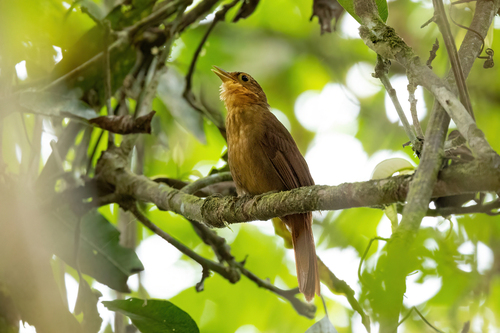
Tawny-winged Woodcreeper

Tawny-winged Woodcreeper

Dendrocincla anabatina

Silhouette: Sheatherius · PhyloPic

LCLeast ConcernNTVUENCR
Daily sighting probability ~20% · Possible
at Tikal National Park

In 3 days ~50% in a week ~80%

373 Verified sightings at Tikal National Park From 2019 to 2026
2,857 In all 15 parks
December Best month
☀️ Diurnal When it's spotted

About the Tawny-winged Woodcreeper

The tawny-winged woodcreeper (Dendrocincla anabatina) is a passerine bird in subfamily Dendrocolaptinae of the ovenbird family Furnariidae. It is found in Belize, Costa Rica, Guatemala, Honduras, Mexico, Nicaragua, and Panama.

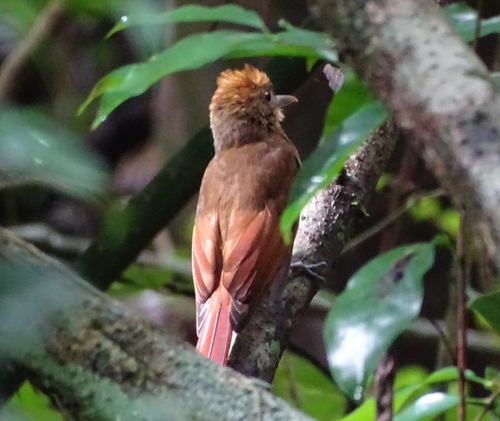
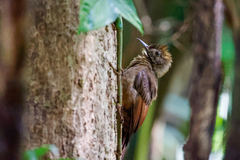
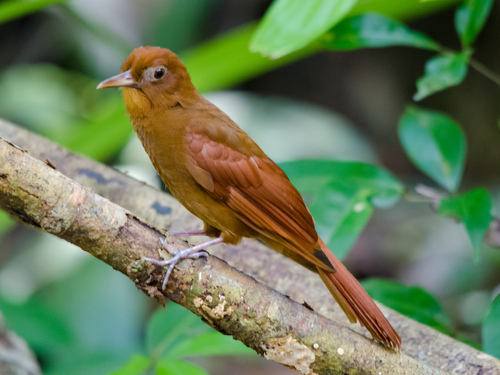
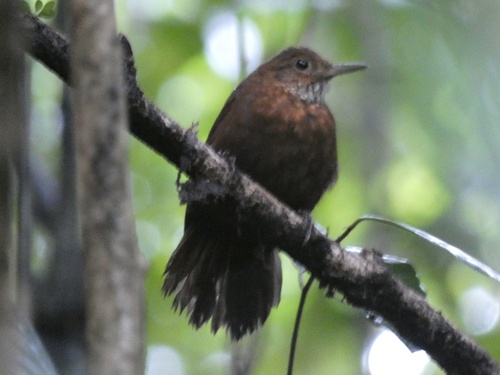
Some authors have merged saturata with the nominate but this treatment has not been widely accepted. The tawny-winged woodcreeper is 17 to 19 cm (6.7 to 7.5 in) long. Males of the nominate subspecies weigh 34 to 42 g (1.2 to 1.5 oz) and females 29 to 39 g (1.0 to 1.4 oz). The species is a medium-sized member of its genus, with a straight bill, a short tail, and a ruffled nape. The sexes have the same plumage. Adults of the nominate subspecies have a brown head with buffy supercilium and bare gray skin around the eye. Their crown, nape, and back are dark olive-brown and their uppertail coverts and tail are cinnamon-rufous to rufous-chestnut. Their wing coverts are dark olive-brown and their flight feathers tawny with dusky tips. Their throat is... Wikipedia →

Sounds

Call0:38

Costa Rica · 2023

© Scott Olmstead · XC863091 · CC BY-NC-SA 4.0

Song0:29

Costa Rica · 2010

© Peter Boesman · XC274029 · CC BY-NC-ND 4.0

Alarm call0:56

Mexico · 2019

© Manuel Grosselet · XC470052 · CC BY-NC-SA 4.0

Global Distribution

Parks Where Found

# Park Country Daily sighting probability
1 Tikal National Park 🇬🇹 Guatemala
~20%
2 Cockscomb Basin Wildlife Sanctuary 🇧🇿 Belize
~20%
3 Corcovado National Park 🇨🇷 Costa Rica
~20%
4 Calakmul Biosphere Reserve 🇲🇽 Mexico
~20%
5 Sian Ka'an Biosphere Reserve 🇲🇽 Mexico
~20%
6 Carara National Park 🇨🇷 Costa Rica
~10%
7 Piedras Blancas National Park 🇨🇷 Costa Rica
~10%
8 Montes Azules Biosphere Reserve 🇲🇽 Mexico
~10%
9 Biotopo Cerro Cahuí 🇬🇹 Guatemala
~10%
10 Pico Bonito National Park 🇭🇳 Honduras
~10%
11 Marino Ballena National Park 🇨🇷 Costa Rica
<5%
12 Manuel Antonio National Park 🇨🇷 Costa Rica
<5%
13 Cerro Azul Meámbar National Park 🇭🇳 Honduras
<5%
14 Chirripó National Park 🇨🇷 Costa Rica
<5%
15 La Amistad International Park (Panama) 🇵🇦 Panama
<5%

Before you go

What are the chances of seeing a Tawny-winged Woodcreeper in Tikal National Park?

Possible

About 20% of wildlife watchers report a Tawny-winged Woodcreeper sighting in Tikal National Park on a given day, based on 373 verified sightings from GBIF citizen-science data from 2019 to 2026. It is the 88th most-seen of the 300 birds we can rate there. Over three days the chance rises to about 50%, and over a week to about 80%, if each day is a fresh chance.

When is the best time to see a Tawny-winged Woodcreeper in Tikal National Park?

February, October and December

In those months about 30% of wildlife watchers report a Tawny-winged Woodcreeper in Tikal National Park on a given day, against under 5% in July, the lowest month.

What time of day is best to see a Tawny-winged Woodcreeper?

Between 9 am and noon

Across all the parks we cover, that three-hour window holds the most Tawny-winged Woodcreeper sightings with a recorded time, and about 9 in 10 of them come between 6 am and 6 pm: it is a daytime animal.

Is Tikal National Park the best place to see a Tawny-winged Woodcreeper?

Yes

Of the 15 parks where we can rate Tawny-winged Woodcreeper sightings, Tikal National Park has the highest daily chance: about 20%. Next come Cockscomb Basin Wildlife Sanctuary (Belize, about 20%) and Corcovado National Park (Costa Rica, about 20%).

Where does the Tawny-winged Woodcreeper sighting chance come from?

GBIF citizen-science records

It is estimated from how often the Tawny-winged Woodcreeper is recorded against all the birds logged in Tikal National Park (373 verified sightings from 2019 to 2026), calibrated against known sighting rates. Figures are rounded to the nearest 10% because citizen-science data supports honest approximations, not decimals, and months with records from fewer than five people show "—". How it works.

← Back to Tikal National Park