
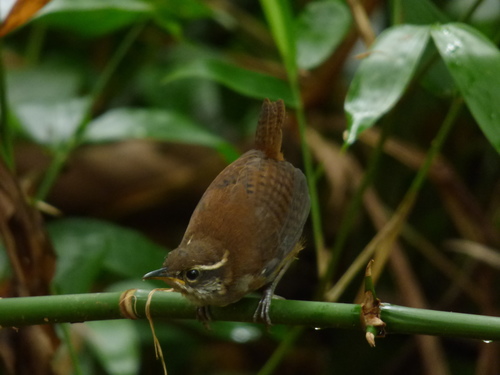
Bay Wren

Bay Wren

Cantorchilus nigricapillus

Silhouette: Matt Wilkins · PhyloPic

LCLeast ConcernNTVUENCR
Daily sighting probability ~10% · With luck
at Tortuguero National Park

In 3 days ~30% in a week ~60%

400 Verified sightings at Tortuguero National Park From 2019 to 2026
12,869 In all 18 parks
October Best month
☀️ Diurnal When it's spotted

About the Bay Wren

The bay wren (Cantorchilus nigricapillus) is a species of bird in the family Troglodytidae. It is native to southern Central America and northwestern South America. The bay wren has sometimes been treated as conspecific with the riverside wren (Cantorchilus semibadius) but their plumages are quite different as are DNA analyses. Some authors consider the two of them a superspecies but others deny that close relationship.

The bay wren has seven subspecies: The Clements taxonomy combines the first five as the "Central American" group and the last two as the "South American" group. Other authors include schottii in the South American group.

The bay wren is 12.6 to 15.6 cm (5.0 to 6.1 in) long. Eight specimens from Panama weighed 17.7 to 26.3 g (0.62 to 0.93 oz). Adults of the nominate subspecies have a black face with a narrow white supercilium, a partial eyering, and a white patch at the back of the cheek. Their crown and... Wikipedia →

Sounds

Duet0:12

Ecuador · 2026

© Daan van der Hoeven · XC1137847 · CC BY-NC-SA 4.0

Song0:21

Ecuador · 2025

© Marc Anderson · XC1078886 · CC BY-NC-ND 4.0

Dawn song0:17

Ecuador · 2014

© Manuel Sanchez-Nivicela · XC955408 · CC BY-NC-ND 4.0

Global Distribution

Parks Where Found

# Park Country Daily sighting probability
1 Farallones de Cali National Natural Park 🇨🇴 Colombia
~40%
2 Gandoca-Manzanillo Wildlife Refuge 🇨🇷 Costa Rica
~40%
3 Cahuita National Park 🇨🇷 Costa Rica
~40%
4 Bastimentos Island National Marine Park 🇵🇦 Panama
~40%
5 Tenorio Volcano National Park 🇨🇷 Costa Rica
~30%
6 San Lorenzo Protected Forest 🇵🇦 Panama
~30%
7 Utría National Natural Park 🇨🇴 Colombia
~20%
8 Braulio Carrillo National Park 🇨🇷 Costa Rica
~20%
9 Arenal Volcano National Park 🇨🇷 Costa Rica
~20%
10 Darién National Park 🇵🇦 Panama
~20%
11 Chagres National Park 🇵🇦 Panama
~20%
12 La Amistad International Park (Panama) 🇵🇦 Panama
~10%
13 Tortuguero National Park 🇨🇷 Costa Rica
~10%
14 Rincón de la Vieja National Park 🇨🇷 Costa Rica
~10%
15 Tapantí-Macizo de la Muerte National Park 🇨🇷 Costa Rica
<5%
16 Soberanía National Park 🇵🇦 Panama
<5%
17 Poás Volcano National Park 🇨🇷 Costa Rica
<5%
18 Parque Natural Metropolitano 🇵🇦 Panama
<5%

Before you go

What are the chances of seeing a Bay Wren in Tortuguero National Park?

With luck

About 10% of wildlife watchers report a Bay Wren sighting in Tortuguero National Park on a given day, based on 400 verified sightings from GBIF citizen-science data from 2019 to 2026. It is the 92nd most-seen of the 348 birds we can rate there. Over three days the chance rises to about 30%, and over a week to about 60%, if each day is a fresh chance.

When is the best time to see a Bay Wren in Tortuguero National Park?

October

In that month about 30% of wildlife watchers report a Bay Wren in Tortuguero National Park on a given day, against under 5% in December, the lowest month.

What time of day is best to see a Bay Wren?

Between 7 and 10 am

Across all the parks we cover, that three-hour window holds the most Bay Wren sightings with a recorded time, and about 9 in 10 of them come between 6 am and 6 pm: it is a daytime animal.

Where does the Bay Wren sighting chance come from?

GBIF citizen-science records

It is estimated from how often the Bay Wren is recorded against all the birds logged in Tortuguero National Park (400 verified sightings from 2019 to 2026), calibrated against known sighting rates. Figures are rounded to the nearest 10% because citizen-science data supports honest approximations, not decimals, and months with records from fewer than five people show "—". How it works.

← Back to Tortuguero National Park