Cloudy Snail-eating Snake

Cloudy Snail-eating Snake

Sibon nebulatus

Silhouette: Alex Slavenko · PhyloPic

LCLeast ConcernNTVUENCR
Daily sighting probability ~20% · Possible
at Tortuguero National Park

In 3 days ~50% in a week ~80%

30 Verified sightings at Tortuguero National Park From 2019 to 2026
348 In all 12 parks
September Best month
🌙 Nocturnal When it's spotted

About the Cloudy Snail-eating Snake

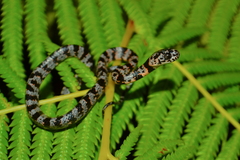
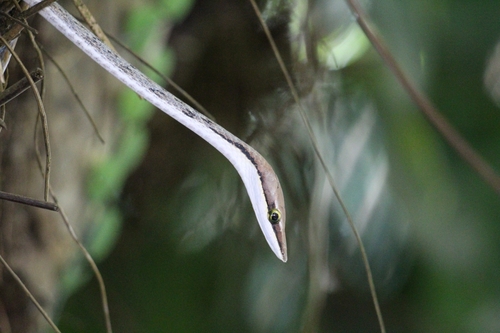
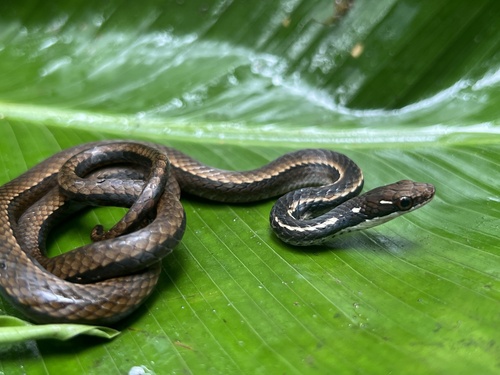
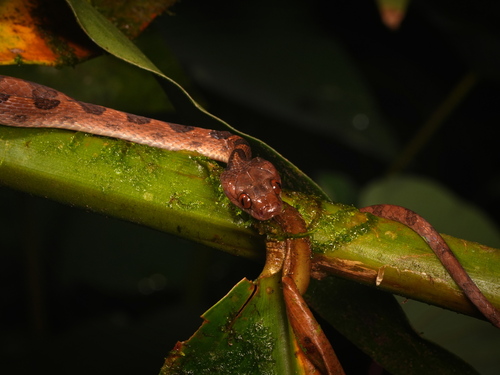
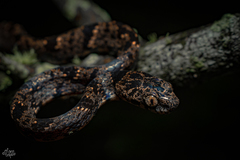
Sibon nebulatus, commonly known as the cloudy snail-eating snake, is a species of small, slender arboreal snake which is found in southern Mexico, Central America, northern South America, Isla Margarita, and Trinidad and Tobago.

The body colour of S. nebulatus varies from grey to brown with dark brown irregular ring-like crossbands. These crossbands are edged by fine, irregular, beige spots. The belly ranges from white to beige, speckled with tiny dark brown points. The labial scale on the upper lip behind the eye is enlarged. In cloud forests of northwestern Ecuador, S. nebulatus is often confused with another snake, the Elegant Snail-Eater (Dipsas elegans), which can be distinguished by its pairs of narrow vertical bars between which there is a more pale bar, as opposed to the unpaired vertical bars of S. nebulatus.

Boos, Hans E.A. (2001). The Snakes of Trinidad and Tobago. College Station, Texas: Texas A&M University Press. ISBN 1-58544-116-3. Wikipedia →

Global Distribution

Parks Where Found

# Park Country Daily sighting probability
1 Braulio Carrillo National Park 🇨🇷 Costa Rica
~30%
2 Tenorio Volcano National Park 🇨🇷 Costa Rica
~30%
3 Main Ridge Forest Reserve 🇹🇹 Trinidad and Tobago
~30%
4 Tayrona National Natural Park 🇨🇴 Colombia
~30%
5 Arenal Volcano National Park 🇨🇷 Costa Rica
~20%
6 Piedras Blancas National Park 🇨🇷 Costa Rica
~20%
7 Tortuguero National Park 🇨🇷 Costa Rica
~20%
8 Gandoca-Manzanillo Wildlife Refuge 🇨🇷 Costa Rica
~20%
9 Cahuita National Park 🇨🇷 Costa Rica
~10%
10 Calakmul Biosphere Reserve 🇲🇽 Mexico
~10%
11 Monteverde Cloud Forest Reserve 🇨🇷 Costa Rica
~10%
12 La Amistad International Park (Panama) 🇵🇦 Panama
~10%

Cities Where Found

# City Country Daily sighting probability
1 Medellín 🇨🇴 Colombia
~10%

Before you go

What are the chances of seeing a Cloudy Snail-eating Snake in Tortuguero National Park?

Possible

About 20% of wildlife watchers report a Cloudy Snail-eating Snake sighting in Tortuguero National Park on a given day, based on 30 verified sightings from GBIF citizen-science data from 2019 to 2026. It is the 18th most-seen of the 34 reptiles we can rate there. Over three days the chance rises to about 50%, and over a week to about 80%, if each day is a fresh chance.

When is the best time to see a Cloudy Snail-eating Snake in Tortuguero National Park?

September

In that month about 40% of wildlife watchers report a Cloudy Snail-eating Snake in Tortuguero National Park on a given day, against under 5% in January, the lowest month.

What time of day is best to see a Cloudy Snail-eating Snake?

Between 7 and 10 pm

Across all the parks we cover, that three-hour window holds the most Cloudy Snail-eating Snake sightings with a recorded time, and about 8 in 10 of them come between 6 pm and 6 am: it is mostly seen at night.

Which relatives of the Cloudy Snail-eating Snake live in Tortuguero National Park?

Same family: Colubridae

The closest relatives of the Cloudy Snail-eating Snake that you can see in Tortuguero National Park (family Colubridae, Colubrid Snakes) are Blunthead Tree Snake (about 40%), Green Vine Snake (about 30%) and Cope's Parrot Snake (about 10%), with each one's daily chance of a sighting.

Where does the Cloudy Snail-eating Snake sighting chance come from?

GBIF citizen-science records

It is estimated from how often the Cloudy Snail-eating Snake is recorded against all the reptiles logged in Tortuguero National Park (30 verified sightings from 2019 to 2026), calibrated against known sighting rates. Figures are rounded to the nearest 10% because citizen-science data supports honest approximations, not decimals, and months with records from fewer than five people show "—". How it works.

← Back to Tortuguero National Park