Common Knob-tailed Lizard

Common Knob-tailed Lizard

Nephrurus levis

Silhouette: Jose Carlos Arenas-Monroy · PhyloPic

LCLeast ConcernNTVUENCR Endemic
Daily sighting probability ~20% · Possible
at Uluru-Kata Tjuta National Park

In 3 days ~40% in a week ~70%

5 Verified sightings at Uluru-Kata Tjuta National Park From 2019 to 2026
29 In all 3 parks
December Best month
☀️ Diurnal When it's spotted

About the Common Knob-tailed Lizard

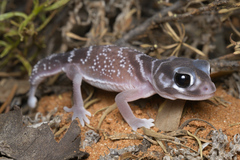
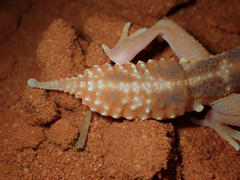
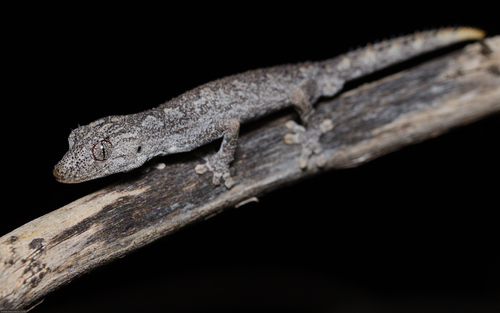
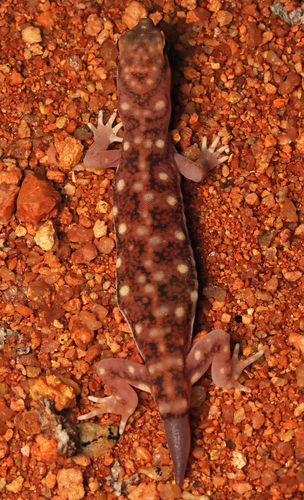
Nephrurus levis, commonly known as the three-lined knob-tailed gecko, smooth knob-tailed gecko, or common knob-tailed gecko, is a native Australian gecko species. The smooth knob-tailed gecko is part of the Carphodactylidae family, a family endemic to Australia. A common alternative name for this family is "barking geckos" due to the loud barks they make during threat displays, which includes swaying their bodies, winding their tail and attacking with an open mouth. There are multiple sub-species of Nephrurus levis, these include N.l. levis, N.l. occidentalis and N.l. pibarenis. Its various Indigenous names include: Illchilijera from the Arrernte people of central Australia, Wauṟa from the Anangu peoples of the Uluru-Kata Tjuta National Park region in central Australia, Jagajagara in the Ngarluma language from the Pilbara region in Coastal Western Australia, and Tyarla-tyarla from the Wangkangurru people whose traditional lands include parts of the Simpson Desert in South Australia and Queensland.

A robust, medium-sized gecko, with a large, triangular head. It has a short, flattened, carrot shaped like tail, that ends in a knob. This tail can be autotomised to distract... Wikipedia →

Global Distribution

Parks Where Found

# Park Country Daily sighting probability
1 Cape Range 🇦🇺 Australia
~30%
2 Ningaloo Marine Park 🇦🇺 Australia
~20%
3 Uluru-Kata Tjuta National Park 🇦🇺 Australia
~20%

Zoos & Centres Where Found

# Zoo / Centre Country
1 National Aquarium 🇺🇸 United States In captivity

Before you go

What are the chances of seeing a Common Knob-tailed Lizard in Uluru-Kata Tjuta National Park?

Possible

About 20% of wildlife watchers report a Common Knob-tailed Lizard sighting in Uluru-Kata Tjuta National Park on a given day, based on 5 verified sightings from GBIF citizen-science data from 2019 to 2026. It is the 19th most-seen of the 25 reptiles we can rate there. Over three days the chance rises to about 40%, and over a week to about 70%, if each day is a fresh chance.

When is the best time to see a Common Knob-tailed Lizard in Uluru-Kata Tjuta National Park?

March and November–December

In those months about 30% of wildlife watchers report a Common Knob-tailed Lizard in Uluru-Kata Tjuta National Park on a given day, against under 5% in January–February and April–August, the lowest months.

What time of day is best to see a Common Knob-tailed Lizard?

Between noon and 3 pm

Across all the parks we cover, that three-hour window holds the most Common Knob-tailed Lizard sightings with a recorded time, and about 8 in 10 of them come between 6 am and 6 pm: it is a daytime animal.

Is Uluru-Kata Tjuta National Park the best place to see a Common Knob-tailed Lizard?

3rd of 3

Of the 3 parks where we can rate Common Knob-tailed Lizard sightings, Uluru-Kata Tjuta National Park ranks 3rd at about 20%. The best odds are in Cape Range (Australia, about 30%) and Ningaloo Marine Park (Australia, about 20%).

Where does the Common Knob-tailed Lizard sighting chance come from?

GBIF citizen-science records

It is estimated from how often the Common Knob-tailed Lizard is recorded against all the reptiles logged in Uluru-Kata Tjuta National Park (5 verified sightings from 2019 to 2026), calibrated against known sighting rates. Figures are rounded to the nearest 10% because citizen-science data supports honest approximations, not decimals, and months with records from fewer than five people show "—". How it works.

← Back to Uluru-Kata Tjuta National Park