Greater Honeyguide

Greater Honeyguide

Indicator indicator

Silhouette: Sheatherius · PhyloPic

LCLeast ConcernNTVUENCR
Daily sighting probability <5% · Rare
at Aberdare National Park

In 3 days ~10% in a week ~20%

11 Verified sightings at Aberdare National Park From 2019 to 2026
1,963 In all 43 parks
March Best month
🌙 Nocturnal When it's spotted

About the Greater Honeyguide

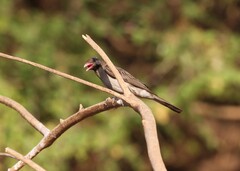
The greater honeyguide (Indicator indicator) is a bird in the family Indicatoridae, paleotropical near passerine birds related to the woodpeckers. Its English and scientific names refer to its habit of guiding people to bee colonies. Claims that it also guides non-human animals are disputed.

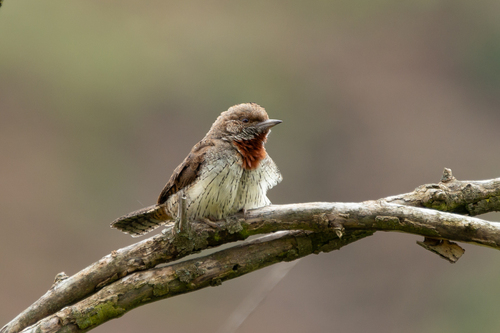
The greater honeyguide is a resident breeder in sub-Saharan Africa. It lives in a variety of habitats with trees, especially dry open woodland, but not in the West African rain forest. The greater honeyguide has bold white patches on the sides of the tail, is about 20 cm (7.9 in) long and weighs about 50 g (1.8 oz). The male has a black throat, pink bill, dark grey-brown upperparts and white underparts. The wings are streaked whitish, and the shoulder patch is yellow. The female is duller, has a blackish bill, and her throat is black. Immature birds have olive-brown upperparts with a white rump, yellow throat and upper breast.

The greater honeyguide is known to guide people to the nests of wild bees. A guiding bird attracts a person's attention with wavering, chattering "'tya' notes compounded with peeps or pipes", sounds it also gives in aggression... Wikipedia →

Sounds

Song1:20

Botswana · 2023

© Marc Anderson · XC875585 · CC BY-NC-ND 4.0

Call0:46

Guinea · 2023

© Marc Languy · XC783926 · CC BY-NC-SA 4.0

Call0:08

South Africa · 2021

© Tony Archer · XC680738 · CC BY-NC-SA 4.0

Global Distribution

Parks Where Found

# Park Country Daily sighting probability
1 Gonarezhou National Park 🇿🇼 Zimbabwe
~30%
2 Ruaha National Park 🇹🇿 Tanzania
~20%
3 Kidepo Valley National Park 🇺🇬 Uganda
~20%
4 Lower Zambezi National Park 🇿🇲 Zambia
~20%
5 Mana Pools National Park 🇿🇼 Zimbabwe
~20%
6 Mikumi National Park 🇹🇿 Tanzania
~10%
7 South Luangwa National Park 🇿🇲 Zambia
~10%
8 Lake Nakuru National Park 🇰🇪 Kenya
~10%
9 uMkhuze Game Reserve 🇿🇦 South Africa
~10%
10 Tarangire National Park 🇹🇿 Tanzania
~10%
11 Kafue National Park 🇿🇲 Zambia
~10%
12 Mkomazi National Park 🇹🇿 Tanzania
~10%
13 Niokolo-Koba National Park 🇸🇳 Senegal
~10%
14 Gorongosa National Park 🇲🇿 Mozambique
~10%
15 Liwonde National Park 🇲🇼 Malawi
~10%
16 Meru National Park 🇰🇪 Kenya
~10%
17 Lake Manyara National Park 🇹🇿 Tanzania
~10%
18 Lake Mburo National Park 🇺🇬 Uganda
~10%
19 Hluhluwe-Imfolozi Park 🇿🇦 South Africa
<5%
20 Hwange National Park 🇿🇼 Zimbabwe
<5%
21 Kruger National Park 🇿🇦 South Africa
<5%
22 Virunga National Park 🇨🇩 Democratic Republic of the Congo
<5%
23 Murchison Falls National Park 🇺🇬 Uganda
<5%
24 Queen Elizabeth National Park 🇺🇬 Uganda
<5%
25 Samburu National Reserve 🇰🇪 Kenya
<5%
26 Tsavo West National Park 🇰🇪 Kenya
<5%
27 Serengeti National Park 🇹🇿 Tanzania
<5%
28 Aberdare National Park 🇰🇪 Kenya
<5%
29 Moremi Game Reserve 🇧🇼 Botswana
<5%
30 Masai Mara National Reserve 🇰🇪 Kenya
<5%
31 Ngorongoro Conservation Area 🇹🇿 Tanzania
<5%
32 iSimangaliso Wetland Park 🇿🇦 South Africa
<5%
33 Akagera National Park 🇷🇼 Rwanda
<5%
34 De Hoop Nature Reserve 🇿🇦 South Africa
<5%
35 Addo Elephant National Park 🇿🇦 South Africa
<5%
36 Nairobi National Park 🇰🇪 Kenya
<5%
37 Tsavo East National Park 🇰🇪 Kenya
<5%
38 West Coast National Park 🇿🇦 South Africa
<5%
39 Chobe National Park 🇧🇼 Botswana
<5%
40 Garden Route National Park 🇿🇦 South Africa
<5%
41 Nyungwe National Park 🇷🇼 Rwanda
<5%
42 Bwindi Impenetrable National Park 🇺🇬 Uganda
<5%
43 Table Mountain National Park 🇿🇦 South Africa
<5%

Cities Where Found

# City Country Daily sighting probability
1 Mombasa 🇰🇪 Kenya
~10%
2 Pretoria 🇿🇦 South Africa
<5%
3 Serrekunda 🇬🇲 Gambia
<5%
4 Johannesburg 🇿🇦 South Africa
<5%
5 Harare 🇿🇼 Zimbabwe
<5%
6 Kampala 🇺🇬 Uganda
<5%
7 Kigali 🇷🇼 Rwanda
<5%

Before you go

What are the chances of seeing a Greater Honeyguide in Aberdare National Park?

Rare

Under 5% of wildlife watchers report a Greater Honeyguide sighting in Aberdare National Park on a given day, based on 11 verified sightings from GBIF citizen-science data from 2019 to 2026. It is the 154th most-seen of the 217 birds we can rate there. Over three days the chance rises to about 10%, and over a week to about 20%, if each day is a fresh chance.

When is the best time to see a Greater Honeyguide in Aberdare National Park?

March and September

In those months about 10% of wildlife watchers report a Greater Honeyguide in Aberdare National Park on a given day, against under 5% in April–August and October–February, the lowest months.

What time of day is best to see a Greater Honeyguide?

Between 7 and 10 pm

Across all the parks we cover, that three-hour window holds the most Greater Honeyguide sightings with a recorded time, and about 8 in 10 of them come between 6 pm and 6 am: it is mostly seen at night.

Is Aberdare National Park the best place to see a Greater Honeyguide?

28th of 43

Of the 43 parks where we can rate Greater Honeyguide sightings, Aberdare National Park ranks 28th at under 5%. The best odds are in Gonarezhou National Park (Zimbabwe, about 30%), Ruaha National Park (Tanzania, about 20%) and Kidepo Valley National Park (Uganda, about 20%).

Where does the Greater Honeyguide sighting chance come from?

GBIF citizen-science records

It is estimated from how often the Greater Honeyguide is recorded against all the birds logged in Aberdare National Park (11 verified sightings from 2019 to 2026), calibrated against known sighting rates. Figures are rounded to the nearest 10% because citizen-science data supports honest approximations, not decimals, and months with records from fewer than five people show "—". How it works.

← Back to Aberdare National Park