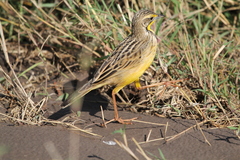
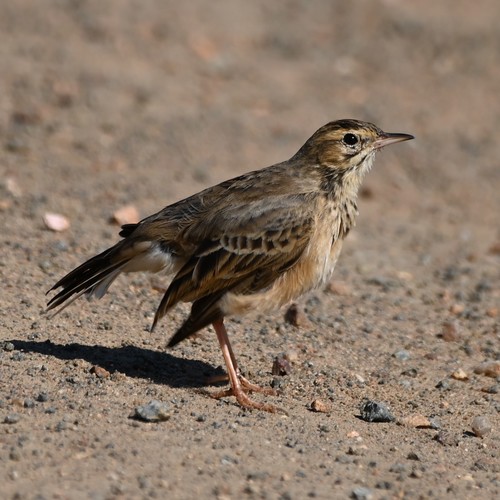
Yellow-throated Longclaw

Yellow-throated Longclaw

Macronyx croceus

Silhouette: Sheatherius · PhyloPic

LCLeast ConcernNTVUENCR
Daily sighting probability ~50% · Likely
at Akagera National Park

In 3 days ~80% in a week >90%

342 Verified sightings at Akagera National Park From 2019 to 2026
7,347 In all 24 parks
December Best month
☀️ Diurnal When it's spotted

About the Yellow-throated Longclaw

The yellow-throated longclaw (Macronyx croceus) is a species of bird in the family Motacillidae. Despite sharing no recent common ancestor, the yellow-throated longclaw and its sister species in Macronyx are very similar in both coloration and behavior to the meadowlarks of North America, an example of convergent evolution.

They have yellow underparts and a black "bib" on the upper chest. They may be distinguished from the closely related pangani longclaw by its yellow under tail-coverts, which the pangani lacks. The pangani also has an orange throat, whereas the yellow-throated does not.

Longclaws are generally solitary, except when found as mated pairs. It is found in Angola, Benin, Burkina Faso, Burundi, Cameroon, Central African Republic, Chad, Republic of the Congo, Democratic Republic of the Congo, Eswatini, Ivory Coast, Gabon, Gambia, Ghana, Guinea, Guinea-Bissau, Kenya, Lesotho, Liberia, Malawi, Mali, Mozambique, Niger, Nigeria, Rwanda, Senegal, Sierra Leone, Somalia, South Africa, South Sudan, Tanzania, Togo, Uganda, Zambia, and Zimbabwe. Its natural habitats are dry savanna, subtropical... Wikipedia →

Sounds

Song0:30

Tanzania · 2026

© isaac kilusu · XC1095743 · CC BY-NC-SA 4.0

Call0:32

Ghana · 2016

© Hans Matheve · XC353156 · CC BY-NC-ND 4.0

Uncertain0:18

Nigeria · 2023

© Sun Madakan · XC776508 · CC BY-NC-SA 4.0

Global Distribution

Parks Where Found

# Park Country Daily sighting probability
1 Queen Elizabeth National Park 🇺🇬 Uganda
~50%
2 Masai Mara National Reserve 🇰🇪 Kenya
~50%
3 Akagera National Park 🇷🇼 Rwanda
~50%
4 Lake Mburo National Park 🇺🇬 Uganda
~40%
5 Lake Nakuru National Park 🇰🇪 Kenya
~30%
6 Mikumi National Park 🇹🇿 Tanzania
~30%
7 Odzala-Kokoua National Park 🇨🇬 Republic of the Congo
~30%
8 Hluhluwe-Imfolozi Park 🇿🇦 South Africa
~30%
9 Nairobi National Park 🇰🇪 Kenya
~30%
10 Serengeti National Park 🇹🇿 Tanzania
~30%
11 iSimangaliso Wetland Park 🇿🇦 South Africa
~20%
12 uMkhuze Game Reserve 🇿🇦 South Africa
~20%
13 Virunga National Park 🇨🇩 Democratic Republic of the Congo
~20%
14 Kidepo Valley National Park 🇺🇬 Uganda
~10%
15 Murchison Falls National Park 🇺🇬 Uganda
~10%
16 Kruger National Park 🇿🇦 South Africa
~10%
17 Gorongosa National Park 🇲🇿 Mozambique
~10%
18 Kibale National Park 🇺🇬 Uganda
~10%
19 Semuliki National Park 🇺🇬 Uganda
<5%
20 Ngorongoro Conservation Area 🇹🇿 Tanzania
<5%
21 Liwonde National Park 🇲🇼 Malawi
<5%
22 Arusha National Park 🇹🇿 Tanzania
<5%
23 Aberdare National Park 🇰🇪 Kenya
<5%
24 Bwindi Impenetrable National Park 🇺🇬 Uganda
<5%

Cities Where Found

# City Country Daily sighting probability
1 Kigali 🇷🇼 Rwanda
~30%
2 Mombasa 🇰🇪 Kenya
~20%
3 Dar es-Salaam 🇹🇿 Tanzania
~10%
4 Harare 🇿🇼 Zimbabwe
~10%
5 Kampala 🇺🇬 Uganda
<5%
6 Accra 🇬🇭 Ghana
<5%
7 Maputo 🇲🇿 Mozambique
<5%
8 Durban 🇿🇦 South Africa
<5%
9 Nairobi 🇰🇪 Kenya
<5%

Before you go

What are the chances of seeing a Yellow-throated Longclaw in Akagera National Park?

Likely

About 50% of wildlife watchers report a Yellow-throated Longclaw sighting in Akagera National Park on a given day, based on 342 verified sightings from GBIF citizen-science data from 2019 to 2026. It is the 31st most-seen of the 320 birds we can rate there. Over three days the chance rises to about 80%, and over a week to over 90%, if each day is a fresh chance.

When is the best time to see a Yellow-throated Longclaw in Akagera National Park?

April and December

In those months about 60% of wildlife watchers report a Yellow-throated Longclaw in Akagera National Park on a given day, against about 30% in June, August and November, the lowest months. Those are among Akagera National Park's wettest months, with about 85 mm of rain a month against almost none in July.

What time of day is best to see a Yellow-throated Longclaw?

Between 8 and 11 am

Across all the parks we cover, that three-hour window holds the most Yellow-throated Longclaw sightings with a recorded time, and about 9 in 10 of them come between 6 am and 6 pm: it is a daytime animal.

Is Akagera National Park the best place to see a Yellow-throated Longclaw?

Among the best

Of the 24 parks where we can rate Yellow-throated Longclaw sightings, Akagera National Park ranks 3rd at about 50%, level with the leaders once rounded. The best odds are in Queen Elizabeth National Park (Uganda, about 50%) and Masai Mara National Reserve (Kenya, about 50%). All parks ranked.

Which relatives of the Yellow-throated Longclaw live in Akagera National Park?

Same family: Motacillidae

The closest relatives of the Yellow-throated Longclaw that you can see in Akagera National Park (family Motacillidae, Wagtails and Pipits) are African Pied Wagtail (about 50%), Plain-backed Pipit (about 20%) and Grassveld Pipit (about 20%), with each one's daily chance of a sighting.

Where does the Yellow-throated Longclaw sighting chance come from?

GBIF citizen-science records

It is estimated from how often the Yellow-throated Longclaw is recorded against all the birds logged in Akagera National Park (342 verified sightings from 2019 to 2026), calibrated against known sighting rates. Figures are rounded to the nearest 10% because citizen-science data supports honest approximations, not decimals, and months with records from fewer than five people show "—". How it works.

← Back to Akagera National Park