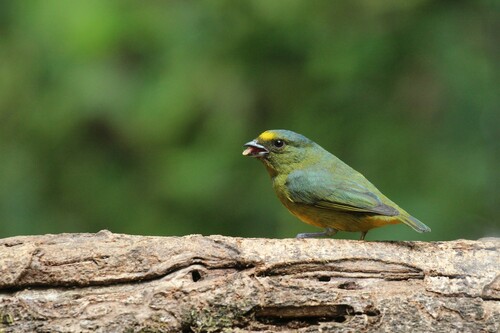
Blue-naped Chlorophonia

Blue-naped Chlorophonia

Chlorophonia cyanea

Silhouette: Sheatherius · PhyloPic

LCLeast ConcernNTVUENCR
Daily sighting probability ~20% · Possible
at Amboró National Park

In 3 days ~40% in a week ~70%

72 Verified sightings at Amboró National Park From 2019 to 2026
1,900 In all 13 parks
January Best month
☀️ Diurnal When it's spotted

About the Blue-naped Chlorophonia

The blue-naped chlorophonia (Chlorophonia cyanea) is a species of bird in the family Fringillidae, the finches and euphonias. It is found in every mainland South American country except Chile, French Guiana, Suriname, and Uruguay.

The blue-naped chlorophonia was originally described in 1822 with the binomial Pipra cyanea, mistakenly identifying it as a manakin. It was eventually reassigned to genus Chlorophonia that was erected in 1851. The genus Chlorophonia was long placed in the family Thraupidae, the "true" tanagers. Multiple studies in the late twentieth and early twenty-first centuries resulted in its being reassigned to its present place in the family Fringillidae.

The blue-naped chlorophonia has these seven subspecies: The blue-naped chlorophonia is a chunky, short-tailed, stubby-billed bird. It is about 11 cm (4.3 in) long and weighs 11 to 15 g (0.39 to 0.53 oz). The species is sexually dimorphic... Wikipedia →

Sounds

Song0:19

Brazil · 2021

© JAYRSON ARAUJO DE OLIVEIRA · XC678086 · CC BY-NC-SA 4.0

Call0:17

Bolivia · 2021

© Jacob Wijpkema · XC639254 · CC BY-NC-SA 4.0

Call0:55

Brazil · 2020

© Caio Brito · XC600134 · CC BY-NC-SA 4.0

Global Distribution

Parks Where Found

# Park Country Daily sighting probability
1 Serra dos Órgãos National Park 🇧🇷 Brazil
~30%
2 Amboró National Park 🇧🇴 Bolivia
~20%
3 Iguazú National Park 🇦🇷 Argentina
~10%
4 Iguaçu National Park 🇧🇷 Brazil
~10%
5 Itatiaia National Park 🇧🇷 Brazil
~10%
6 Farallones de Cali National Natural Park 🇨🇴 Colombia
~10%
7 Henri Pittier National Park 🇻🇪 Venezuela
<5%
8 Podocarpus National Park 🇪🇨 Ecuador
<5%
9 Tijuca National Park 🇧🇷 Brazil
<5%
10 Sierra de la Macarena National Park 🇨🇴 Colombia
<5%
11 Los Nevados National Natural Park 🇨🇴 Colombia
<5%
12 Chingaza National Natural Park 🇨🇴 Colombia
<5%
13 Manu National Park 🇵🇪 Peru
<5%

Cities Where Found

# City Country Daily sighting probability
1 Rio de Janeiro 🇧🇷 Brazil
<5%
2 Belo Horizonte 🇧🇷 Brazil
<5%
3 Porto Alegre 🇧🇷 Brazil
<5%
4 São Paulo 🇧🇷 Brazil
<5%

Before you go

What are the chances of seeing a Blue-naped Chlorophonia in Amboró National Park?

Possible

About 20% of wildlife watchers report a Blue-naped Chlorophonia sighting in Amboró National Park on a given day, based on 72 verified sightings from GBIF citizen-science data from 2019 to 2026. It is the 77th most-seen of the 273 birds we can rate there. Over three days the chance rises to about 40%, and over a week to about 70%, if each day is a fresh chance.

When is the best time to see a Blue-naped Chlorophonia in Amboró National Park?

January, March, September and November

In those months about 20% of wildlife watchers report a Blue-naped Chlorophonia in Amboró National Park on a given day, against about 10% in February, April–May, July–August, October and December, the lowest months. June has too few records to rate.

What time of day is best to see a Blue-naped Chlorophonia?

Between noon and 3 pm

Across all the parks we cover, that three-hour window holds the most Blue-naped Chlorophonia sightings with a recorded time, and about 9 in 10 of them come between 6 am and 6 pm: it is a daytime animal.

Is Amboró National Park the best place to see a Blue-naped Chlorophonia?

2nd of 13

Of the 13 parks where we can rate Blue-naped Chlorophonia sightings, Amboró National Park ranks 2nd at about 20%. The best odds are in Serra dos Órgãos National Park (Brazil, about 30%).

Which relatives of the Blue-naped Chlorophonia live in Amboró National Park?

Same family: Fringillidae

The closest relatives of the Blue-naped Chlorophonia that you can see in Amboró National Park (family Fringillidae, Finches, Euphonias, and Allies) are Thick-billed Euphonia (about 20%), Purple-throated Euphonia (about 20%) and Hooded Siskin (about 10%), with each one's daily chance of a sighting.

Where does the Blue-naped Chlorophonia sighting chance come from?

GBIF citizen-science records

It is estimated from how often the Blue-naped Chlorophonia is recorded against all the birds logged in Amboró National Park (72 verified sightings from 2019 to 2026), calibrated against known sighting rates. Figures are rounded to the nearest 10% because citizen-science data supports honest approximations, not decimals, and months with records from fewer than five people show "—". How it works.

← Back to Amboró National Park