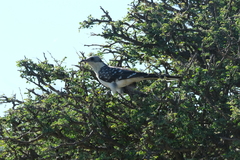
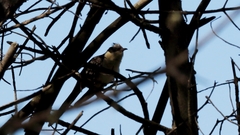
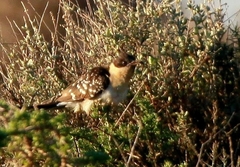
Great Spotted Cuckoo

Great Spotted Cuckoo

Clamator glandarius

Silhouette: Nicolas Huet le Jeune and Jean-Gabriel Prêtre (vectorized by T. Michael Keesey) · PhyloPic

LCLeast ConcernNTVUENCR
Daily sighting probability ~10% · With luck
at Awash National Park

In 3 days ~30% in a week ~50%

17 Verified sightings at Awash National Park From 2019 to 2026
1,400 In all 25 parks
August Best month
☀️ Diurnal When it's spotted

About the Great Spotted Cuckoo

The great spotted cuckoo (Clamator glandarius) is a member of the cuckoo order of birds, the Cuculiformes, which also includes the roadrunners, the anis and the coucals. It is widely spread throughout Africa and the Mediterranean Basin. It is a brood parasite that lays its eggs in the nests of corvids, in particular the Eurasian magpie.

In 1747 the English naturalist George Edwards included an illustration and a description of the great spotted cuckoo in the second volume of his A Natural History of Uncommon Birds. He used the English name "The Great Spotted Cuckow". Edwards based his hand-coloured etching on a specimen that had been shot in Gibraltar and sent to the English naturalist Mark Catesby in London. When in 1758 the Swedish naturalist Carl Linnaeus updated his Systema Naturae for the tenth edition, he placed the great spotted cuckoo with the other cuckoos in the genus Cuculus. Linnaeus included a brief description, coined the binomial name Cuculus glandarius and cited Edwards's work. The great spotted cuckoo is now placed in the genus Clamator that was introduced by German naturalist Johann Jakob Kaup in 1829. The species is monotypic: no subspecies are recognised... Wikipedia →

Sounds

Recording0:11

Turkey · 2026

© Emin Yogurtcuoglu · XC1144937 · CC BY-NC-SA 4.0

Call0:10

France · 2026

© Thierry THOMAS · XC1134316 · CC BY-NC-SA 4.0

Nocturnal flight call0:21

Spain · 2026

© Bosco Dies / BirdingAlbufera · XC1101963 · CC BY-NC-SA 4.0

Global Distribution

Parks Where Found

# Park Country Daily sighting probability
1 Meru National Park 🇰🇪 Kenya
~10%
2 Awash National Park 🇪🇹 Ethiopia
~10%
3 Serengeti National Park 🇹🇿 Tanzania
~10%
4 Ngorongoro Conservation Area 🇹🇿 Tanzania
~10%
5 Samburu National Reserve 🇰🇪 Kenya
~10%
6 Tsavo West National Park 🇰🇪 Kenya
<5%
7 Tarangire National Park 🇹🇿 Tanzania
<5%
8 Ruaha National Park 🇹🇿 Tanzania
<5%
9 Mkomazi National Park 🇹🇿 Tanzania
<5%
10 Kruger National Park 🇿🇦 South Africa
<5%
11 Doñana National Park 🇪🇸 Spain
<5%
12 Murchison Falls National Park 🇺🇬 Uganda
<5%
13 Monfragüe National Park 🇪🇸 Spain
<5%
14 Nairobi National Park 🇰🇪 Kenya
<5%
15 Etosha National Park 🇳🇦 Namibia
<5%
16 Kidepo Valley National Park 🇺🇬 Uganda
<5%
17 Pilanesberg National Park 🇿🇦 South Africa
<5%
18 Masai Mara National Reserve 🇰🇪 Kenya
<5%
19 Tsavo East National Park 🇰🇪 Kenya
<5%
20 Camargue 🇫🇷 France
<5%
21 Lake Nakuru National Park 🇰🇪 Kenya
<5%
22 Sierra de Guadarrama National Park 🇪🇸 Spain
<5%
23 Queen Elizabeth National Park 🇺🇬 Uganda
<5%
24 iSimangaliso Wetland Park 🇿🇦 South Africa
<5%
25 Chobe National Park 🇧🇼 Botswana
<5%

Cities Where Found

# City Country Daily sighting probability
1 Ramallah 🇵🇸 Palestine
~10%
2 Maiduguri 🇳🇬 Nigeria
<5%
3 Jerusalem 🇮🇱 Israel
<5%
4 Tel Aviv 🇮🇱 Israel
<5%
5 Madrid 🇪🇸 Spain
<5%

Zoos & Centres Where Found

# Zoo / Centre Country
1 Seaquarium du Grau-du-Roi 🇫🇷 France In captivity

Before you go

What are the chances of seeing a Great Spotted Cuckoo in Awash National Park?

With luck

About 10% of wildlife watchers report a Great Spotted Cuckoo sighting in Awash National Park on a given day, based on 17 verified sightings from GBIF citizen-science data from 2019 to 2026. It is the 135th most-seen of the 217 birds we can rate there. Over three days the chance rises to about 30%, and over a week to about 50%, if each day is a fresh chance.

When is the best time to see a Great Spotted Cuckoo in Awash National Park?

August and November

In those months about 20% of wildlife watchers report a Great Spotted Cuckoo in Awash National Park on a given day, against under 5% in April and December, the lowest months. Those are among Awash National Park's wettest months, with about 65 mm of rain a month against 10 mm in January. February–March, May and September have too few records to rate.

What time of day is best to see a Great Spotted Cuckoo?

Between 8 and 11 am

Across all the parks we cover, that three-hour window holds the most Great Spotted Cuckoo sightings with a recorded time, and about 8 in 10 of them come between 6 am and 6 pm: it is a daytime animal.

Is Awash National Park the best place to see a Great Spotted Cuckoo?

Among the best

Of the 25 parks where we can rate Great Spotted Cuckoo sightings, Awash National Park ranks 2nd at about 10%, level with the leaders once rounded. The best odds are in Meru National Park (Kenya, about 10%).

Where does the Great Spotted Cuckoo sighting chance come from?

GBIF citizen-science records

It is estimated from how often the Great Spotted Cuckoo is recorded against all the birds logged in Awash National Park (17 verified sightings from 2019 to 2026), calibrated against known sighting rates. Figures are rounded to the nearest 10% because citizen-science data supports honest approximations, not decimals, and months with records from fewer than five people show "—". How it works.

← Back to Awash National Park