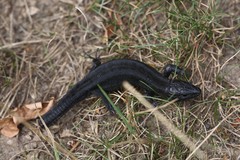
Sand Lizard

Sand Lizard

Lacerta agilis

Silhouette: Gustav Mützel · PhyloPic

LCLeast ConcernNTVUENCR
Daily sighting probability ~40% · Likely
at Bavarian Forest National Park

In 3 days ~80% in a week >90%

91 Verified sightings at Bavarian Forest National Park From 2019 to 2026
322 In all 13 parks
April Best month
☀️ Diurnal When it's spotted

About the Sand Lizard

The sand lizard (Lacerta agilis) is a lacertid lizard. The sand lizard is distributed across most of Europe from the southern coast of Britain and across the continent to Lake Baikal in Russia. It does not occur in European Turkey. Its distribution is often patchy. In the northern extremes of the sand lizard's distribution, it survives by inhabiting seaside heathlands, where the ground temperature is elevated by the sun. The sand lizard uses warm sand to thermoregulate itself and to incubate its eggs.

Males are known for their bright coloration and aggressive, possessive behaviors when seasonally competing for females. In contrast to other squamates, the sand lizard's mating season is very short. Males choose mates selectively, whereas females mate more indiscriminately. Females usually lay only a single clutch of eggs per year.

Sand lizards spend most of their time basking, foraging, or under vegetation. They prefer to live in diverse habitats. They are largely solitary outside of mating season. Male sand lizards typically have larger territories than females, and they will compete with other males when territory overlaps. Females neighbour each other more amicably, occasionally sharing habitats.

Sand lizards may live up to ten years. Due to their longevity, they are sometimes prone to inbreeding. Wikipedia →

Sounds

Recording0:03

Ukraine · 2025

© vitaroses · iNaturalist · CC BY-NC 4.0

Recording0:06

Slovakia · 2025

© Močiliak Filip · iNaturalist · CC BY-NC 4.0

Global Distribution

Parks Where Found

# Park Country Daily sighting probability
1 Hortobágy National Park 🇭🇺 Hungary
~40%
2 Biebrza National Park 🇵🇱 Poland
~40%
3 Bavarian Forest National Park 🇩🇪 Germany
~40%
4 Kiskunság National Park 🇭🇺 Hungary
~30%
5 Tatra National Park 🇸🇰 Slovakia
~30%
6 Białowieża National Park 🇵🇱 Poland
~30%
7 Mercantour National Park 🇫🇷 France
~30%
8 Fertő-Hanság National Park 🇭🇺 Hungary
~20%
9 Snowdonia National Park 🇬🇧 United Kingdom
~20%
10 Triglav National Park 🇸🇮 Slovenia
~10%
11 Cévennes National Park 🇫🇷 France
~10%
12 Wadden Sea National Park 🇩🇪 Germany
~10%
13 Pyrénées National Park 🇫🇷 France
~10%

Cities Where Found

# City Country Daily sighting probability
1 Vienna 🇦🇹 Austria
~20%
2 Kyiv 🇺🇦 Ukraine
~20%
3 Munich 🇩🇪 Germany
~20%
4 Warsaw 🇵🇱 Poland
~20%
5 Berlin 🇩🇪 Germany
~20%
6 Kharkiv 🇺🇦 Ukraine
~20%
7 Kazan 🇷🇺 Russia
~10%
8 Nizhny Novgorod 🇷🇺 Russia
~10%
9 Bucharest 🇷🇴 Romania
~10%
10 Prague 🇨🇿 Czechia
~10%

Zoos & Centres Where Found

# Zoo / Centre Country
1 Skansen 🇸🇪 Sweden In captivity
2 Chester Zoo 🇬🇧 United Kingdom In captivity
3 Hellabrunn Zoo 🇩🇪 Germany In captivity
4 Lithuanian Zoo 🇱🇹 Lithuania In captivity
5 Grodno Zoo 🇧🇾 Belarus In captivity
6 Universeum 🇸🇪 Sweden In captivity
7 Baltic Sea Science Center 🇸🇪 Sweden In captivity
8 Lake Tisza Ecocentre 🇭🇺 Hungary In captivity
9 Tierpark Schlichtweg 15 in München 🇩🇪 Germany In captivity
10 Zoo Schlichtweg 11 in München 🇩🇪 Germany In captivity
11 Zoo Siebenbrunner Straße 6 in München 🇩🇪 Germany In captivity

Before you go

What are the chances of seeing a Sand Lizard in Bavarian Forest National Park?

Likely

About 40% of wildlife watchers report a Sand Lizard sighting in Bavarian Forest National Park on a given day, based on 91 verified sightings from GBIF citizen-science data from 2019 to 2026. It is the 3rd most-seen of the 9 reptiles we can rate there. Over three days the chance rises to about 80%, and over a week to over 90%, if each day is a fresh chance.

When is the best time to see a Sand Lizard in Bavarian Forest National Park?

April and July

In those months about 50% of wildlife watchers report a Sand Lizard in Bavarian Forest National Park on a given day, against under 5% in November to March, the lowest months.

What time of day is best to see a Sand Lizard?

Between 11 am and 2 pm

Across all the parks we cover, that three-hour window holds the most Sand Lizard sightings with a recorded time, and nearly all of them come between 6 am and 6 pm: it is a daytime animal.

Is Bavarian Forest National Park the best place to see a Sand Lizard?

Among the best

Of the 13 parks where we can rate Sand Lizard sightings, Bavarian Forest National Park ranks 3rd at about 40%, level with the leaders once rounded. The best odds are in Hortobágy National Park (Hungary, about 40%) and Biebrza National Park (Poland, about 40%). All parks ranked.

Where does the Sand Lizard sighting chance come from?

GBIF citizen-science records

It is estimated from how often the Sand Lizard is recorded against all the reptiles logged in Bavarian Forest National Park (91 verified sightings from 2019 to 2026), calibrated against known sighting rates. Figures are rounded to the nearest 10% because citizen-science data supports honest approximations, not decimals, and months with records from fewer than five people show "—". How it works.

← Back to Bavarian Forest National Park