
House Wren

House Wren

Troglodytes aedon

Silhouette: Edwin Price · PhyloPic

LCLeast ConcernNTVUENCR
Daily sighting probability ~10% · With luck
at Big Bend National Park

In 3 days ~30% in a week ~50%

417 Verified sightings at Big Bend National Park From 2019 to 2026
24,164 In all 36 parks
December Best month
☀️ Diurnal When it's spotted

About the House Wren

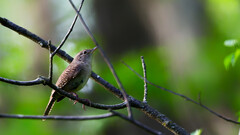
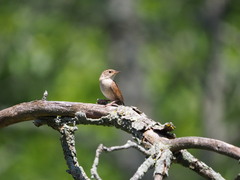
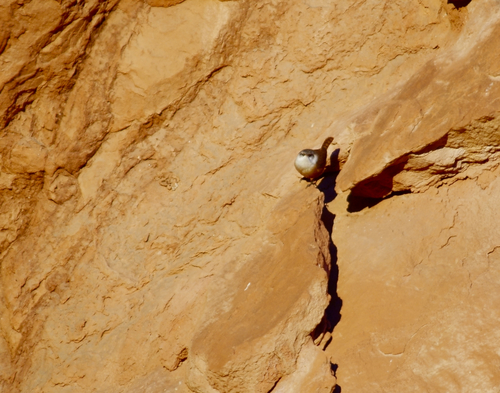
The northern house wren (Troglodytes aedon) is a very small passerine in the wren family Troglodytidae. It is found in southern Canada, the USA and Mexico. It occurs in most suburban areas in its range. It formerly included many subspecies resident in South America and in the Caribbean that are now considered as separate species. The name troglodytes means "hole dweller", and is a reference to the bird's tendency to disappear into crevices when hunting insects or to seek shelter.

The northern house wren was formally described in 1809 by the French ornithologist Louis Pierre Vieillot under the current binomial name Troglodytes aedon. The specific epithet is from the Ancient Greek aēdōn meaning "nightingale". The type locality was designated as New York City by Harry Oberholser in 1934. An earlier specific name, domestica in the combination Sylvia domestica, was introduced in 1808 by the American ornithologist Alexander Wilson. This was rarely used and in 1998 to conserve the widely used name aedon, the International Commission on Zoological Nomenclature suppressed the specific name domestica for the purposes of the principle of priority.

Four subspecies are recognised... Wikipedia →

Sounds

Song0:37

Brazil · 2026

© JAYRSON ARAUJO DE OLIVEIRA · XC1183074 · CC BY-NC-SA 4.0

Call0:26

Ecuador · 2023

© Manuel Sánchez-Nivicela · XC1161900 · CC BY-NC-ND 4.0

Alarm call0:40

United States · 2025

© Rory Nefdt · XC1029469 · CC BY-NC-SA 4.0

Global Distribution

Parks Where Found

# Park Country Daily sighting probability
1 Point Pelee National Park 🇨🇦 Canada
~60%
2 Sequoia and Kings Canyon National Parks 🇺🇸 United States
~30%
3 Rocky Mountain National Park 🇺🇸 United States
~30%
4 Riding Mountain National Park 🇨🇦 Canada
~30%
5 Zion National Park 🇺🇸 United States
~30%
6 Reserva de la Biosfera Mariposa Monarca 🇲🇽 Mexico
~30%
7 Cumbres de Monterrey National Park 🇲🇽 Mexico
~30%
8 Cabo Pulmo National Park 🇲🇽 Mexico
~30%
9 Grand Teton National Park 🇺🇸 United States
~20%
10 Elk Island National Park 🇨🇦 Canada
~20%
11 Everglades National Park 🇺🇸 United States
~20%
12 Guadalupe Mountains National Park 🇺🇸 United States
~20%
13 Big Cypress National Preserve 🇺🇸 United States
~20%
14 Yosemite National Park 🇺🇸 United States
~10%
15 Grand Canyon National Park 🇺🇸 United States
~10%
16 Glacier National Park 🇺🇸 United States
~10%
17 Shenandoah National Park 🇺🇸 United States
~10%
18 Channel Islands National Park 🇺🇸 United States
~10%
19 Big Bend National Park 🇺🇸 United States
~10%
20 Merritt Island National Wildlife Refuge 🇺🇸 United States
~10%
21 Yellowstone National Park 🇺🇸 United States
~10%
22 El Vizcaíno Biosphere Reserve 🇲🇽 Mexico
~10%
23 Congaree National Park 🇺🇸 United States
~10%
24 Saguaro National Park 🇺🇸 United States
~10%
25 Bahía de Loreto National Park 🇲🇽 Mexico
<5%
26 Death Valley National Park 🇺🇸 United States
<5%
27 Great Smoky Mountains National Park 🇺🇸 United States
<5%
28 Joshua Tree National Park 🇺🇸 United States
<5%
29 Voyageurs National Park 🇺🇸 United States
<5%
30 Badlands National Park 🇺🇸 United States
<5%
31 Jasper National Park 🇨🇦 Canada
<5%
32 Banff National Park 🇨🇦 Canada
<5%
33 Great Bear Rainforest 🇨🇦 Canada
<5%
34 Olympic National Park 🇺🇸 United States
<5%
35 Acadia National Park 🇺🇸 United States
<5%
36 Redwood National Park 🇺🇸 United States
<5%

Cities Where Found

# City Country Daily sighting probability
1 Sacramento 🇺🇸 United States
~30%
2 Los Angeles 🇺🇸 United States
~20%
3 Philadelphia 🇺🇸 United States
~20%
4 Baltimore 🇺🇸 United States
~20%
5 Denver 🇺🇸 United States
~20%
6 Guadalajara 🇲🇽 México
~20%
7 Calgary 🇨🇦 Canada
~20%
8 Chicago 🇺🇸 United States
~20%
9 San Diego 🇺🇸 United States
~20%
10 Toluca 🇲🇽 México
~20%

Before you go

What are the chances of seeing a House Wren in Big Bend National Park?

With luck

About 10% of wildlife watchers report a House Wren sighting in Big Bend National Park on a given day, based on 417 verified sightings from GBIF citizen-science data from 2019 to 2026. It is the 84th most-seen of the 270 birds we can rate there. Over three days the chance rises to about 30%, and over a week to about 50%, if each day is a fresh chance.

When is the best time to see a House Wren in Big Bend National Park?

December

In that month about 20% of wildlife watchers report a House Wren in Big Bend National Park on a given day, against under 5% in June to August, the lowest months.

What time of day is best to see a House Wren?

Between 8 and 11 am

Across all the parks we cover, that three-hour window holds the most House Wren sightings with a recorded time, and about 9 in 10 of them come between 6 am and 6 pm: it is a daytime animal.

Where does the House Wren sighting chance come from?

GBIF citizen-science records

It is estimated from how often the House Wren is recorded against all the birds logged in Big Bend National Park (417 verified sightings from 2019 to 2026), calibrated against known sighting rates. Figures are rounded to the nearest 10% because citizen-science data supports honest approximations, not decimals, and months with records from fewer than five people show "—". How it works.

← Back to Big Bend National Park