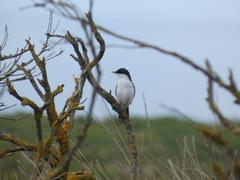
White-winged Triller

White-winged Triller

Lalage tricolor

Silhouette: PhyloPic

LCLeast ConcernNTVUENCR
Daily sighting probability <5% · Rare
at Blue Mountains National Park

In 3 days <5%

16 Verified sightings at Blue Mountains National Park From 2019 to 2026
493 In all 10 parks
November Best month
☀️ Diurnal When it's spotted

About the White-winged Triller

The white-winged triller (Lalage tricolor) is one of the smaller members of the cuckooshrike family, Campephagidae. It is found throughout mainland Australia and possibly on the islands to the north, including New Guinea and eastern Indonesia. It is resident or nomadic over the warmer part of its range (inland Australia and points north), and a summer breeding migrant to the cooler southern parts of Australia.

White-winged trillers are fairly common in woodland, and open scrub through most of their range, and close to riverbeds in the central arid zone. The conspicuous male bird—black above and white below in breeding plumage—trills cheerfully through much of the day during the breeding season (mid-spring to early summer), frequently rising on fluttering wings in song flight.

The female is similarly patterned but in dull fawns and white. In the non-breeding season, male birds appear similar to the female, retaining blackish feathers only on the wings and tail. Typically 16 to 18 cm long, white-winged trillers eat a variety of insects, which are taken on the ground, from foliage, or in the air.

The correct classification of the white-winged triller and its close northern relative, the white-shouldered triller (Lalage sueurii) of eastern Indonesia is uncertain. Some authorities regard them as two races of a single species, in which case the white-winged triller becomes Lalage sueurii tricolor. Wikipedia →

Sounds

Song0:44

Australia · 2020

© Marc Anderson · XC1080734 · CC BY-NC-ND 4.0

Song and call0:38

Australia · 2023

© Peter Boesman · XC859909 · CC BY-NC-ND 4.0

Call0:36

Australia · 2016

© Greg McLachlan · XC354157 · CC BY-NC-SA 4.0

Global Distribution

Parks Where Found

# Park Country Daily sighting probability
1 Uluru-Kata Tjuta National Park 🇦🇺 Australia
~20%
2 Kakadu National Park 🇦🇺 Australia
~10%
3 Hattah-Kulkyne National Park 🇦🇺 Australia
~10%
4 Litchfield National Park 🇦🇺 Australia
~10%
5 Nitmiluk National Park 🇦🇺 Australia
~10%
6 Flinders Ranges National Park 🇦🇺 Australia
<5%
7 Kosciuszko National Park 🇦🇺 Australia
<5%
8 Great Otway National Park 🇦🇺 Australia
<5%
9 Daintree National Park 🇦🇺 Australia
<5%
10 Blue Mountains National Park 🇦🇺 Australia
<5%

Cities Where Found

# City Country Daily sighting probability
1 Brisbane 🇦🇺 Australia
<5%
2 Melbourne 🇦🇺 Australia
<5%
3 Perth 🇦🇺 Australia
<5%
4 Sydney 🇦🇺 Australia
<5%

Zoos & Centres Where Found

# Zoo / Centre Country
1 Alice Springs Desert Park 🇦🇺 Australia In captivity

Before you go

What are the chances of seeing a White-winged Triller in Blue Mountains National Park?

Rare

Under 5% of wildlife watchers report a White-winged Triller sighting in Blue Mountains National Park on a given day, based on 16 verified sightings from GBIF citizen-science data from 2019 to 2026. It is the 179th most-seen of the 196 birds we can rate there. Over three days the chance rises to under 5%, if each day is a fresh chance.

When is the best time to see a White-winged Triller in Blue Mountains National Park?

Any time of year

In every month with enough records, under 5% of wildlife watchers report a White-winged Triller in Blue Mountains National Park on a given day, so our monthly data shows no clear season.

What time of day is best to see a White-winged Triller?

Between 7 and 10 am

Across all the parks we cover, that three-hour window holds the most White-winged Triller sightings with a recorded time, and about 9 in 10 of them come between 6 am and 6 pm: it is a daytime animal.

Where does the White-winged Triller sighting chance come from?

GBIF citizen-science records

It is estimated from how often the White-winged Triller is recorded against all the birds logged in Blue Mountains National Park (16 verified sightings from 2019 to 2026), calibrated against known sighting rates. Figures are rounded to the nearest 10% because citizen-science data supports honest approximations, not decimals, and months with records from fewer than five people show "—". How it works.

← Back to Blue Mountains National Park