Brown Quail

Brown Quail

Synoicus ypsilophorus

Silhouette: Edwin Price · PhyloPic

LCLeast ConcernNTVUENCR
Daily sighting probability ~10% · With luck
at Booderee National Park

In 3 days ~20% in a week ~40%

38 Verified sightings at Booderee National Park From 2019 to 2026
381 In all 12 parks
May Best month
☀️ Diurnal When it's spotted

About the Brown Quail

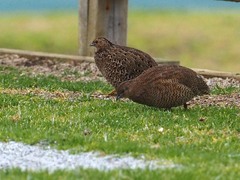
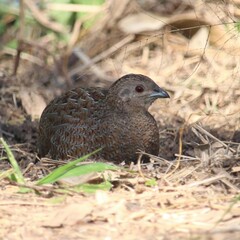
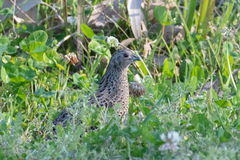
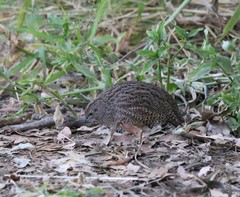
The brown quail (Synoicus ypsilophorus), also known as the swamp quail, silver quail and Tasmanian quail, is an Australasian true quail of the family Phasianidae. It is a small, ground-dwelling bird and is native to mainland Australia, Tasmania and Papua New Guinea and has been introduced to New Zealand and Fiji. Widespread and common throughout its large range, the brown quail is evaluated as being of least concern by the International Union for Conservation of Nature on the IUCN Red List of Threatened Species.

Although previously classified in the genus Coturnix, phylogenetic analyses have found it to form a monophyletic grouping with several other quail species, all of which have since been grouped in the genus Synoicus. It is thought to be the sister species to the Snow Mountain quail (S. monorthonyx), which was previously classified in the genus Anurophasis. Wikipedia →

Sounds

Song0:59

Australia · 2020

© Marc Anderson · XC1070970 · CC BY-NC-ND 4.0

Uncertain0:28

Australia · 2021

© nick talbot · XC689257 · CC BY-NC-SA 4.0

Song0:30

Indonesia · 2017

© Ross Gallardy · XC409803 · CC BY-NC-SA 4.0

Global Distribution

Parks Where Found

# Park Country Daily sighting probability
1 Booderee National Park 🇦🇺 Australia
~10%
2 Ningaloo Marine Park 🇦🇺 Australia
<5%
3 Royal National Park 🇦🇺 Australia
<5%
4 Cape Range 🇦🇺 Australia
<5%
5 Springbrook National Park 🇦🇺 Australia
<5%
6 Nitmiluk National Park 🇦🇺 Australia
<5%
7 Kakadu National Park 🇦🇺 Australia
<5%
8 Noosa National Park 🇦🇺 Australia
<5%
9 Blue Mountains National Park 🇦🇺 Australia
<5%
10 Lamington National Park 🇦🇺 Australia
<5%
11 Hattah-Kulkyne National Park 🇦🇺 Australia
<5%
12 Great Otway National Park 🇦🇺 Australia
<5%

Cities Where Found

# City Country Daily sighting probability
1 Brisbane 🇦🇺 Australia
~10%
2 Sydney 🇦🇺 Australia
<5%
3 Melbourne 🇦🇺 Australia
<5%
4 Perth 🇦🇺 Australia
<5%

Zoos & Centres Where Found

# Zoo / Centre Country
1 Featherdale Sydney Wildlife Park 🇦🇺 Australia In captivity
2 Birdworld Kuranda 🇦🇺 Australia In captivity
3 Kuranda Koala Gardens 🇦🇺 Australia In captivity

Closest Relatives at Booderee National Park

No species of the same family or order lives in Booderee National Park, so these are its closest relatives here: other birds.

Before you go

What are the chances of seeing a Brown Quail in Booderee National Park?

With luck

About 10% of wildlife watchers report a Brown Quail sighting in Booderee National Park on a given day, based on 38 verified sightings from GBIF citizen-science data from 2019 to 2026. It is the 73rd most-seen of the 128 birds we can rate there. Over three days the chance rises to about 20%, and over a week to about 40%, if each day is a fresh chance.

When is the best time to see a Brown Quail in Booderee National Park?

May

In that month about 30% of wildlife watchers report a Brown Quail in Booderee National Park on a given day, against under 5% in June–July and September–February, the lowest months.

What time of day is best to see a Brown Quail?

Between noon and 3 pm

Across all the parks we cover, that three-hour window holds the most Brown Quail sightings with a recorded time, and nearly all of them come between 6 am and 6 pm: it is a daytime animal.

Is Booderee National Park the best place to see a Brown Quail?

Yes

Of the 12 parks where we can rate Brown Quail sightings, Booderee National Park has the highest daily chance: about 10%. Next come Ningaloo Marine Park (Australia, under 5%) and Royal National Park (Australia, under 5%).

Where does the Brown Quail sighting chance come from?

GBIF citizen-science records

It is estimated from how often the Brown Quail is recorded against all the birds logged in Booderee National Park (38 verified sightings from 2019 to 2026), calibrated against known sighting rates. Figures are rounded to the nearest 10% because citizen-science data supports honest approximations, not decimals, and months with records from fewer than five people show "—". How it works.

← Back to Booderee National Park