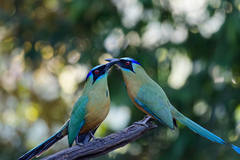

Amazonian Motmot

Amazonian Motmot

Momotus momota

Silhouette: Sofía Terán Sánchez · PhyloPic

LCLeast ConcernNTVUENCR
Daily sighting probability <5% · Rare
at Brownsberg Nature Park

In 3 days ~10% in a week ~20%

9 Verified sightings at Brownsberg Nature Park From 2019 to 2026
2,763 In all 11 parks
February Best month
☀️ Diurnal When it's spotted

About the Amazonian Motmot

The Amazonian motmot (Momotus momota) is a colorful near-passerine bird in the family Momotidae. It is found in the Amazon lowlands and low Andean foothills from eastern Venezuela to eastern Brazil and northeastern Argentina.

The Amazonian motmot and the blue-capped (Momotus coeruleiceps), whooping (M. subrufrescens), Trinidad (M. bahamensis), Lesson's (M. lessonii), and Andean motmots (M. aequatorialis) were all at one time considered conspecific. The Amazonian motmot has nine recognized subspecies; they are listed in the "Distribution and habitat" section below.

The Amazonian motmot's plumage varies among the subspecies. The bodies of all are shades of green. All have a long tail that has extended feathers with racquet tips that are green or black. Most have a black eyemask, though their size and shape differ. The central crown is black and surrounded or partially bordered by a blue band. The nominate subspecies has a chestnut nape. Momotus momota ignobilis and M. m. cametensis have more extensive chestnut on the neck and face.

The Amazonian motmot is widely distributed in South America east of the Andes... Wikipedia →

Sounds

Call0:42

Brazil · 2026

© JAYRSON ARAUJO DE OLIVEIRA · XC1186224 · CC BY-NC-SA 4.0

Song1:06

Brazil · 2025

© Joost van Bruggen · XC1050424 · CC BY-NC-ND 4.0

Alarm call0:28

Suriname · 2014

© Peter Boesman · XC272213 · CC BY-NC-ND 4.0

Global Distribution

Parks Where Found

# Park Country Daily sighting probability
1 Amboró National Park 🇧🇴 Bolivia
~40%
2 Tambopata National Reserve 🇵🇪 Peru
~30%
3 Sierra de la Macarena National Park 🇨🇴 Colombia
~30%
4 Chapada dos Guimarães National Park 🇧🇷 Brazil
~30%
5 Yasuní National Park 🇪🇨 Ecuador
~20%
6 Manu National Park 🇵🇪 Peru
~10%
7 Cuyabeno Wildlife Reserve 🇪🇨 Ecuador
~10%
8 Brownsberg Nature Park 🇸🇷 Suriname
<5%
9 Emas National Park 🇧🇷 Brazil
<5%
10 Anavilhanas National Park 🇧🇷 Brazil
<5%
11 Parque Estadual Encontro das Águas 🇧🇷 Brazil
<5%

Cities Where Found

# City Country Daily sighting probability
1 Campo Grande 🇧🇷 Brazil
~20%
2 Goiânia 🇧🇷 Brazil
~20%
3 Maceió 🇧🇷 Brazil
~10%

Zoos & Centres Where Found

# Zoo / Centre Country
1 San Diego Zoo 🇺🇸 United States In captivity
2 Barcelona Zoo 🇪🇸 Spain In captivity
3 Parc des oiseaux 🇫🇷 France In captivity
4 San Diego Zoo Safari Park 🇺🇸 United States In captivity
5 Bronx Zoo 🇺🇸 United States In captivity
6 Parc zoologique de Montpellier 🇫🇷 France In captivity
7 Sedgwick County Zoo 🇺🇸 United States In captivity
8 Omaha’s Henry Doorly Zoo and Aquarium 🇺🇸 United States In captivity
9 Milwaukee County Zoo 🇺🇸 United States In captivity
10 Phoenix Zoo 🇺🇸 United States In captivity
11 Birmingham Zoo 🇺🇸 United States In captivity
12 Louisville Zoo 🇺🇸 United States In captivity
13 Berlin Zoological Garden 🇩🇪 Germany In captivity
14 Woodland Park Zoo 🇺🇸 United States In captivity
15 Moody Gardens 🇺🇸 United States In captivity
16 Houston Zoo 🇺🇸 United States In captivity
17 Aquarama Barcelona 🇪🇸 Spain In captivity
18 Cleres Zoological Park 🇫🇷 France In captivity
19 Lincoln Park Zoo 🇺🇸 United States In captivity
20 Roger Williams Park Zoo 🇺🇸 United States In captivity
21 Mangal das Garças 🇧🇷 Brazil In captivity
22 Staten Island Zoo 🇺🇸 United States In captivity
23 Aquarium Berlin 🇩🇪 Germany In captivity
24 Dallas World Aquarium 🇺🇸 United States In captivity
25 National Aquarium 🇺🇸 United States In captivity
26 Bird Kingdom 🇨🇦 Canada In captivity
27 The Zoo In Forest Park 🇺🇸 United States In captivity

Closest Relatives at Brownsberg Nature Park

No species of the same family or order lives in Brownsberg Nature Park, so these are its closest relatives here: other birds.

Before you go

What are the chances of seeing an Amazonian Motmot in Brownsberg Nature Park?

Rare

Under 5% of wildlife watchers report an Amazonian Motmot sighting in Brownsberg Nature Park on a given day, based on 9 verified sightings from GBIF citizen-science data from 2019 to 2026. It is the 182nd most-seen of the 221 birds we can rate there. Over three days the chance rises to about 10%, and over a week to about 20%, if each day is a fresh chance.

When is the best time to see an Amazonian Motmot in Brownsberg Nature Park?

February to April

In those months about 10% of wildlife watchers report an Amazonian Motmot in Brownsberg Nature Park on a given day, against under 5% in August to January, the lowest months. May to July have too few records to rate.

What time of day is best to see an Amazonian Motmot?

Between 8 and 11 am

Across all the parks we cover, that three-hour window holds the most Amazonian Motmot sightings with a recorded time, and about 7 in 10 of them come between 6 am and 6 pm: it is a daytime animal.

Where does the Amazonian Motmot sighting chance come from?

GBIF citizen-science records

It is estimated from how often the Amazonian Motmot is recorded against all the birds logged in Brownsberg Nature Park (9 verified sightings from 2019 to 2026), calibrated against known sighting rates. Figures are rounded to the nearest 10% because citizen-science data supports honest approximations, not decimals, and months with records from fewer than five people show "—". How it works.

← Back to Brownsberg Nature Park