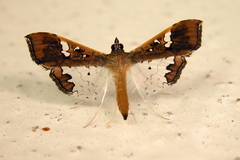
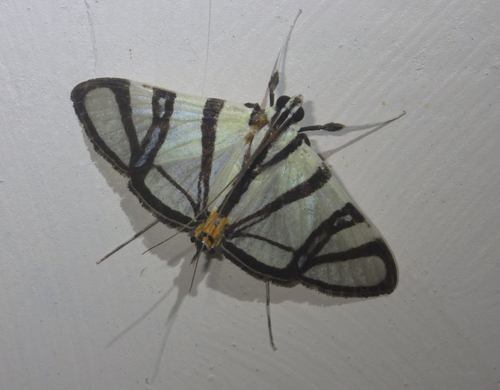
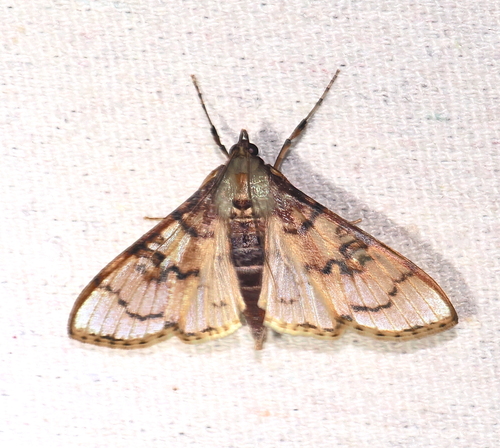
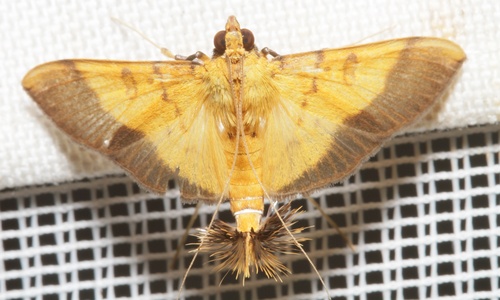
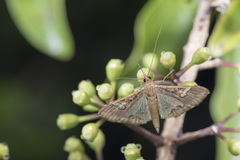
Mung Bean Moth

Mung Bean Moth

Maruca vitrata

Daily sighting probability ~40% · Likely
at Brownsberg Nature Park

In 3 days ~80% in a week >90%

12 Verified sightings at Brownsberg Nature Park From 2019 to 2026
266 In all 20 parks
December Best month
🌙 Nocturnal When it's spotted

About the Mung Bean Moth

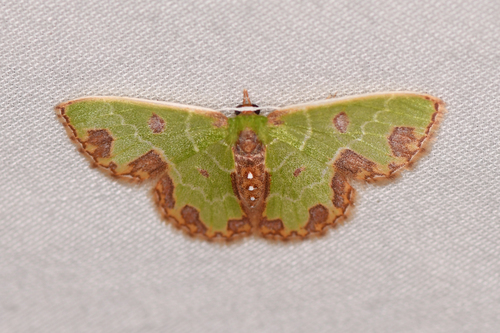
Maruca vitrata is a pantropical insect pest of leguminous crops like pigeon pea, cowpea, mung bean and soybean. Its common names include the maruca pod borer, bean pod borer, soybean pod borer, mung moth, and the legume pod borer. The species was first described by Johan Christian Fabricius in 1787.

It can cause losses of 20–80% on the harvests of cowpeas. Its feeding sites on plants are flower buds, flowers and young pods. In some cases early instars feed on flower peduncles and young stems. Some parasitoids have been shown to serve as a biological control for Maruca vitrata. Parasitoid wasps families include Braconidae and Ichneumonidae; some parasitoid flies in the Tachinidae are also natural enemies of the moth. M. vitrata prefers to lay its eggs on the flowering bodies of the cowpea plant. Efforts have been made to deter M. vitrata from reproducing on the plant ranging from pesticides to a chemical specifically designed to sterilize the moth. Genetically modified cowpeas has been developed to express the cry protein from Bacillus thuringiensis, which is toxic to lepidopteran species, particularly to the pod borer. This technology have... Wikipedia →

Global Distribution

Parks Where Found

# Park Country Daily sighting probability
1 Brownsberg Nature Park 🇸🇷 Suriname
~40%
2 Gorongosa National Park 🇲🇿 Mozambique
~30%
3 Kanha National Park 🇮🇳 India
~20%
4 Ranomafana National Park 🇲🇬 Madagascar
~20%
5 Doi Inthanon National Park 🇹🇭 Thailand
~20%
6 Main Ridge Forest Reserve 🇹🇹 Trinidad and Tobago
~20%
7 Podocarpus National Park 🇪🇨 Ecuador
~20%
8 Monteverde Cloud Forest Reserve 🇨🇷 Costa Rica
~10%
9 Daintree National Park 🇦🇺 Australia
~10%
10 Sinharaja Forest Reserve 🇱🇰 Sri Lanka
~10%
11 Serra dos Órgãos National Park 🇧🇷 Brazil
~10%
12 Manu National Park 🇵🇪 Peru
~10%
13 Lamington National Park 🇦🇺 Australia
~10%
14 Kinabalu Park 🇲🇾 Malaysia
~10%
15 Tambopata National Reserve 🇵🇪 Peru
~10%
16 Taroko National Park 🇹🇼 Taiwan
~10%
17 Arenal Volcano National Park 🇨🇷 Costa Rica
~10%
18 La Amistad International Park (Panama) 🇵🇦 Panama
~10%
19 Tapantí-Macizo de la Muerte National Park 🇨🇷 Costa Rica
~10%
20 Kruger National Park 🇿🇦 South Africa
<5%

Cities Where Found

# City Country Daily sighting probability
1 Vijayawada 🇮🇳 India
~30%
2 Kathmandu 🇳🇵 Nepal
~20%
3 Vadodara 🇮🇳 India
~20%
4 Dehradun 🇮🇳 India
~10%
5 Bengaluru 🇮🇳 India
~10%
6 Antananarivo 🇲🇬 Madagascar
~10%
7 Ahmedabad 🇮🇳 India
~10%
8 Dhaka 🇧🇩 Bangladesh
~10%
9 Hyderabad 🇮🇳 India
~10%
10 Prayagraj 🇮🇳 India
~10%

Before you go

What are the chances of seeing a Mung Bean Moth in Brownsberg Nature Park?

Likely

About 40% of wildlife watchers report a Mung Bean Moth sighting in Brownsberg Nature Park on a given day, based on 12 verified sightings from GBIF citizen-science data from 2019 to 2026. It is the 6th most-seen of the 74 insects we can rate there. Over three days the chance rises to about 80%, and over a week to over 90%, if each day is a fresh chance.

When is the best time to see a Mung Bean Moth in Brownsberg Nature Park?

December

In that month about 70% of wildlife watchers report a Mung Bean Moth in Brownsberg Nature Park on a given day, against about 10% in February–March, May, August and October, the lowest months. September has too few records to rate.

What time of day is best to see a Mung Bean Moth?

Between 7 and 10 pm

Across all the parks we cover, that three-hour window holds the most Mung Bean Moth sightings with a recorded time, and about 8 in 10 of them come between 6 pm and 6 am: it is mostly seen at night.

Is Brownsberg Nature Park the best place to see a Mung Bean Moth?

Yes

Of the 20 parks where we can rate Mung Bean Moth sightings, Brownsberg Nature Park has the highest daily chance: about 40%. Next come Gorongosa National Park (Mozambique, about 30%) and Kanha National Park (India, about 20%). All parks ranked.

Which relatives of the Mung Bean Moth live in Brownsberg Nature Park?

Same family: Crambidae

The closest relatives of the Mung Bean Moth that you can see in Brownsberg Nature Park (family Crambidae, Crambid Snout Moths) are Conchylodes nolckenialis (about 30%), Azochis pieralis (about 30%) and Desmia chryseis (about 30%), with each one's daily chance of a sighting.

Where does the Mung Bean Moth sighting chance come from?

GBIF citizen-science records

It is estimated from how often the Mung Bean Moth is recorded against all the insects logged in Brownsberg Nature Park (12 verified sightings from 2019 to 2026), calibrated against known sighting rates. Figures are rounded to the nearest 10% because citizen-science data supports honest approximations, not decimals, and months with records from fewer than five people show "—". How it works.
← Back to Brownsberg Nature Park