
Hammond's Flycatcher

Hammond's Flycatcher

Empidonax hammondii

Silhouette: Emily Willoughby · PhyloPic

LCLeast ConcernNTVUENCR
Daily sighting probability <5% · Rare
at Cañón del Sumidero National Park

In 3 days ~10%

21 Verified sightings at Cañón del Sumidero National Park From 2019 to 2026
3,510 In all 27 parks
January Best month
☀️ Diurnal When it's spotted

About the Hammond's Flycatcher

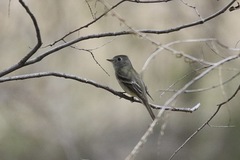
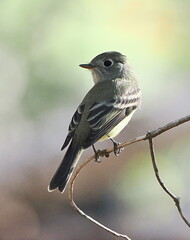
Hammond's flycatcher (Empidonax hammondii) is a flycatcher in the family Tyrannidae. This small insectivorous bird inhabits the coniferous and mixed forests of western North America. The name of this bird commemorates William Alexander Hammond who was the surgeon general of the US Army. Hammond collected bird specimens for Spencer Fullerton Baird.

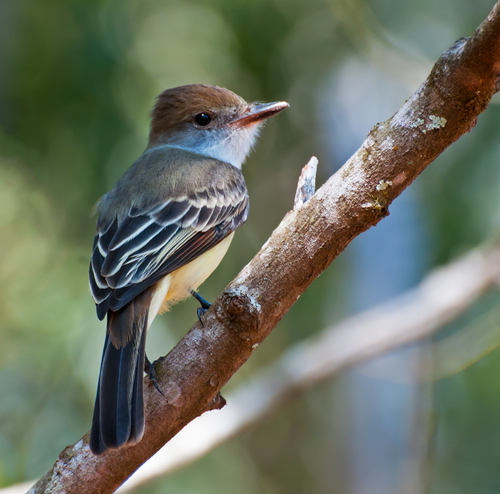
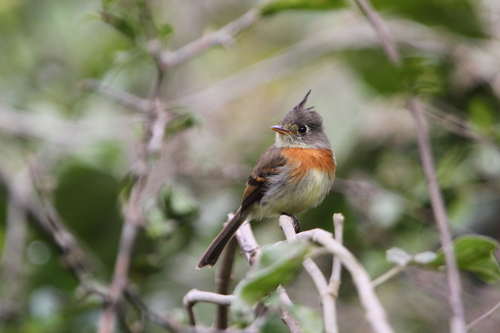
Adults are 12–14 cm long (4.7–5.5 in), span about 22 cm (8.7 in) across the wing and weigh 8–12 g (0.3–04 oz). They have grayish-olive upperparts, darker on the wings and tail, with whitish underparts; they have a conspicuous white eye ring, white wing bars, a small bill and a short tail. The breast is washed with grey and the sides of the belly with yellow. Females usually have a shorter, wider bill than males. Immature birds are similar to adults, but have broader wing bars and are more buff.

Many species of Empidonax flycatchers are very similar in appearance. Hammond's flycatchers are mainly confused with Dusky (E. oberholseri) and Gray (E. wrightii) flycatchers, which are similar in color and size and have an overlapping range. The best way to distinguish Hammond's flycatcher is by its call, breeding habitat and/or range... Wikipedia →

Sounds

Call0:56

United States · 2022

© Paul Marvin · XC748158 · CC BY-NC-SA 4.0

Song1:07

Canada · 2003

© Peter Ward · XC509621 · CC BY-NC-SA 4.0

Dawn song1:14

Canada · 2014

© Richard E. Webster · XC196460 · CC BY-NC-SA 4.0

Global Distribution

Parks Where Found

# Park Country Daily sighting probability
1 Glacier National Park 🇺🇸 United States
~20%
2 El Triunfo 🇲🇽 Mexico
~10%
3 Sequoia and Kings Canyon National Parks 🇺🇸 United States
~10%
4 Yosemite National Park 🇺🇸 United States
~10%
5 Jasper National Park 🇨🇦 Canada
~10%
6 Cumbres de Monterrey National Park 🇲🇽 Mexico
~10%
7 Olympic National Park 🇺🇸 United States
~10%
8 Wrangell-St. Elias National Park 🇺🇸 United States
~10%
9 Grand Teton National Park 🇺🇸 United States
~10%
10 Great Bear Rainforest 🇨🇦 Canada
~10%
11 Yellowstone National Park 🇺🇸 United States
~10%
12 Celaque National Park 🇭🇳 Honduras
~10%
13 La Tigra National Park 🇭🇳 Honduras
<5%
14 Reserva de la Biosfera Mariposa Monarca 🇲🇽 Mexico
<5%
15 Rocky Mountain National Park 🇺🇸 United States
<5%
16 Death Valley National Park 🇺🇸 United States
<5%
17 Cañón del Sumidero National Park 🇲🇽 Mexico
<5%
18 Grand Canyon National Park 🇺🇸 United States
<5%
19 Big Bend National Park 🇺🇸 United States
<5%
20 Pacific Rim National Park Reserve 🇨🇦 Canada
<5%
21 Denali National Park 🇺🇸 United States
<5%
22 Banff National Park 🇨🇦 Canada
<5%
23 Cusuco National Park 🇭🇳 Honduras
<5%
24 Joshua Tree National Park 🇺🇸 United States
<5%
25 Guadalupe Mountains National Park 🇺🇸 United States
<5%
26 Saguaro National Park 🇺🇸 United States
<5%
27 Zion National Park 🇺🇸 United States
<5%

Cities Where Found

# City Country Daily sighting probability
1 Toluca 🇲🇽 México
~20%
2 Mexico City 🇲🇽 México
~10%
3 Puebla 🇲🇽 México
~10%
4 Guadalajara 🇲🇽 México
~10%
5 Guatemala City 🇬🇹 Guatemala
<5%
6 Vancouver 🇨🇦 Canada
<5%
7 Portland 🇺🇸 United States
<5%
8 Los Angeles 🇺🇸 United States
<5%
9 Mesa 🇺🇸 United States
<5%
10 Salt Lake City 🇺🇸 United States
<5%

Before you go

What are the chances of seeing a Hammond's Flycatcher in Cañón del Sumidero National Park?

Rare

Under 5% of wildlife watchers report a Hammond's Flycatcher sighting in Cañón del Sumidero National Park on a given day, based on 21 verified sightings from GBIF citizen-science data from 2019 to 2026. It is the 200th most-seen of the 243 birds we can rate there. Over three days the chance rises to about 10%, if each day is a fresh chance.

When is the best time to see a Hammond's Flycatcher in Cañón del Sumidero National Park?

January

In that month about 10% of wildlife watchers report a Hammond's Flycatcher in Cañón del Sumidero National Park on a given day, against under 5% in February to December, the lowest months. That is one of Cañón del Sumidero National Park's driest months, with about 10 mm of rain against 260 mm in June.

What time of day is best to see a Hammond's Flycatcher?

Between 8 and 11 am

Across all the parks we cover, that three-hour window holds the most Hammond's Flycatcher sightings with a recorded time, and about 9 in 10 of them come between 6 am and 6 pm: it is a daytime animal.

Is Cañón del Sumidero National Park the best place to see a Hammond's Flycatcher?

17th of 27

Of the 27 parks where we can rate Hammond's Flycatcher sightings, Cañón del Sumidero National Park ranks 17th at under 5%. The best odds are in Glacier National Park (United States, about 20%), El Triunfo (Mexico, about 10%) and Sequoia and Kings Canyon National Parks (United States, about 10%).

Which relatives of the Hammond's Flycatcher live in Cañón del Sumidero National Park?

Same genus: Empidonax

The closest relatives of the Hammond's Flycatcher that you can see in Cañón del Sumidero National Park (genus Empidonax, Empidonax Flycatchers) are Least Flycatcher (about 30%) and Yellow-bellied Flycatcher (about 10%), with each one's daily chance of a sighting.

Where does the Hammond's Flycatcher sighting chance come from?

GBIF citizen-science records

It is estimated from how often the Hammond's Flycatcher is recorded against all the birds logged in Cañón del Sumidero National Park (21 verified sightings from 2019 to 2026), calibrated against known sighting rates. Figures are rounded to the nearest 10% because citizen-science data supports honest approximations, not decimals, and months with records from fewer than five people show "—". How it works.

← Back to Cañón del Sumidero National Park