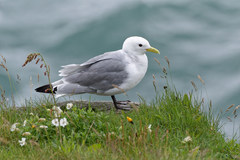
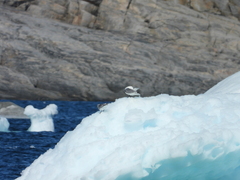
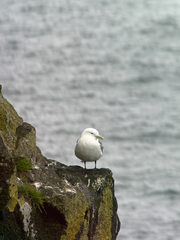
Black-legged Kittiwake

Black-legged Kittiwake

Rissa tridactyla

Silhouette: Andy Wilson · PhyloPic

LCNTVUVulnerableENCR
Daily sighting probability <5% · Rare
at Cape Breton Highlands National Park

In 3 days ~10% in a week ~20%

36 Verified sightings at Cape Breton Highlands National Park From 2019 to 2026
5,406 In all 15 parks
October Best month
☀️ Diurnal When it's spotted

About the Black-legged Kittiwake

The black-legged kittiwake (Rissa tridactyla) is a seabird species in the gull family Laridae. This species was first described by Carl Linnaeus in his landmark 1758 10th edition of Systema Naturae as Larus tridactylus. The English name is derived from its call, a shrill 'kittee-wa-aaake, kitte-wa-aaake'. In North America, this species is known as the black-legged kittiwake to differentiate it from the red-legged kittiwake, but in Europe, where it is the only member of the genus, it is often known just as kittiwake.

The black-legged kittiwake was formally described in 1758 by the Swedish naturalist Carl Linnaeus in the tenth edition of his Systema Naturae. He placed with the gulls in the genus Larus and coined the binomial name Larus tridactylus. Linnaeus specified the type location as northern Europe but this has been restricted to Great Britain. The black-legged kittiwake is now placed together with the red-legged kittiwake in the genus Rissa that was introduced in 1826 by the English naturalist James Stephens. The genus name is from the Icelandic word "rita" for a black-legged kittiwake. The specific tridactyla is from Ancient Greek tridaktulos meaning "three-toed... Wikipedia →

Sounds

Flight call1:24

Norway · 2016

© Jens Kirkeby · XC1070628 · CC BY-NC-SA 4.0

Call0:10

France · 2024

© FREDERIC Lionel · XC928152 · CC BY-NC-SA 4.0

Nocturnal flight call0:15

United Kingdom · 2022

© Gavin Paterson · XC734496 · CC BY-NC-SA 4.0

Global Distribution

Parks Where Found

# Park Country Daily sighting probability
1 Svalbard 🇳🇴 Norway
~90%
2 Kenai Fjords National Park 🇺🇸 United States
~70%
3 Vatnajokull National Park 🇮🇸 Iceland
~50%
4 Katmai National Park 🇺🇸 United States
~10%
5 Gros Morne National Park 🇨🇦 Canada
~10%
6 Wrangell-St. Elias National Park 🇺🇸 United States
<5%
7 Redwood National Park 🇺🇸 United States
<5%
8 Great Bear Rainforest 🇨🇦 Canada
<5%
9 Cape Breton Highlands National Park 🇨🇦 Canada
<5%
10 Acadia National Park 🇺🇸 United States
<5%
11 Wadden Sea National Park 🇩🇪 Germany
<5%
12 Olympic National Park 🇺🇸 United States
<5%
13 Snowdonia National Park 🇬🇧 United Kingdom
<5%
14 Point Pelee National Park 🇨🇦 Canada
<5%
15 Pacific Rim National Park Reserve 🇨🇦 Canada
<5%

Cities Where Found

# City Country Daily sighting probability
1 Dublin 🇮🇪 Ireland
~10%
2 Rotterdam [The Hague] 🇳🇱 Netherlands
<5%
3 Liverpool 🇬🇧 United Kingdom
<5%
4 Tel Aviv 🇮🇱 Israel
<5%
5 Calgary 🇨🇦 Canada
<5%
6 San Diego 🇺🇸 United States
<5%
7 London 🇬🇧 United Kingdom
<5%
8 Manchester 🇬🇧 United Kingdom
<5%
9 Chicago 🇺🇸 United States
<5%
10 Porto 🇵🇹 Portugal
<5%

Zoos & Centres Where Found

# Zoo / Centre Country
1 The Blue Planet 🇩🇰 Denmark In captivity
2 Alaska SeaLife Center 🇺🇸 United States In captivity
3 Oceanium 🇳🇱 Netherlands In captivity
4 Montreal Biodome 🇨🇦 Canada In captivity
5 Nordsøen Oceanarium 🇩🇰 Denmark In captivity

Before you go

What are the chances of seeing a Black-legged Kittiwake in Cape Breton Highlands National Park?

Rare

Under 5% of wildlife watchers report a Black-legged Kittiwake sighting in Cape Breton Highlands National Park on a given day, based on 36 verified sightings from GBIF citizen-science data from 2019 to 2026. It is the 93rd most-seen of the 145 birds we can rate there. Over three days the chance rises to about 10%, and over a week to about 20%, if each day is a fresh chance.

When is the best time to see a Black-legged Kittiwake in Cape Breton Highlands National Park?

January and October

In those months about 10% of wildlife watchers report a Black-legged Kittiwake in Cape Breton Highlands National Park on a given day, against under 5% in February–September and November–December, the lowest months.

What time of day is best to see a Black-legged Kittiwake?

Between 9 am and noon

Across all the parks we cover, that three-hour window holds the most Black-legged Kittiwake sightings with a recorded time, and about 8 in 10 of them come between 6 am and 6 pm: it is a daytime animal.

Is Cape Breton Highlands National Park the best place to see a Black-legged Kittiwake?

9th of 15

Of the 15 parks where we can rate Black-legged Kittiwake sightings, Cape Breton Highlands National Park ranks 9th at under 5%. The best odds are in Svalbard (Norway, about 90%), Kenai Fjords National Park (United States, about 70%) and Vatnajokull National Park (Iceland, about 50%).

Which relatives of the Black-legged Kittiwake live in Cape Breton Highlands National Park?

Same family: Laridae

The closest relatives of the Black-legged Kittiwake that you can see in Cape Breton Highlands National Park (family Laridae, Gulls, Terns, and Skimmers) are American Herring Gull (about 70%), Great Black-backed Gull (about 50%) and Ring-billed Gull (about 10%), with each one's daily chance of a sighting.

Where does the Black-legged Kittiwake sighting chance come from?

GBIF citizen-science records

It is estimated from how often the Black-legged Kittiwake is recorded against all the birds logged in Cape Breton Highlands National Park (36 verified sightings from 2019 to 2026), calibrated against known sighting rates. Figures are rounded to the nearest 10% because citizen-science data supports honest approximations, not decimals, and months with records from fewer than five people show "—". How it works.

← Back to Cape Breton Highlands National Park