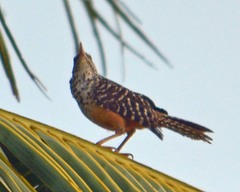
Band-backed Wren

Band-backed Wren

Campylorhynchus zonatus

Silhouette: Andy Wilson · PhyloPic

LCLeast ConcernNTVUENCR
Daily sighting probability <5% · Rare
at Celaque National Park

In 3 days ~10% in a week ~30%

10 Verified sightings at Celaque National Park From 2019 to 2026
1,187 In all 18 parks
June Best month
☀️ Diurnal When it's spotted

About the Band-backed Wren

The band-backed wren (Campylorhynchus zonatus) is a small songbird of the wren family. The band-backed wren is a resident breeding species from south-central Gulf Coast Mexico to northwestern Ecuador. It occurs in five disjunct areas, the central region being in southern Central America, in Costa Rica and northern Panama. The next two regions are northern Colombia adjacent to Panama, and 800 km to the south in northwestern Ecuador.

This large wren breeds in lowlands and foothills from sea level up to 1700 m altitude in thinned forest or open woodland, scrub, second growth and groves around houses. It mainly occurs on the Caribbean side of the Central American mountain ranges. Its large spherical nest has a wide side entrance and is constructed 2 – 30 m high in a tree or shrub, often hidden amidst bromeliads. The female alone incubates the three to five unmarked or lightly brown-spotted white eggs for about two weeks to hatching, and the young fledge in about the same length of time again. After breeding, families sleep together in dormitory nests like those used for breeding throughout the year.

The adult band-backed wren is 16.5 cm long and weighs 29 g. It has a... Wikipedia →

Sounds

Song0:15

Ecuador · 2010

© Manuel Sánchez-Nivicela · XC1162229 · CC BY-NC-ND 4.0

Call0:34

Guatemala · 2024

© Peter Boesman · XC880004 · CC BY-NC-ND 4.0

Recording0:10

Colombia · 2022

© Fabian Cote Navarro · XC742094 · CC BY-NC-SA 4.0

Global Distribution

Parks Where Found

# Park Country Daily sighting probability
1 La Tigra National Park 🇭🇳 Honduras
~10%
2 Cañón del Sumidero National Park 🇲🇽 Mexico
~10%
3 Cusuco National Park 🇭🇳 Honduras
~10%
4 Montes Azules Biosphere Reserve 🇲🇽 Mexico
~10%
5 Braulio Carrillo National Park 🇨🇷 Costa Rica
~10%
6 Celaque National Park 🇭🇳 Honduras
<5%
7 Arenal Volcano National Park 🇨🇷 Costa Rica
<5%
8 Gandoca-Manzanillo Wildlife Refuge 🇨🇷 Costa Rica
<5%
9 La Amistad International Park (Panama) 🇵🇦 Panama
<5%
10 Cahuita National Park 🇨🇷 Costa Rica
<5%
11 Tapantí-Macizo de la Muerte National Park 🇨🇷 Costa Rica
<5%
12 Tortuguero National Park 🇨🇷 Costa Rica
<5%
13 Bastimentos Island National Marine Park 🇵🇦 Panama
<5%
14 Cockscomb Basin Wildlife Sanctuary 🇧🇿 Belize
<5%
15 Tayrona National Natural Park 🇨🇴 Colombia
<5%
16 Tikal National Park 🇬🇹 Guatemala
<5%
17 Monteverde Cloud Forest Reserve 🇨🇷 Costa Rica
<5%
18 Tenorio Volcano National Park 🇨🇷 Costa Rica
<5%

Cities Where Found

# City Country Daily sighting probability
1 Guatemala City 🇬🇹 Guatemala
~50%
2 Tegucigalpa 🇭🇳 Honduras
<5%

Before you go

What are the chances of seeing a Band-backed Wren in Celaque National Park?

Rare

Under 5% of wildlife watchers report a Band-backed Wren sighting in Celaque National Park on a given day, based on 10 verified sightings from GBIF citizen-science data from 2019 to 2026. It is the 150th most-seen of the 193 birds we can rate there. Over three days the chance rises to about 10%, and over a week to about 30%, if each day is a fresh chance.

When is the best time to see a Band-backed Wren in Celaque National Park?

June

In that month about 30% of wildlife watchers report a Band-backed Wren in Celaque National Park on a given day, against under 5% in March, May and July–January, the lowest months. That is one of Celaque National Park's wettest months, with about 330 mm of rain against 60 mm in February.

What time of day is best to see a Band-backed Wren?

Between 7 and 10 am

Across all the parks we cover, that three-hour window holds the most Band-backed Wren sightings with a recorded time, and about 9 in 10 of them come between 6 am and 6 pm: it is a daytime animal.

Which relatives of the Band-backed Wren live in Celaque National Park?

Same family: Troglodytidae

The closest relatives of the Band-backed Wren that you can see in Celaque National Park (family Troglodytidae, Wrens) are Southern House Wren (about 40%) and Cabanis's Wren (about 20%), with each one's daily chance of a sighting.

Where does the Band-backed Wren sighting chance come from?

GBIF citizen-science records

It is estimated from how often the Band-backed Wren is recorded against all the birds logged in Celaque National Park (10 verified sightings from 2019 to 2026), calibrated against known sighting rates. Figures are rounded to the nearest 10% because citizen-science data supports honest approximations, not decimals, and months with records from fewer than five people show "—". How it works.

← Back to Celaque National Park