
Lark Sparrow

Lark Sparrow

Chondestes grammacus

Silhouette: L. Shyamal · PhyloPic

LCLeast ConcernNTVUENCR
Daily sighting probability <5% · Rare
at Celestún Biosphere Reserve

In 3 days <5% in a week ~10%

16 Verified sightings at Celestún Biosphere Reserve From 2019 to 2026
3,510 In all 23 parks
October Best month
☀️ Diurnal When it's spotted

About the Lark Sparrow

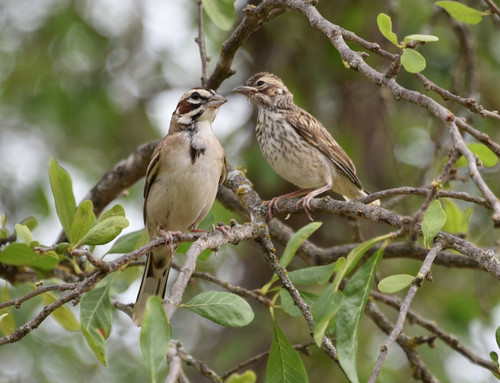
The lark sparrow (Chondestes grammacus) is a fairly large New World sparrow. It is the only member of the genus Chondestes. It breeds in southern Canada, much of the United States, and northern Mexico. It is much less common in the east, where its range is contracting. The populations in Mexico and adjacent states of the United States are resident, but other birds are migratory, wintering in the southern United States, Mexico and south to Guatemala.

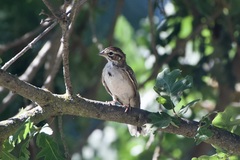
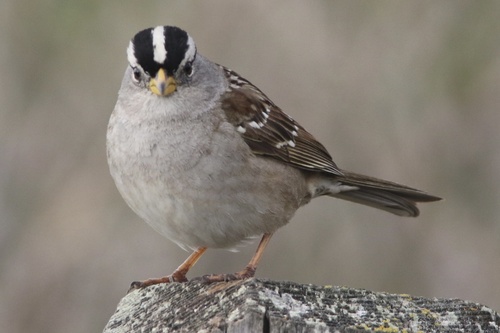
It is a very rare vagrant to western Europe, with two accepted records in Great Britain in 1981 and 1991. The lark sparrow is distinctive. Adults have a typically sparrow-like dark-streaked brown back, and white underparts except for a dark central spot. The cheeks and crown sides are chestnut, with white eyebrow and crown stripes. The dark tail's corners are also white. Young lark sparrows are duller, and the underparts are streaked.

Measurements: Length: 5.9–6.7 in (15–17 cm) Weight: 0.8–1.2 oz (24–33 g) Wingspan: 11.0 in (28 cm) They forage on the ground or in low bushes. They mainly eat seeds, but insects, including grasshoppers, are also eaten in the breeding... Wikipedia →

Sounds

Song0:05

United States · 2026

© Ed Pandolfino · XC1103030 · CC BY-NC-SA 4.0

Call1:29

Mexico · 2026

© Manuel Grosselet · XC1084537 · CC BY-NC-SA 4.0

Alarm call0:59

Mexico · 2020

© Isain Contreras Rodríguez · XC531200 · CC BY-NC-SA 4.0

Global Distribution

Parks Where Found

# Park Country Daily sighting probability
1 Badlands National Park 🇺🇸 United States
~50%
2 Cabo Pulmo National Park 🇲🇽 Mexico
~40%
3 Bahía de Loreto National Park 🇲🇽 Mexico
~30%
4 Big Bend National Park 🇺🇸 United States
~20%
5 Zion National Park 🇺🇸 United States
~10%
6 Saguaro National Park 🇺🇸 United States
~10%
7 Guadalupe Mountains National Park 🇺🇸 United States
~10%
8 Sequoia and Kings Canyon National Parks 🇺🇸 United States
~10%
9 El Vizcaíno Biosphere Reserve 🇲🇽 Mexico
~10%
10 Death Valley National Park 🇺🇸 United States
<5%
11 Grand Canyon National Park 🇺🇸 United States
<5%
12 Joshua Tree National Park 🇺🇸 United States
<5%
13 Yellowstone National Park 🇺🇸 United States
<5%
14 Rocky Mountain National Park 🇺🇸 United States
<5%
15 Padre Island National Seashore 🇺🇸 United States
<5%
16 Grand Teton National Park 🇺🇸 United States
<5%
17 Celestún Biosphere Reserve 🇲🇽 Mexico
<5%
18 Channel Islands National Park 🇺🇸 United States
<5%
19 Yosemite National Park 🇺🇸 United States
<5%
20 Cumbres de Monterrey National Park 🇲🇽 Mexico
<5%
21 Olympic National Park 🇺🇸 United States
<5%
22 Everglades National Park 🇺🇸 United States
<5%
23 Point Pelee National Park 🇨🇦 Canada
<5%

Cities Where Found

# City Country Daily sighting probability
1 Guadalajara 🇲🇽 México
~10%
2 Toluca 🇲🇽 México
~10%
3 León 🇲🇽 México
~10%
4 Mesa 🇺🇸 United States
~10%
5 Sacramento 🇺🇸 United States
~10%
6 Mexico City 🇲🇽 México
~10%
7 Phoenix 🇺🇸 United States
~10%
8 Puebla 🇲🇽 México
<5%
9 Los Angeles 🇺🇸 United States
<5%
10 Denver 🇺🇸 United States
<5%

Zoos & Centres Where Found

# Zoo / Centre Country
1 Zoológico Benito Juárez 🇲🇽 Mexico In captivity

Before you go

What are the chances of seeing a Lark Sparrow in Celestún Biosphere Reserve?

Rare

Under 5% of wildlife watchers report a Lark Sparrow sighting in Celestún Biosphere Reserve on a given day, based on 16 verified sightings from GBIF citizen-science data from 2019 to 2026. It is the 236th most-seen of the 297 birds we can rate there. Over three days the chance rises to under 5%, and over a week to about 10%, if each day is a fresh chance.

When is the best time to see a Lark Sparrow in Celestún Biosphere Reserve?

Any time of year

In every month with enough records, under 5% of wildlife watchers report a Lark Sparrow in Celestún Biosphere Reserve on a given day, so our monthly data shows no clear season.

What time of day is best to see a Lark Sparrow?

Between 7 and 10 am

Across all the parks we cover, that three-hour window holds the most Lark Sparrow sightings with a recorded time, and about 9 in 10 of them come between 6 am and 6 pm: it is a daytime animal.

Where does the Lark Sparrow sighting chance come from?

GBIF citizen-science records

It is estimated from how often the Lark Sparrow is recorded against all the birds logged in Celestún Biosphere Reserve (16 verified sightings from 2019 to 2026), calibrated against known sighting rates. Figures are rounded to the nearest 10% because citizen-science data supports honest approximations, not decimals, and months with records from fewer than five people show "—". How it works.

← Back to Celestún Biosphere Reserve