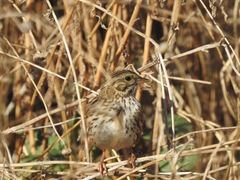
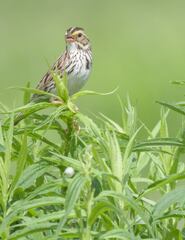
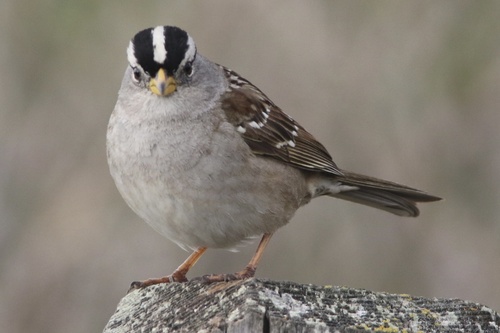
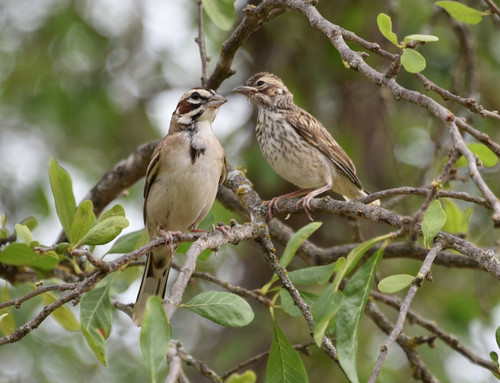
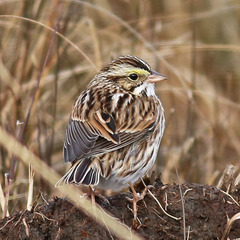
Savannah Sparrow

Savannah Sparrow

Passerculus sandwichensis

Silhouette: Caleb M. Gordon · PhyloPic

LCLeast ConcernNTVUENCR
Daily sighting probability <5% · Rare
at Celestún Biosphere Reserve

In 3 days ~10% in a week ~20%

68 Verified sightings at Celestún Biosphere Reserve From 2019 to 2026
13,026 In all 47 parks
March Best month
☀️ Diurnal When it's spotted

About the Savannah Sparrow

The Savannah sparrow (Passerculus sandwichensis) is a small New World sparrow that is the only member of the genus Passerculus. It is a widespread and abundant species that occupies open grassland habitats in North America.

Over most of its range it is migratory, breeding in Canada and the northern United States while wintering in Mexico and the southern United States. It is a sexually monomorphic species that is quite variable in appearance. Around 17 subspecies are currently recognised. These are divided into several groups, some of which have sometimes been considered as separate species.

The species name sandwichensis is Latin from Sandwich Sound (now Prince William Sound) in southern Alaska from where the first specimen was collected. The common name refers to Savannah, Georgia, where Alexander Wilson observed the species in 1811.

The Savannah sparrow was formally described in 1789 by the German naturalist Johann Friedrich Gmelin in his revised and expanded edition of Carl Linnaeus's Systema Naturae. He placed it with the buntings in the genus Emberiza and coined the binomial name Emberiza sandwichensis. Gmelin based his text on the Sandwich bunting that had been... Wikipedia →

Sounds

Song1:16

United States · 2026

© Greg Irving · XC1138976 · CC BY-NC-SA 4.0

Call0:42

Mexico · 2022

© Manuel Grosselet · XC754224 · CC BY-NC-SA 4.0

Alarm call0:28

United States · 2022

© Jorge de Leon Cardozo · XC727762 · CC BY-NC-SA 4.0

Global Distribution

Parks Where Found

# Park Country Daily sighting probability
1 Gros Morne National Park 🇨🇦 Canada
~50%
2 El Vizcaíno Biosphere Reserve 🇲🇽 Mexico
~40%
3 Denali National Park 🇺🇸 United States
~30%
4 Padre Island National Seashore 🇺🇸 United States
~30%
5 Kluane National Park 🇨🇦 Canada
~20%
6 Pacific Rim National Park Reserve 🇨🇦 Canada
~20%
7 Katmai National Park 🇺🇸 United States
~20%
8 Death Valley National Park 🇺🇸 United States
~20%
9 Yellowstone National Park 🇺🇸 United States
~20%
10 Cape Breton Highlands National Park 🇨🇦 Canada
~20%
11 Wrangell-St. Elias National Park 🇺🇸 United States
~20%
12 Everglades National Park 🇺🇸 United States
~10%
13 Elk Island National Park 🇨🇦 Canada
~10%
14 Great Bear Rainforest 🇨🇦 Canada
~10%
15 Merritt Island National Wildlife Refuge 🇺🇸 United States
~10%
16 Point Pelee National Park 🇨🇦 Canada
~10%
17 Big Cypress National Preserve 🇺🇸 United States
~10%
18 Channel Islands National Park 🇺🇸 United States
~10%
19 Wood Buffalo National Park 🇨🇦 Canada
~10%
20 Jasper National Park 🇨🇦 Canada
~10%
21 Grand Teton National Park 🇺🇸 United States
~10%
22 Olympic National Park 🇺🇸 United States
~10%
23 Banff National Park 🇨🇦 Canada
~10%
24 Redwood National Park 🇺🇸 United States
~10%
25 Cabo Pulmo National Park 🇲🇽 Mexico
~10%
26 Big Bend National Park 🇺🇸 United States
~10%
27 Joshua Tree National Park 🇺🇸 United States
~10%
28 Acadia National Park 🇺🇸 United States
~10%
29 Bahía de Loreto National Park 🇲🇽 Mexico
<5%
30 Isle Royale National Park 🇺🇸 United States
<5%
31 Glacier National Park 🇺🇸 United States
<5%
32 Congaree National Park 🇺🇸 United States
<5%
33 Riding Mountain National Park 🇨🇦 Canada
<5%
34 Celestún Biosphere Reserve 🇲🇽 Mexico
<5%
35 Kenai Fjords National Park 🇺🇸 United States
<5%
36 Rocky Mountain National Park 🇺🇸 United States
<5%
37 Badlands National Park 🇺🇸 United States
<5%
38 Guadalupe Mountains National Park 🇺🇸 United States
<5%
39 Great Smoky Mountains National Park 🇺🇸 United States
<5%
40 Zion National Park 🇺🇸 United States
<5%
41 Cumbres de Monterrey National Park 🇲🇽 Mexico
<5%
42 Ciénaga de Zapata 🇨🇺 Cuba
<5%
43 Yosemite National Park 🇺🇸 United States
<5%
44 Ría Lagartos Biosphere Reserve 🇲🇽 Mexico
<5%
45 Saguaro National Park 🇺🇸 United States
<5%
46 Arrecifes de Cozumel National Park 🇲🇽 Mexico
<5%
47 Shenandoah National Park 🇺🇸 United States
<5%

Cities Where Found

# City Country Daily sighting probability
1 San Diego 🇺🇸 United States
~20%
2 Calgary 🇨🇦 Canada
~10%
3 Los Angeles 🇺🇸 United States
~10%
4 Toluca 🇲🇽 México
~10%
5 Seattle 🇺🇸 United States
~10%
6 León 🇲🇽 México
~10%
7 Chicago 🇺🇸 United States
~10%
8 San Francisco 🇺🇸 United States
~10%
9 Boston 🇺🇸 United States
~10%
10 Vancouver 🇨🇦 Canada
~10%

Zoos & Centres Where Found

# Zoo / Centre Country
1 Ralph Perkins II Wildlife Center and Woods Garden 🇺🇸 United States In captivity

Before you go

What are the chances of seeing a Savannah Sparrow in Celestún Biosphere Reserve?

Rare

Under 5% of wildlife watchers report a Savannah Sparrow sighting in Celestún Biosphere Reserve on a given day, based on 68 verified sightings from GBIF citizen-science data from 2019 to 2026. It is the 158th most-seen of the 297 birds we can rate there. Over three days the chance rises to about 10%, and over a week to about 20%, if each day is a fresh chance.

When is the best time to see a Savannah Sparrow in Celestún Biosphere Reserve?

March–April and November–December

In those months about 10% of wildlife watchers report a Savannah Sparrow in Celestún Biosphere Reserve on a given day, against under 5% in January–February and May–October, the lowest months. Those are among Celestún Biosphere Reserve's driest months, with about 25 mm of rain a month against 160 mm in June.

What time of day is best to see a Savannah Sparrow?

Between 8 and 11 am

Across all the parks we cover, that three-hour window holds the most Savannah Sparrow sightings with a recorded time, and about 9 in 10 of them come between 6 am and 6 pm: it is a daytime animal.

Where does the Savannah Sparrow sighting chance come from?

GBIF citizen-science records

It is estimated from how often the Savannah Sparrow is recorded against all the birds logged in Celestún Biosphere Reserve (68 verified sightings from 2019 to 2026), calibrated against known sighting rates. Figures are rounded to the nearest 10% because citizen-science data supports honest approximations, not decimals, and months with records from fewer than five people show "—". How it works.

← Back to Celestún Biosphere Reserve