


Completed
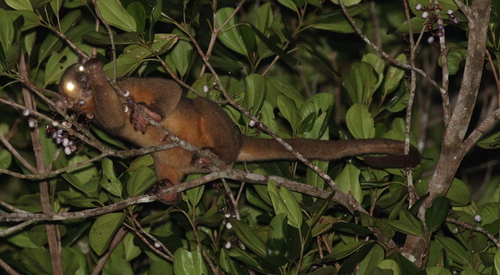


Kinkajou
Potos flavus
Silhouette: Margot Michaud · PhyloPic
- KingdomAnimalia (Animals)
- PhylumChordata (Chordates)
- ClassMammalia (Mammals)
- OrderCarnivora (Carnivorans)
- FamilyProcyonidae (Raccoons, Coatis, and Allies)
- GenusPotos (Kinkajous)
- SpeciesPotos flavus (Kinkajou)
In 3 days ~40% in a week ~70%
6 Verified sightings at Cerro Azul Meámbar National Park From 2019 to 2026
201 In all 15 parks
June Best month
🌅 Crepuscular When it's spotted
About the Kinkajou
The kinkajou (/ˈkɪŋkədʒuː/ KING-kə-joo; Potos flavus) is a mammal of the family Procyonidae, a relative to olingos, coatis, raccoons, and the ringtail and cacomistle. It is the only member of the genus Potos and is also known as the honey bear (a name shared with several unrelated species). Though kinkajous are arboreal, they are not closely related to any other tree-dwelling mammal group (primates, mustelids, etc.).
Native to tropical rainforests of Mexico, Central and South America, this mostly frugivorous mammal is seldom seen by people because of its strict nocturnal habits. However, it is hunted for the pet trade, its skin (to make wallets and horse saddles), and its meat. The species has been included in Appendix III of CITES by Honduras, which means that exports from Honduras require an export permit, and exports from other countries require a certificate of origin or of re-export. They may live up to 40 years in captivity.
The common name kinkajou derives from French quincajou, based on the Algonquian name for the wolverine. It is similar to the Ojibwe word gwiingwaʼaage, perhaps from a Proto-Algonquian *kwi·nkwaʔa·ke. Its other names in English... Wikipedia →
Sounds
Call0:45
Ecuador · 2025
© Marc Anderson · XC985502 · CC BY-NC-ND 4.0
Recording0:10
Brazil · 2020
© Marllus Rafael Almeida · iNaturalist · CC BY-NC 4.0
Recording0:05
Costa Rica · 2026
© Andres Vila · iNaturalist · CC BY-NC 4.0
Recent sightings of Kinkajou in Cerro Azul Meámbar National Park
LIVEiNaturalistGlobal Distribution
Parks Where Found
| # | Park | Country | Daily sighting probability |
|---|---|---|---|
| 1 | Cockscomb Basin Wildlife Sanctuary | 🇧🇿 Belize | |
| 2 | Cuyabeno Wildlife Reserve | 🇪🇨 Ecuador | |
| 3 | Soberanía National Park | 🇵🇦 Panama | |
| 4 | Monteverde Cloud Forest Reserve | 🇨🇷 Costa Rica | |
| 5 | Piedras Blancas National Park | 🇨🇷 Costa Rica | |
| 6 | Gandoca-Manzanillo Wildlife Refuge | 🇨🇷 Costa Rica | |
| 7 | Cerro Azul Meámbar National Park | 🇭🇳 Honduras | |
| 8 | Tayrona National Natural Park | 🇨🇴 Colombia | |
| 9 | Braulio Carrillo National Park | 🇨🇷 Costa Rica | |
| 10 | Manuel Antonio National Park | 🇨🇷 Costa Rica | |
| 11 | Yasuní National Park | 🇪🇨 Ecuador | |
| 12 | Tambopata National Reserve | 🇵🇪 Peru | |
| 13 | Cahuita National Park | 🇨🇷 Costa Rica | |
| 14 | La Amistad International Park (Panama) | 🇵🇦 Panama | |
| 15 | Arenal Volcano National Park | 🇨🇷 Costa Rica |
Zoos & Centres Where Found
Closest Relatives at Cerro Azul Meámbar National Park


Before you go
What are the chances of seeing a Kinkajou in Cerro Azul Meámbar National Park?
With luck
About 10% of wildlife watchers report a Kinkajou sighting in Cerro Azul Meámbar National Park on a given day, based on 6 verified sightings from GBIF citizen-science data from 2019 to 2026. It is the 6th most-seen of the 6 mammals we can rate there. Over three days the chance rises to about 40%, and over a week to about 70%, if each day is a fresh chance.
When is the best time to see a Kinkajou in Cerro Azul Meámbar National Park?
June
In that month about 30% of wildlife watchers report a Kinkajou in Cerro Azul Meámbar National Park on a given day, against under 5% in February–March, May and August–December, the lowest months. That is one of Cerro Azul Meámbar National Park's wettest months, with about 310 mm of rain against 80 mm in February.
What time of day is best to see a Kinkajou?
Between 7 and 10 pm
Across all the parks we cover, that three-hour window holds the most Kinkajou sightings with a recorded time, and about 7 in 10 of them come between 6 pm and 6 am: it is most active around dawn and dusk.
Is Cerro Azul Meámbar National Park the best place to see a Kinkajou?
7th of 15
Of the 15 parks where we can rate Kinkajou sightings, Cerro Azul Meámbar National Park ranks 7th at about 10%. The best odds are in Cockscomb Basin Wildlife Sanctuary (Belize, about 30%), Cuyabeno Wildlife Reserve (Ecuador, about 20%) and Soberanía National Park (Panama, about 20%).
Where does the Kinkajou sighting chance come from?
GBIF citizen-science records
It is estimated from how often the Kinkajou is recorded against all the mammals logged in Cerro Azul Meámbar National Park (6 verified sightings from 2019 to 2026), calibrated against known sighting rates. Figures are rounded to the nearest 10% because citizen-science data supports honest approximations, not decimals, and months with records from fewer than five people show "—". How it works.
