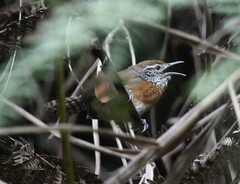

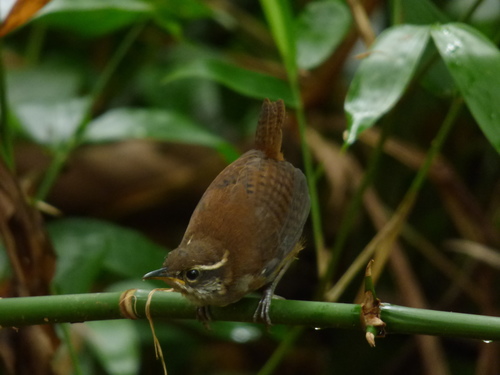
Rufous-breasted Wren

Rufous-breasted Wren

Pheugopedius rutilus

Silhouette: Matt Wilkins · PhyloPic

LCLeast ConcernNTVUENCR
Daily sighting probability ~10% · With luck
at Chagres National Park

In 3 days ~20% in a week ~50%

103 Verified sightings at Chagres National Park From 2019 to 2026
6,221 In all 14 parks
October Best month
☀️ Diurnal When it's spotted

About the Rufous-breasted Wren

The rufous-breasted wren (Pheugopedius rutilus) is a small songbird of the family Troglodytidae. It is found in Colombia, Costa Rica, Panama, Trinidad and Tobago, and Venezuela. The rufous-breasted wren was formerly placed in the genus Thryothorus which in the old, broad sense was a motley assemblage of similar-looking wrens. Since being moved into genus Pheugopedius it has at times been treated as conspecific with speckle-breasted wren (P. sclateri) and spot-breasted wren (P. maculipectus). They do form a superspecies.

The rufous-breasted wren has seven subspecies: Adult rufous-breasted wrens of the nominate subspecies are 14 cm (5.5 in) long and weigh 13.5 to 18.5 g (0.48 to 0.65 oz). Their crowns and upperparts are warm brown; their tail is gray-brown with heavy dark brown bars. They have a white supercilium with a black edge above it. Their face and throat are speckled black and white. The chest is bright chestnut... Wikipedia →

Sounds

Song0:29

Venezuela · 2026

Rosa Elena Albornoz @rosaelena_naturaleza · XC1107397 · CC0

Duet0:27

Panama · 2025

© Sue Riffe · XC1075926 · CC BY-NC-SA 4.0

Call0:33

Colombia · 2021

© Peter Boesman · XC693751 · CC BY-NC-ND 4.0

Global Distribution

Parks Where Found

# Park Country Daily sighting probability
1 Main Ridge Forest Reserve 🇹🇹 Trinidad and Tobago
~40%
2 Chirripó National Park 🇨🇷 Costa Rica
~30%
3 Parque Natural Metropolitano 🇵🇦 Panama
~30%
4 Henri Pittier National Park 🇻🇪 Venezuela
~20%
5 Carara National Park 🇨🇷 Costa Rica
~20%
6 Soberanía National Park 🇵🇦 Panama
~10%
7 Chagres National Park 🇵🇦 Panama
~10%
8 La Amistad International Park (Panama) 🇵🇦 Panama
~10%
9 Volcán Barú National Park 🇵🇦 Panama
~10%
10 Sierra de la Macarena National Park 🇨🇴 Colombia
<5%
11 Monteverde Cloud Forest Reserve 🇨🇷 Costa Rica
<5%
12 Tayrona National Natural Park 🇨🇴 Colombia
<5%
13 Marino Ballena National Park 🇨🇷 Costa Rica
<5%
14 Los Quetzales National Park 🇨🇷 Costa Rica
<5%

Cities Where Found

# City Country Daily sighting probability
1 Caracas 🇻🇪 Venezuela
~10%
2 San José 🇨🇷 Costa Rica
<5%
3 Panama City 🇵🇦 Panama
<5%
4 Valencia 🇻🇪 Venezuela
<5%

Before you go

What are the chances of seeing a Rufous-breasted Wren in Chagres National Park?

With luck

About 10% of wildlife watchers report a Rufous-breasted Wren sighting in Chagres National Park on a given day, based on 103 verified sightings from GBIF citizen-science data from 2019 to 2026. It is the 138th most-seen of the 372 birds we can rate there. Over three days the chance rises to about 20%, and over a week to about 50%, if each day is a fresh chance.

When is the best time to see a Rufous-breasted Wren in Chagres National Park?

October

In that month about 20% of wildlife watchers report a Rufous-breasted Wren in Chagres National Park on a given day, against under 5% in January and June, the lowest months. That is one of Chagres National Park's wettest months, with about 290 mm of rain against 30 mm in February.

What time of day is best to see a Rufous-breasted Wren?

Between 8 and 11 am

Across all the parks we cover, that three-hour window holds the most Rufous-breasted Wren sightings with a recorded time, and about 9 in 10 of them come between 6 am and 6 pm: it is a daytime animal.

Where does the Rufous-breasted Wren sighting chance come from?

GBIF citizen-science records

It is estimated from how often the Rufous-breasted Wren is recorded against all the birds logged in Chagres National Park (103 verified sightings from 2019 to 2026), calibrated against known sighting rates. Figures are rounded to the nearest 10% because citizen-science data supports honest approximations, not decimals, and months with records from fewer than five people show "—". How it works.

← Back to Chagres National Park