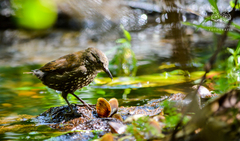
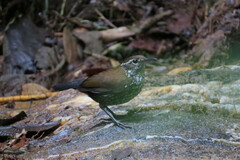
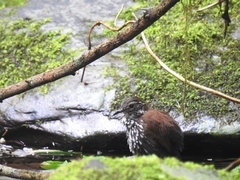
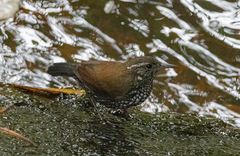

Sharp-tailed Streamcreeper

Sharp-tailed Streamcreeper

Lochmias nematura

Silhouette: Sheatherius · PhyloPic

LCLeast ConcernNTVUENCR
Daily sighting probability <5% · Rare
at Chapada dos Guimarães National Park

In 3 days <5% in a week ~10%

10 Verified sightings at Chapada dos Guimarães National Park From 2019 to 2026
748 In all 10 parks
December Best month
☀️ Diurnal When it's spotted

About the Sharp-tailed Streamcreeper

The sharp-tailed streamcreeper (Lochmias nematura) is a passerine bird of South America in the Furnariinae subfamily of the ovenbird family Furnariidae. Alternate names include streamside Lochmias, sharp-tailed creeper, and simply streamcreeper. It is found in Panama and every mainland South American country except Chile, French Guiana, and Suriname.

The sharp-tailed streamcreeper is 13 to 14 cm (5.1 to 5.5 in) long and weighs 20 to 38 g (0.71 to 1.3 oz). It is a rather dark furnariid with a long and slightly decurved bill. The sexes' plumages are alike. Adults of the nominate subspecies have a narrow ragged white supercilium... Wikipedia →

Sounds

Call0:05

Brazil · 2026

© JAYRSON ARAUJO DE OLIVEIRA · XC1150903 · CC BY-NC-SA 4.0

Song0:30

Brazil · 2025

© Joost van Bruggen · XC1050589 · CC BY-NC-ND 4.0

Alarm call0:29

Bolivia · 2023

© Niels Krabbe · XC778875 · CC BY-NC-SA 4.0

Global Distribution

Parks Where Found

# Park Country Daily sighting probability
1 Serra dos Órgãos National Park 🇧🇷 Brazil
~20%
2 Serra da Canastra National Park 🇧🇷 Brazil
~20%
3 Itatiaia National Park 🇧🇷 Brazil
~10%
4 Tijuca National Park 🇧🇷 Brazil
~10%
5 Darién National Park 🇵🇦 Panama
<5%
6 Farallones de Cali National Natural Park 🇨🇴 Colombia
<5%
7 Chapada dos Guimarães National Park 🇧🇷 Brazil
<5%
8 Podocarpus National Park 🇪🇨 Ecuador
<5%
9 Iguazú National Park 🇦🇷 Argentina
<5%
10 Iguaçu National Park 🇧🇷 Brazil
<5%

Cities Where Found

# City Country Daily sighting probability
1 Curitiba 🇧🇷 Brazil
<5%
2 São Paulo 🇧🇷 Brazil
<5%
3 Campinas 🇧🇷 Brazil
<5%
4 Rio de Janeiro 🇧🇷 Brazil
<5%
5 Belo Horizonte 🇧🇷 Brazil
<5%
6 Brasilia 🇧🇷 Brazil
<5%
7 Santos 🇧🇷 Brazil
<5%

Before you go

What are the chances of seeing a Sharp-tailed Streamcreeper in Chapada dos Guimarães National Park?

Rare

Under 5% of wildlife watchers report a Sharp-tailed Streamcreeper sighting in Chapada dos Guimarães National Park on a given day, based on 10 verified sightings from GBIF citizen-science data from 2019 to 2026. It is the 240th most-seen of the 273 birds we can rate there. Over three days the chance rises to under 5%, and over a week to about 10%, if each day is a fresh chance.

When is the best time to see a Sharp-tailed Streamcreeper in Chapada dos Guimarães National Park?

December

In that month about 10% of wildlife watchers report a Sharp-tailed Streamcreeper in Chapada dos Guimarães National Park on a given day, against under 5% in January and May–November, the lowest months. That is one of Chapada dos Guimarães National Park's wettest months, with about 210 mm of rain against almost none in July. February to April have too few records to rate.

What time of day is best to see a Sharp-tailed Streamcreeper?

Between 9 am and noon

Across all the parks we cover, that three-hour window holds the most Sharp-tailed Streamcreeper sightings with a recorded time, and about 9 in 10 of them come between 6 am and 6 pm: it is a daytime animal.

Which relatives of the Sharp-tailed Streamcreeper live in Chapada dos Guimarães National Park?

Same family: Furnariidae

The closest relatives of the Sharp-tailed Streamcreeper that you can see in Chapada dos Guimarães National Park (family Furnariidae, Ovenbirds and Woodcreepers) are Rufous Hornero (about 70%), Narrow-billed Woodcreeper (about 20%) and Sooty-fronted Spinetail (about 10%), with each one's daily chance of a sighting.

Where does the Sharp-tailed Streamcreeper sighting chance come from?

GBIF citizen-science records

It is estimated from how often the Sharp-tailed Streamcreeper is recorded against all the birds logged in Chapada dos Guimarães National Park (10 verified sightings from 2019 to 2026), calibrated against known sighting rates. Figures are rounded to the nearest 10% because citizen-science data supports honest approximations, not decimals, and months with records from fewer than five people show "—". How it works.

← Back to Chapada dos Guimarães National Park