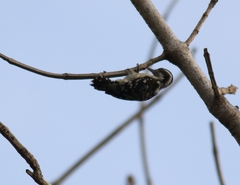
Brown-capped Woodpecker

Brown-capped Woodpecker

Yungipicus nanus

Silhouette: Pepe Reigada · PhyloPic

Daily sighting probability <5% · Rare
at Chitwan National Park

In 3 days ~10%

28 Verified sightings at Chitwan National Park From 2019 to 2026
3,034 In all 18 parks
March Best month
🌅 Crepuscular When it's spotted

About the Brown-capped Woodpecker

The brown-capped pygmy woodpecker or Indian pygmy woodpecker (Yungipicus nanus) is a species of very small woodpecker found in Nepal, India and Sri Lanka. Some taxonomic authorities continue to place this species in the genus Dendrocopos or Picoides. This species is non-migratory and often spotted in pairs or small family groups. They are known for being very active and are not often spotted, despite their constant foraging in the tree canopy.

The brown-capped pygmy woodpecker has brownish cap from the forehead to hindneck. A small brown and white woodpecker with distinctive pink-rimmed white irises. Barred brown and white above, lightly streaked dirty white below. Tail spotted white. Paler brown crown (edged red in male) and eyestripes contrasting with white supercilia and cheeks.

This is a non-migratory bird found across most of India (except the northeast/Thar desert), Nepal, and Sri Lanka. It inhabits diverse, habitats up to 2300m, including deciduous/secondary forests, orchards, and also urban gardens. They are resident, though birds at higher altitudes may move to lower elevations during the winter months. Wikipedia →

Sounds

Call0:19

India · 1986

© Jelle Scharringa · XC620471 · CC BY-NC-SA 4.0

Song0:05

India · 2013

© Frank Lambert · XC148770 · CC BY-NC-ND 4.0

Call0:26

India · 2020

© Mandar Bhagat · XC551837 · CC BY-NC-SA 4.0

Global Distribution

Parks Where Found

# Park Country Daily sighting probability
1 Mudumalai National Park 🇮🇳 India
~30%
2 Royal Bardia National Park 🇳🇵 Nepal
~20%
3 Bandhavgarh National Park 🇮🇳 India
~20%
4 Satpura National Park 🇮🇳 India
~20%
5 Kanha National Park 🇮🇳 India
~20%
6 Nagarhole National Park 🇮🇳 India
~20%
7 Minneriya National Park 🇱🇰 Sri Lanka
~10%
8 Sinharaja Forest Reserve 🇱🇰 Sri Lanka
~10%
9 Periyar National Park 🇮🇳 India
~10%
10 Yala National Park 🇱🇰 Sri Lanka
~10%
11 Ranthambore National Park 🇮🇳 India
~10%
12 Bandipur National Park 🇮🇳 India
~10%
13 Gir National Park 🇮🇳 India
~10%
14 Wilpattu National Park 🇱🇰 Sri Lanka
~10%
15 Udawalawe National Park 🇱🇰 Sri Lanka
<5%
16 Chitwan National Park 🇳🇵 Nepal
<5%
17 Keoladeo National Park 🇮🇳 India
<5%
18 Jim Corbett National Park 🇮🇳 India
<5%

Cities Where Found

# City Country Daily sighting probability
1 Thrissur 🇮🇳 India
~10%
2 Lucknow 🇮🇳 India
~10%
3 Kozhikode 🇮🇳 India
<5%
4 Kochi 🇮🇳 India
<5%
5 Chandigarh 🇮🇳 India
<5%
6 Prayagraj 🇮🇳 India
<5%
7 Jabalpur 🇮🇳 India
<5%
8 Bhopal 🇮🇳 India
<5%
9 Mumbai 🇮🇳 India
<5%
10 Pune 🇮🇳 India
<5%

Before you go

What are the chances of seeing a Brown-capped Woodpecker in Chitwan National Park?

Rare

Under 5% of wildlife watchers report a Brown-capped Woodpecker sighting in Chitwan National Park on a given day, based on 28 verified sightings from GBIF citizen-science data from 2019 to 2026. It is the 241st most-seen of the 367 birds we can rate there. Over three days the chance rises to about 10%, if each day is a fresh chance.

When is the best time to see a Brown-capped Woodpecker in Chitwan National Park?

March

In that month about 10% of wildlife watchers report a Brown-capped Woodpecker in Chitwan National Park on a given day, against under 5% in April to February, the lowest months. That is one of Chitwan National Park's driest months, with about 40 mm of rain against 660 mm in July.

What time of day is best to see a Brown-capped Woodpecker?

Between 3 and 6 am

Across all the parks we cover, that three-hour window holds the most Brown-capped Woodpecker sightings with a recorded time, and about 6 in 10 of them come between 6 am and 6 pm: it is most active around dawn and dusk.

Where does the Brown-capped Woodpecker sighting chance come from?

GBIF citizen-science records

It is estimated from how often the Brown-capped Woodpecker is recorded against all the birds logged in Chitwan National Park (28 verified sightings from 2019 to 2026), calibrated against known sighting rates. Figures are rounded to the nearest 10% because citizen-science data supports honest approximations, not decimals, and months with records from fewer than five people show "—". How it works.

← Back to Chitwan National Park