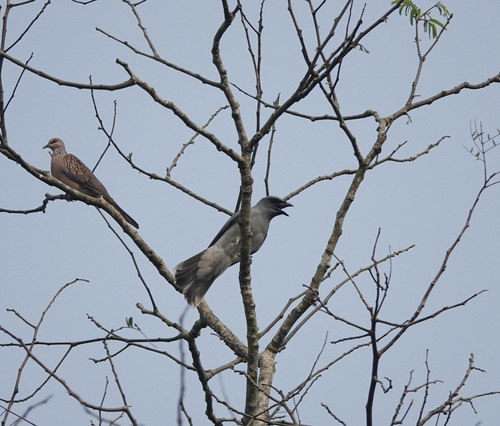
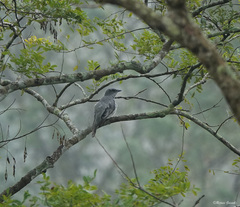
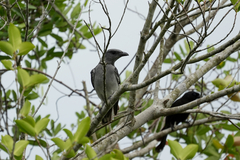
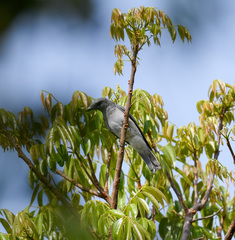
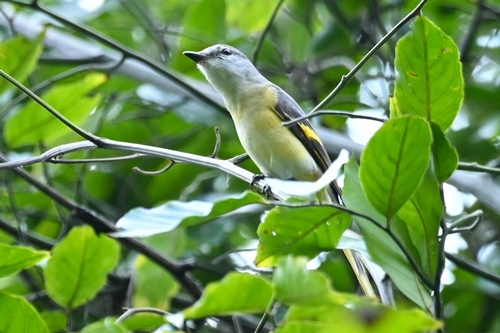

Javan Cuckoo-shrike

Javan Cuckoo-shrike

Coracina javensis

Silhouette: PhyloPic

LCLeast ConcernNTVUENCR
Daily sighting probability ~20% · Possible
at Chitwan National Park

In 3 days ~50% in a week ~80%

337 Verified sightings at Chitwan National Park From 2019 to 2026
1,772 In all 12 parks
January Best month
🌅 Crepuscular When it's spotted

About the Javan Cuckoo-shrike

The Oriental cuckooshrike (Coracina javensis) is a species of bird in the family Campephagidae. It is widely distributed from the Himalayas through Southeast Asia to east China and Taiwan. It is also found on the islands of Java and Bali in Indonesia. Its natural habitat is subtropical or tropical moist lowland forest. The range of this species was formerly restricted to Java and Bali and had the English name "Javan cuckooshrike".

Six subspecies are recognised. Wikipedia →

Sounds

Call0:27

Indonesia · 2019

© Okamoto Keita Sin · XC578386 · CC BY-NC-SA 4.0

Flight call0:12

Indonesia · 2019

© Frank Lambert · XC468851 · CC BY-NC-ND 4.0

Song?0:11

Indonesia · 2009

© Swiss Winnasis · XC38628 · CC BY-NC-ND 2.5

Global Distribution

Parks Where Found

# Park Country Daily sighting probability
1 Bali Barat National Park 🇮🇩 Indonesia
~30%
2 Chitwan National Park 🇳🇵 Nepal
~20%
3 Royal Bardia National Park 🇳🇵 Nepal
~20%
4 Sundarbans National Park 🇮🇳 India
~20%
5 Manas National Park 🇮🇳 India
~20%
6 Kaziranga National Park 🇮🇳 India
~10%
7 Jim Corbett National Park 🇮🇳 India
~10%
8 Namdapha National Park 🇮🇳 India
~10%
9 Cat Tien National Park 🇻🇳 Vietnam
~10%
10 Doi Inthanon National Park 🇹🇭 Thailand
<5%
11 Cuc Phuong National Park 🇻🇳 Vietnam
<5%
12 Royal Manas National Park 🇧🇹 Bhutan
<5%

Cities Where Found

# City Country Daily sighting probability
1 Savar 🇧🇩 Bangladesh
~20%
2 Guwahati 🇮🇳 India
~10%
3 Kathmandu 🇳🇵 Nepal
~10%
4 Dhaka 🇧🇩 Bangladesh
<5%
5 Dehradun 🇮🇳 India
<5%

Before you go

What are the chances of seeing a Javan Cuckoo-shrike in Chitwan National Park?

Possible

About 20% of wildlife watchers report a Javan Cuckoo-shrike sighting in Chitwan National Park on a given day, based on 337 verified sightings from GBIF citizen-science data from 2019 to 2026. It is the 81st most-seen of the 367 birds we can rate there. Over three days the chance rises to about 50%, and over a week to about 80%, if each day is a fresh chance.

When is the best time to see a Javan Cuckoo-shrike in Chitwan National Park?

January to March

In those months about 30% of wildlife watchers report a Javan Cuckoo-shrike in Chitwan National Park on a given day, against about 20% in April to December, the lowest months. Those are among Chitwan National Park's driest months, with about 30 mm of rain a month against 660 mm in July.

What time of day is best to see a Javan Cuckoo-shrike?

Between 2 and 5 am

Across all the parks we cover, that three-hour window holds the most Javan Cuckoo-shrike sightings with a recorded time, and about half of them come between 6 am and 6 pm: it is most active around dawn and dusk.

Is Chitwan National Park the best place to see a Javan Cuckoo-shrike?

2nd of 12

Of the 12 parks where we can rate Javan Cuckoo-shrike sightings, Chitwan National Park ranks 2nd at about 20%. The best odds are in Bali Barat National Park (Indonesia, about 30%).

Where does the Javan Cuckoo-shrike sighting chance come from?

GBIF citizen-science records

It is estimated from how often the Javan Cuckoo-shrike is recorded against all the birds logged in Chitwan National Park (337 verified sightings from 2019 to 2026), calibrated against known sighting rates. Figures are rounded to the nearest 10% because citizen-science data supports honest approximations, not decimals, and months with records from fewer than five people show "—". How it works.

← Back to Chitwan National Park