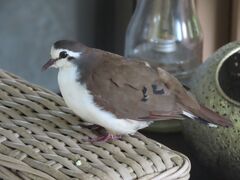
Tambourine Dove

Tambourine Dove

Turtur tympanistria

Silhouette: Sheatherius · PhyloPic

LCLeast ConcernNTVUENCR
Daily sighting probability <5% · Rare
at Abuja

In 3 days ~10% in a week ~30%

8 Verified sightings at Abuja
3,691 In all 30 parks From 2019 to 2026
July Best month
☀️ Diurnal When it's spotted

About the Tambourine Dove

The tambourine dove (Turtur tympanistria) is a pigeon which is a widespread resident breeding bird in woodlands and other thick vegetation in Africa south of the Sahara Desert. Its range extends from Senegal east to Ethiopia and Kenya and southwards through eastern Africa to south-eastern South Africa, but it is absent from the drier areas of south-western Africa. There is a population on the Comoros Islands.

This is very much a species of thick woodlands, including dense gardens and plantations of castor oil, cocoa and rubber. As such, this shy species is usually seen when flushed whilst feeding on the forest floor. The tambourine dove builds a frail stick nest low in a thicket or vine tangle, and lays two cream-coloured eggs. Both sexes incubate, although this task is performed mainly by the female, and the eggs hatch in 13 days with another 13–14 days to fledging. The chicks are fed regurgitated food.

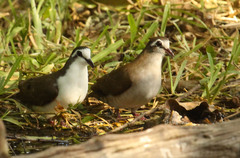
The tambourine dove is a small plump pigeon, typically 22 cm in length. The male has a white face with a black spot behind the eye, white underparts and a grey crown. Its back, hind neck, wings and tail are pale grey brown, and the folded wings have large dark purple patches. The under tail is brown. The eye ring and feet are purple-red, and the bill is purple.

The female is duller, and is white only on the belly, the face and breast being a pale grey-brown. The crown is grey-brown, without the blue-grey of the male. The juvenile resembles the female but has chestnut fringes to the feathers of the back, breast and flanks. Even in these plumages, this species is paler below than other small African doves.

The tambourine dove's flight is fast and agile, and it tends to stay quite low when flushed. In flight it shows chestnut primary flight feathers and under wings. The call of this bird is a persistently repeated du-du-du-du-du.

Tambourine dove is usually solitary, but is sometimes seen in family groups or with lemon doves. It is quite terrestrial, and usually forages on the ground for seeds and small fruits. It has a preference for seeds of the castor oil plant. It will on occasion eat small insects and molluscs. Wikipedia →

Sounds

Song1:02

Ghana · 2022

© Peter Boesman · XC719557 · CC BY-NC-ND 4.0

Call0:20

South Africa · 2021

© Lynette Rudman · XC682448 · CC BY-NC-SA 4.0

Song0:46

South Africa · 2019

© Frank Lambert · XC518893 · CC BY-NC-ND 4.0

Global Distribution

Parks Where Found

# Park Country Daily sighting probability
1 Semuliki National Park 🇺🇬 Uganda
~50%
2 Kibale National Park 🇺🇬 Uganda
~50%
3 Bwindi Impenetrable National Park 🇺🇬 Uganda
~30%
4 Arusha National Park 🇹🇿 Tanzania
~30%
5 Nyungwe National Park 🇷🇼 Rwanda
~20%
6 iSimangaliso Wetland Park 🇿🇦 South Africa
~20%
7 Virunga National Park 🇨🇩 Democratic Republic of the Congo
~20%
8 Queen Elizabeth National Park 🇺🇬 Uganda
~10%
9 uMkhuze Game Reserve 🇿🇦 South Africa
~10%
10 Aberdare National Park 🇰🇪 Kenya
~10%
11 Hluhluwe-Imfolozi Park 🇿🇦 South Africa
~10%
12 Akagera National Park 🇷🇼 Rwanda
~10%
13 Volcanoes National Park 🇷🇼 Rwanda
~10%
14 Nairobi National Park 🇰🇪 Kenya
~10%
15 Murchison Falls National Park 🇺🇬 Uganda
~10%
16 Lake Manyara National Park 🇹🇿 Tanzania
~10%
17 Liwonde National Park 🇲🇼 Malawi
~10%
18 Mkomazi National Park 🇹🇿 Tanzania
~10%
19 Lake Mburo National Park 🇺🇬 Uganda
~10%
20 Garden Route National Park 🇿🇦 South Africa
~10%
21 Ngorongoro Conservation Area 🇹🇿 Tanzania
~10%
22 Addo Elephant National Park 🇿🇦 South Africa
<5%
23 Gorongosa National Park 🇲🇿 Mozambique
<5%
24 Ruaha National Park 🇹🇿 Tanzania
<5%
25 Kruger National Park 🇿🇦 South Africa
<5%
26 Table Mountain National Park 🇿🇦 South Africa
<5%
27 Masai Mara National Reserve 🇰🇪 Kenya
<5%
28 Tsavo East National Park 🇰🇪 Kenya
<5%
29 Tarangire National Park 🇹🇿 Tanzania
<5%
30 Serengeti National Park 🇹🇿 Tanzania
<5%

Cities Where Found

# City Country Daily sighting probability
1 Kampala 🇺🇬 Uganda
~20%
2 Lilongwe 🇲🇼 Malawi
~10%
3 Mombasa 🇰🇪 Kenya
~10%
4 Durban 🇿🇦 South Africa
~10%
5 Nairobi 🇰🇪 Kenya
~10%
6 Freetown 🇸🇱 Sierra Leone
~10%
7 Abuja 🇳🇬 Nigeria
<5%
8 Kigali 🇷🇼 Rwanda
<5%
9 Cape Town 🇿🇦 South Africa
<5%

Zoos & Centres Where Found

# Zoo / Centre Country
1 San Diego Zoo 🇺🇸 United States In captivity
2 San Diego Zoo Safari Park 🇺🇸 United States In captivity
3 Bronx Zoo 🇺🇸 United States In captivity
4 Sedgwick County Zoo 🇺🇸 United States In captivity
5 Fort Worth Zoo 🇺🇸 United States In captivity
6 Houston Zoo 🇺🇸 United States In captivity
7 San Antonio Zoo 🇺🇸 United States In captivity
8 Bird Paradise 🇸🇬 Singapore In captivity
9 Rainforest Wild Asia 🇸🇬 Singapore In captivity
10 Santillana Zoo 🇪🇸 Spain In captivity
11 Newquay Zoo 🇬🇧 United Kingdom In captivity

Before you go

What are the chances of seeing a Tambourine Dove in Abuja?

Rare

Under 5% of wildlife watchers report a Tambourine Dove sighting in Abuja on a given day, based on 8 verified sightings from GBIF citizen-science data. It is the 108th most-seen of the 131 birds we can rate there. Over three days the chance rises to about 10%, and over a week to about 30%, if each day is a fresh chance.

When is the best time to see a Tambourine Dove in Abuja?

March, July and October–November

In those months about 10% of wildlife watchers report a Tambourine Dove in Abuja on a given day, against under 5% in April–June, August–September and December–February, the lowest months.

What time of day is best to see a Tambourine Dove?

Between 7 and 10 am

Across all the parks we cover, that three-hour window holds the most Tambourine Dove sightings with a recorded time, and nearly all of them come between 6 am and 6 pm: it is a daytime animal.

Is Abuja the best place to see a Tambourine Dove?

7th of 9

Of the 9 cities where we can rate Tambourine Dove sightings, Abuja ranks 7th at under 5%. The best odds are in Kampala (Uganda, about 20%), Lilongwe (Malawi, about 10%) and Mombasa (Kenya, about 10%).

Where does the Tambourine Dove sighting chance come from?

GBIF citizen-science records

It is estimated from how often the Tambourine Dove is recorded against all the birds logged in Abuja (8 verified sightings), calibrated against known sighting rates. Figures are rounded to the nearest 10% because citizen-science data supports honest approximations, not decimals, and months with records from fewer than five people show "—". How it works.

← Back to Abuja