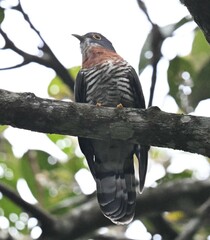
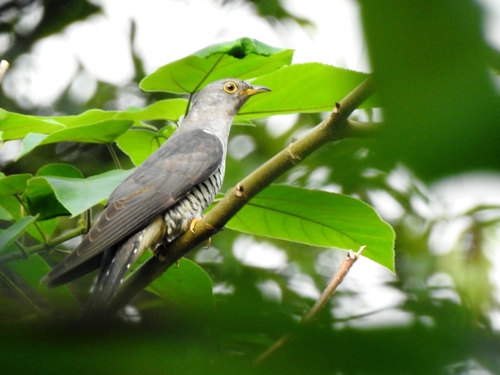
Large Hawk Cuckoo

Large Hawk Cuckoo

Cuculus sparverioides

Silhouette: Nicolas Huet le Jeune and Jean-Gabriel Prêtre (vectorized by T. Michael Keesey) · PhyloPic

Daily sighting probability <5% · Rare
at Bangkok

In 3 days <5%

43 Verified sightings at Bangkok
1,328 In all 17 parks From 2019 to 2026
February Best month
☀️ Diurnal When it's spotted

About the Large Hawk Cuckoo

The large hawk-cuckoo (Hierococcyx sparverioides) is a species of cuckoo in the family Cuculidae. It has a wide breeding distribution from temperate Asia along the Himalayas extending to East Asia. Many populations winter further south. They are known for their loud and repetitive calls which are similar to that of the common hawk-cuckoo but do not rise in crescendo. They are also somewhat larger and adults can be readily told apart from the smaller common hawk-cuckoo by the black patch on the chin. They are brood-parasites of babblers and laughing-thrushes.

It is found in Bangladesh, Bhutan, Cambodia, China, India, Indonesia, Laos, Malaysia, Myanmar, Nepal, Pakistan, the Philippines, Singapore, Taiwan, Thailand, and Vietnam. Found as a vagrant on Christmas Island. The subspecies H. s. bocki of the Malay Peninsula, Sumatra and Borneo is usually considered a separate species, the dark hawk-cuckoo.

Its natural habitats are temperate forest and subtropical or tropical mangrove forest. They call in summer and calling goes on well after dusk. In their winter grounds, they tend to be silent. Like many other cuckoos, this species is a brood... Wikipedia →

Sounds

Recording0:10

China · 2022

© Sun Jiao · iNaturalist · CC BY 4.0

Recording0:20

China · 2024

© 红梅 · iNaturalist · CC BY-NC 4.0

Recording0:25

Macao SAR China · 2026

© Miles 小智 · iNaturalist · CC BY-NC 4.0

Global Distribution

Parks Where Found

# Park Country Daily sighting probability
1 Royal Manas National Park 🇧🇹 Bhutan
~20%
2 Langtang National Park 🇳🇵 Nepal
~20%
3 Kinabalu Park 🇲🇾 Malaysia
~10%
4 Doi Inthanon National Park 🇹🇭 Thailand
~10%
5 Jiuzhaigou National Park 🇨🇳 China
~10%
6 Taroko National Park 🇹🇼 Taiwan
~10%
7 Namdapha National Park 🇮🇳 India
~10%
8 Khao Yai National Park 🇹🇭 Thailand
<5%
9 Kerinci Seblat National Park 🇮🇩 Indonesia
<5%
10 Cuc Phuong National Park 🇻🇳 Vietnam
<5%
11 Kaeng Krachan National Park 🇹🇭 Thailand
<5%
12 Khao Luang National Park 🇹🇭 Thailand
<5%
13 Chitwan National Park 🇳🇵 Nepal
<5%
14 Periyar National Park 🇮🇳 India
<5%
15 Kaziranga National Park 🇮🇳 India
<5%
16 Cat Tien National Park 🇻🇳 Vietnam
<5%
17 Manas National Park 🇮🇳 India
<5%

Cities Where Found

# City Country Daily sighting probability
1 Hefei 🇨🇳 China
~10%
2 Nanjing 🇨🇳 China
~10%
3 Tuen Mun 🇨🇳 China
~10%
4 Wuhan 🇨🇳 China
~10%
5 Guangzhou 🇨🇳 China
~10%
6 Hangzhou 🇨🇳 China
<5%
7 Hong Kong 🇨🇳 China
<5%
8 Suzhou 🇨🇳 China
<5%
9 Singapore 🇸🇬 Singapore
<5%
10 Beijing 🇨🇳 China
<5%

Before you go

What are the chances of seeing a Large Hawk Cuckoo in Bangkok?

Rare

Under 5% of wildlife watchers report a Large Hawk Cuckoo sighting in Bangkok on a given day, based on 43 verified sightings from GBIF citizen-science data. It is the 198th most-seen of the 277 birds we can rate there. Over three days the chance rises to under 5%, if each day is a fresh chance.

When is the best time to see a Large Hawk Cuckoo in Bangkok?

Any time of year

In every month with enough records, under 5% of wildlife watchers report a Large Hawk Cuckoo in Bangkok on a given day, so our monthly data shows no clear season.

What time of day is best to see a Large Hawk Cuckoo?

Between 7 and 10 am

Across all the parks we cover, that three-hour window holds the most Large Hawk Cuckoo sightings with a recorded time, and about 8 in 10 of them come between 6 am and 6 pm: it is a daytime animal.

Is Bangkok the best place to see a Large Hawk Cuckoo?

12th of 14

Of the 14 cities where we can rate Large Hawk Cuckoo sightings, Bangkok ranks 12th at under 5%. The best odds are in Hefei (China, about 10%), Nanjing (China, about 10%) and Tuen Mun (China, about 10%).

Where does the Large Hawk Cuckoo sighting chance come from?

GBIF citizen-science records

It is estimated from how often the Large Hawk Cuckoo is recorded against all the birds logged in Bangkok (43 verified sightings), calibrated against known sighting rates. Figures are rounded to the nearest 10% because citizen-science data supports honest approximations, not decimals, and months with records from fewer than five people show "—". How it works.

← Back to Bangkok